‘We need to get back to class’: some teachers lose patience as France enters its eighth week of student protests
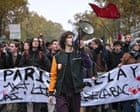
Educators voice concerns as thousands of children facing exams miss up to 150 hours of class For several weeks, Alex, 16, has woken at 4am and walked 90 minutes in the dark from his northern Paris suburb so he can help gather wheelie bins to blockade his high school in Vincennes. His parents, who work in the arts and vote left, support the French school student protesters who since September have blocked schools demanding repairs to dilapidated school buildings, more replacement teachers, a solution to overcrowded classes and more equality in the university application system.
Educators voice concerns as thousands of children facing exams miss up to 150 hours of class
For several weeks, Alex, 16, has woken at 4am and walked 90 minutes in the dark from his northern Paris suburb so he can help gather wheelie bins to blockade his high school in Vincennes.
In a tote bag, he brings some masks and some swimming goggles in case of police teargas. His parents, who work in the arts and vote left, support the French school student protesters who since September have blocked schools demanding repairs to dilapidated school buildings, more replacement teachers, a solution to overcrowded classes and more equality in the university application system.
“But this week, my mum woke up early and said to me: ‘Do you really think you need to blockade again today?’’ said Alex. “She supports me but is starting to think I’m doing too much. But how else can we make ourselves heard? We can’t stop now. It’s the only way the government will listen.”
His 17-year-old friend, also on the school barricade with dozens of pupils this week, said: “Any progress that has been won in France has been achieved through people demonstrating on the street.”
France is entering the eighth week of an unprecedented schools crisis. The biggest youth protest movement in decades has over the past two months seen hundreds of high schools barricaded with wheelie bins or shut amid security fears.
The government is now facing criticism of its handling of the crisis. It first responded with a security crackdown, mobilising riot police outside schools across France amid clashes that led to injuries from police weaponry, including children who lost a hand or an eye.
Then over the past two weeks, the government attempted to argue that its offer to decrease some class sizes and review the university application platform meant the movement was coming to an end.
But in recent days, the government has been accused by teachers’ unions of letting the protests fester into an increasingly dangerous mood of violence. Fireworks have been fired outside schools and inside classrooms in different parts of France.
A local councillor outside Paris was hit in the chest by a bottle of gasoline as she was trying to mediate outside a school. One education trade unionist said a school principal had bought a bulletproof vest for protection.
The government and teachers’ unions have said that individuals committing violence outside or inside schools were not the same people as students who were peacefully protesting for education rights.
But high school principals held their own demonstrations on Friday, saying they were struggling to cope with the confusion and chaos. At least 50 principals have made requests to quit their posts. More than 360 schoolchildren and 245 staff have been injured since the protests started.
So many weeks of classes have now been missed that one teacher, who demonstrated outside a central Paris police station this week after one of her pupils was arrested, said: “There is absolute uncertainty over how we can return to proper teaching. This is becoming an intractable situation with no end in sight.”
Thousands of French children in key baccalauréat (the French A-levels) exam years – even children who are not protesting directly – have now missed up to 150 hours of teaching at schools that have been barricaded daily or closed regularly for security reasons since the end of September. This is particularly acute in the Paris area, and in other cities such as Toulouse.
Online lessons have rarely fully replaced missed classes. Many teenagers are at home in their fourth or fifth week of no school. Some parents are beginning to wake early to stand outside schools themselves to try to individually stop wheelie bin barricades – sometimes leading to more clashes.
Police are increasingly stationed outside schools, sometimes hitting students’ hands with truncheons to make them loosen their grip on bins, as happened in central Paris this week.
“The French administration is trying to impose a kind of smokescreen of wishful thinking, that everything is alright, stiff-upper-lip, no problem, but everyone needs to face up to what is happening,” said Julien Roy, 52, who teaches history and geography at Lycée Balzac in the central city of Tours and represents the SNALC education union in Indre-et-Loire. “There is a crisis of trust. We need a de-escalation of violence and a path back to education.”
Roy’s school has been at the centre of the protests since the end of September when, on the pavement outside, a 16-year-old school student from a different school, lost the use of his eye after he was allegedly struck by a police rubber bullet.
“There is still constant tension,” said Roy. He added that in recent weeks firework mortars had been set off, sometimes aimed at staff, and fires had been started in bins and materials for molotov cocktails were found in a building opposite the school.
Police were regularly present. Staff felt individuals not connected to the school were involved in the violence. He said stress was taking a toll on staff: 10 colleagues were on sick leave, including his principal and deputy principal.
“We need to get back to class to teach our pupils again, some of whom are booing us,” Roy said. “We’ll have to sit down and talk about this, honestly and calmly, to get it out of everyone’s system so we can restore trust.”
He said: “There are children who are suffering, and many of them we’re not seeing because they are stuck at home. Some pupils approach school, see the police, panic and go away, because they can’t bear this atmosphere with police outside school. There are fragile teenagers with difficulties at school who can’t come in, and those children are shattered by this.”
He said: “What is lethal is that we’re leading children to conclude that it’s only through violence that they can be heard, that violence is legitimate and nothing can be gained through negotiation … this is going to leave an impact on society, creating future adults who are going to feel bitter and broken.”
At a high school in the Créteil area, an English teacher said: “I feel proud of my students’ peaceful protests. The children demonstrating are asking for the same thing teachers have wanted for years: more resources, more dignity in teaching environments. Teachers’ strikes haven’t been listened to, whereas students see they are having an impact.
“But with a presidential election next spring, and the start of electoral season, it’s difficult to imagine that this is going to stop. I do worry about students’ exams. One former colleague said to me that this school year could be a write-off.”
- class
- student
- school
- teacher
- patience
- france
- protest
- educator


