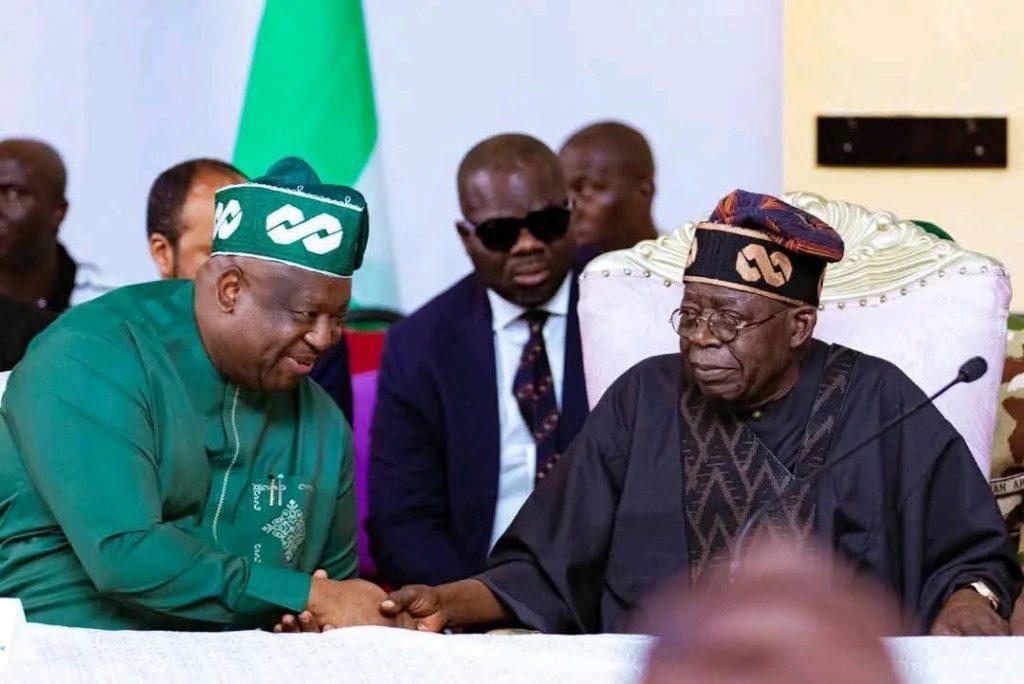
Despite ₦166.79tn debt, Tinubu’s reforms yet to lift 140m Nigerians out of poverty, Oye says

…says Nigerian banks made ₦5.93tn from govt securities while farmers, manufacturers, businesses struggle to access loans The Chairman of the Alliance for Economic Research and Ethics (AERE), Dele Oye, has raised concerns over Nigeria’s rising debt profile and worsening poverty levels, saying the economic reforms introduced by President Bola Tinubu have yet to translate into improved living conditions for more than 140 million Nigerians. He expressed concern that the growing debt burden was occurring alongside persistent poverty, with the World Bank estimating that about 63 per cent of…
…says Nigerian banks made ₦5.93tn from govt securities while farmers, manufacturers, businesses struggle to access loans The Chairman of the Alliance for Economic Research and Ethics (AERE), Dele Oye, has raised concerns over Nigeria’s rising debt profile and worsening poverty levels, saying the economic reforms introduced by President Bola Tinubu have yet to translate into improved living conditions for more than 140 million Nigerians.
Oye, who spoke at the 2026 National Convention of the Immaculate Conception College Old Boys Association (ICCOBA), said the country’s total public debt had risen from ₦87.38 trillion in June 2023 to ₦166.79 trillion in June 2026, nearly doubling within three years. “Let the numbers speak, because numbers have no party,” he said. He expressed concern that the growing debt burden was occurring alongside persistent poverty, with the World Bank estimating that about 63 per cent of Nigerians, representing more than 140 million people, would be living below the national poverty line in 2026.
According to him, although the administration’s economic reforms have contributed to improvements in some macroeconomic indicators, the gains have yet to translate into meaningful relief for ordinary Nigerians. “So we have built an economy whose GDP is rising while its stomachs are emptying. We are producing statistics the poor cannot eat,” he said.
He said the country’s experience had exposed a gap between economic stability and shared prosperity, noting that poverty had continued to advance despite improvements in inflation, foreign exchange reserves and economic growth. “Stability is not prosperity. A stabilised patient is still a patient. While the indicators have been recovering at the top, poverty has been advancing at the bottom,” he said.
Oye, however, acknowledged that Tinubu inherited a difficult economic situation in May 2023, stressing that the President did not create the crisis. “Let the record show, and I say this as one who led the organised private sector through that period, that this President did not create the crisis. He inherited it,” he said. He also commended the President for taking what he described as courageous decisions to remove petrol subsidy and liberalise the foreign exchange market, reforms which he said the organised private sector had advocated for over the years.
“Let no one rewrite history: these were the right things to do, and it took political courage to do them,” he said. He faulted, however, the sequencing of the policies, arguing that subsidy removal came before the availability of functional refineries, mass transportation alternatives and adequate social protection measures. “But courage, my brothers, is not the same thing as sequencing; and boldness is not the same thing as a safety net.
The subsidy went before the refineries, before the buses, before the buffers,” he said. He also said the naira was floated before the foreign exchange market was sufficiently deep to absorb the adjustment, while monetary policy initially failed to respond quickly enough to the resulting price shocks. “When reform is badly sequenced, it is the poor who serve as the shock absorbers of the state,” he said.
The AERE chairman further criticised the structure of Nigeria’s financial system, arguing that banks were increasingly attracted to government securities because of their high returns, rather than extending credit to businesses in the productive sectors of the economy. “Nigeria has quietly become a rent-seeking economy, rigged against the majority of our people,” he said.
He disclosed that listed Nigerian banks earned ₦5.93 trillion from investment securities, including Treasury bills and government bonds, in 2024, adding that the biggest banks generated ₦3.03 trillion from Treasury bills in the first half of 2025 alone, representing a 60.4 per cent increase compared with the corresponding period of the previous year.
Oye said the trend was particularly troubling because ordinary businesses were struggling to obtain loans at interest rates of 30 per cent and above, while banks were making substantial returns from government borrowing. “While ordinary businesses gasped for credit at thirty per cent and above, our banks declared record profits not by funding farmers, not by financing manufacturers, but by lending to the government,” he said.
He argued that the high yields offered on government securities had created an incentive for banks to lend to government rather than finance farmers, manufacturers and small businesses. “When government paper pays 20% and more, risk-free, why should any rational banker lend to a farmer in Benin or a processor in Aba? The banker is not wicked; he is rational.
It is the structure that is perverse,” he said. He described the situation as a structural problem in which government borrowing was competing with private businesses for available funds, limiting access to the financing needed to expand production and create jobs. “Our banki
- poverty
- debt
- nigerians
- tinubu
- oye
- reform
- bank
- president