State Police: Four states yet to transmit resolutions to NASS – Senate Leader

The Senate leader says that although the National Assembly is still awaiting the resolutions from the four states, their failure to transmit them will not prevent federal lawmakers from proceeding with the process.
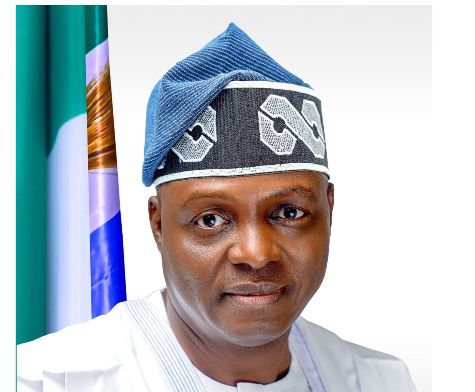
Senate Leader Opeyemi Bamidele
The Senate Leader, Opeyemi Bamidele, said four of Nigeria’s 36 state Houses of Assembly have yet to transmit their resolutions on the proposed creation of state police to the National Assembly.
Mr Bamidele, who represents Ekiti Central Senatorial District, said although the National Assembly was still awaiting the resolutions from the four states, their failure to transmit them would not prevent federal lawmakers from proceeding with the process and forwarding the bill to the president for assent.
He stated this on Friday at an award ceremony organised by The Sun Publishing Limited, publisher of The Sun newspaper, in Abuja, according to a statement by his media office on Sunday.
Mr Bamidele was honoured with the newspaper’s Senator of the Year award.
On 4 November, during plenary, the Senate fixed 15 November as the deadline for state Houses of Assembly to transmit their resolutions on the proposed creation of state police to the National Assembly.
At the time, six states were yet to transmit their resolutions. They were Kano, Oyo, Cross River, Abia, Niger and Benue.
However, while speaking on the development, the Senate Leader did not identify the two state assemblies that had transmitted their resolutions since the deadline was announced or those that were yet to comply.
“We are now expecting four State Houses of Assembly to turn in their reports on or before the National Assembly reconvenes on November 17, 2026. This suggests that next week will be decisive and defining for the National Assembly. Whether the remaining states turn in their reports or not, we must move forward and fulfil the aspiration of our people,” he said.
Mr Bamidele said the National Assembly was under an obligation to transmit the bill to the presidency for assent in the interest of national peace, progress and stability.
“We are now under obligation to transmit the State Police (Constitution Alteration) Bill, 2026 to the President and Commander-in-Chief of the Armed Forces, His Excellency Bola Ahmed Tinubu, GCFR, for assent. This is a responsibility we must consciously discharge on behalf of our constituents and in the interest of national peace, progress, and stability,” he said.
The Senate leader said the proposed state police system was not meant to create ethnic or state armies but to establish state-led, community-anchored policing within clear constitutional safeguards.
Mr Bamidele’s remarks indicated that the proposal had met the constitutional requirement of approval by at least two-thirds of the 36 state assemblies, equivalent to 24 states.
The National Assembly can now proceed with the remaining stages of the constitutional amendment process, including harmonising the versions passed by both chambers before transmitting the bill to the president for assent.
The proposal was transmitted to the state assemblies in September for consideration as part of the ongoing amendment of the 1999 Constitution.
It seeks to establish state police services that would operate alongside the existing federal police system.
Under the proposed framework, state governors would appoint police commissioners, subject to confirmation by their respective Houses of Assembly. Governors would also be empowered to issue directives to state police on matters relating to insecurity.
While the federal police would continue to be headed by the Inspector-General of Police, each state police service would be headed by a commissioner appointed by the governor and confirmed by the state assembly.
The proposal, however, prohibits converting existing local security outfits into state police services or allowing them to exercise police powers under the new framework. It also bars them from bearing firearms.
Such outfits include Amotekun in the South-west, Ebube Agu in the South-east and Hisbah in parts of northern Nigeria.
Mr Bamidele also expressed concern about the unregulated social media space, arguing that the platform needed regulation consistent with press freedom.
He said he had personally experienced the consequences of unregulated social media and questioned whether the space should continue to operate without adequate oversight.
“We have seen characters assassinated. We have seen public institutions blackmailed. We have watched people deliberately distort facts. We have seen people unjustifiably peddling lies. We cannot fold our hands and allow this illegality to continue.
“I have been a victim of these outlawed activities at different times. I know many Nigerians have been victims as well. But the urgent questions are: Should we leave unregulated the space that will define our lives unregulated in the decades to come? Or do we prefer a space where characters are assassinated daily, lies peddled, and public institutions unjustifiably discredited,” he said.
He urged newspaper proprietors and other journalism regulatory bodies to discuss the consequences of unregulated social media and work toward lasting solutions.
“These are questions that key media actors – Newspaper Proprietors’ Association of Nigeria, Broadcasting Organisations of Nigeria, Nigerian Guild of Editors, and Nigeria Union of Journalists – must honestly answer in this age of information technology. Otherwise, we must all brace up for the consequences of our inability to act at the time that matters most.
“We all know that information is critical to our national development as much as to our internal stability. Obviously, this suggests that the way we disseminate information, whether through the traditional or social media, must be well guided by international best practices.
“This further suggests that information must be disseminated objectively and responsibly with the intention to inform and not disinform; build and not destroy; develop and not blackmail,” Mr Bamidele stated.
- state
- senate
- leader
- police
- resolution
- nass
- national
- assembly