AI in German classrooms: Fighting the great 'dumbing down'
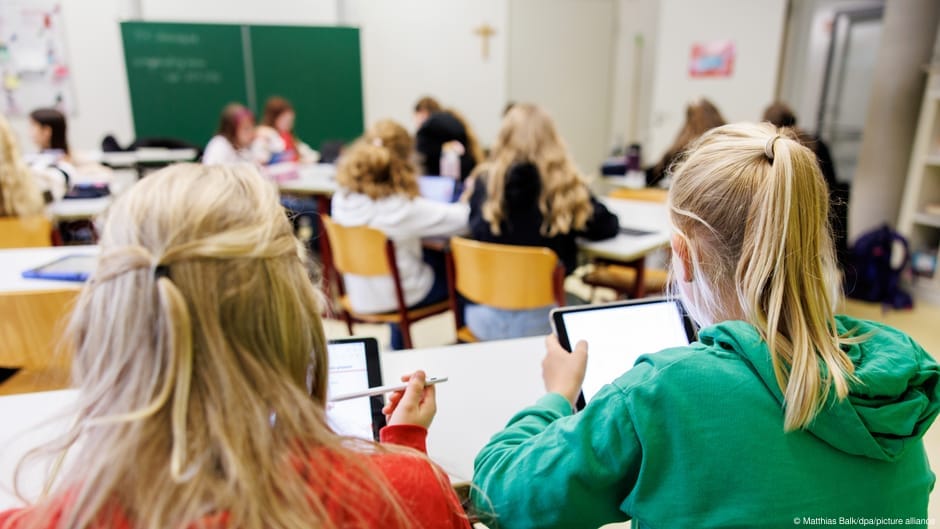
The research points in one direction: If students aren't careful about how they use AI-enabled tools, then academic performance can plummet. It's a huge challenge for teachers.
Jakob is 15 years old and attends a secondary school for more academic students, known in Germany as a gymnasium. He and his classmates have already been using artificial intelligence-enabled tools, or AI, for the last two and a half years.
"I had a French test today, and yesterday I had ChatGPT explain a lot of the topics to me again," the student told DW. Jakob isn't his real name, because he doesn't want to publicly admit he and many others of his age use AI to do their homework.
Math, German, English, chemistry and even physics: In one click, the solution or the path to a solution is available thanks to AI.
In science, this is called "cognitive outsourcing." Basically, the required thinking is shifted to another device, whether that's a calculator, notepad or a large language model (LLM) like ChatGPT.
There's a difference with AI, though. A notepad or calculator can take over a step or two but rarely the whole thought process. That's not the same for an LLM, which can handle the entire problem-solving process.
Jakob admitted he's also had an AI help him with his homework. "But only when I was really stuck," he insisted. And he's also aware that it can become a problem when AI does all your homework. "The students who get good grades tend not to do that," he explained.
Franziska Müller has been a German teacher for several decades and is currently teaching senior classes at a gymnasium. Her name has also been changed for privacy reasons.
"They can't even think for themselves anymore," she told DW, complaining about some of her classes.
Even in ordinary classes, some of the students type their questions into their tablets or phones, asking for AI assistance. And should they be called upon in class, she knows that they're reading out the answers that the AI has prepared for them and hoping nobody notices.
Müller believes students these days are less able to comprehend text. "Because they read less and let AI summarize almost everything for them," she said.
Several studies have reached very similar conclusions.
That includes the latest PISA (Program for International Student Assessment) study from September. PISA, which is run by the Organization for Economic Cooperation and Development, regularly evaluates the abilities of 15-year-old students around the world.
"Students who report using AI chatbots get lower scores in science, on average, than those who don't use AI," Andreas Schleicher, the OECD director for education and skills, wrote in his report in October. "This includes using AI to summarize texts they had to read, conduct preliminary research on a new topic, or draft texts for writing assignments."
With participants from more than 90 countries, PISA is considered the largest international comparative study of 15-year-olds worldwide. This year, German 15-year-olds posted their lowest PISA scores in the 25-year history of the study.
"The connections are complex and depend heavily on how generative AI is used, but the central insight is simple: Just as we don't get fit by watching sports but by doing sports ourselves, learning doesn't come from consuming content, but from the mind's productive cognitive engagement with new material," Schleicher explained.
Put simply, those who don't exercise their brains risk becoming less intelligent.
US think tank, the Brookings Institution, has already argued that the risks of using AI in education outweigh the benefits.
Its own research, which included young participants from around the world, speaks of students losing "fundamental cognitive and durable skills as they increasingly rely on AI to perform learning's intellectual work," as well as the decline of critical thinking, memory, perseverance and independent judgment.
But what can be done against the power of ChatGPT, Claude, Grok, Gemini and Meta AI?
New York Mayor Zohran Mamdani has banned the use of AI in public schools up to the eighth grade for the 2026 and 2027 school years — so that's up to about the age of 14 or 15.
Not everyone agrees this is the right thing to do. Julian Hinn, who teaches German to students aged between 15 and 18 in Germany, said class members can still use AI apps on their mobile phones. "And anyone who thinks they won't use it at home is ignoring reality," Hinn told DW.
Germany's annual JIM study, which tracks teenagers' media use and device ownership, supports that view.
Ninety-one percent of young people surveyed in Germany, between the ages of 12 and 19, stated that they use at least one AI application. The study also reports that 74% use AI for homework and learning.
The last JIM study actually dates back to 2024 so those percentages might be even higher now. Data on AI use in Asia, Latin America and the US from the Brookings study show similarly high figures.
German politicians have recognized the problem. Although education in Germany is the responsibility of the individual federal states, the so-called Standing Conference of the Ministers of Education and Cultural Affairs, or KMK, has been issuing statements on the use of AI since 2024.
The KMK's statements have been rather vague though, saying only that students should be enabled to engage with AI in a critical, reflective and responsible manner.
Teachers and students alike are aware that AI can be a powerful support in the classroom.
"The AIs simply explain things much better than textbooks," said Jakob, adding that he'll often get an AI to explain basic concepts to him.
Sometimes teachers can't respond like an AI, Hinn conceded. "The AI can respond much better to the language and needs of the students."
That's why he thinks it's important to include AI in classes, starting from the 10th grade when students are around 15 or 16. Hinn doesn't think it should be introduced before that, when children's basic skills are still being developed.
In more senior classes, Hinn will encourage his students to question the AI critically. "We look at the quality of the solutions," he explained.
German teacher Müller has also integrated some use of AI into her lessons for older students. But in some aspects of the class, she also bans it altogether so that her students can focus on thinking for themselves.
"I understand very well that it's tempting to use AI," she said.
There are also other problems with AI in education. According to the Brookings study, students with basic skills can use AI to deepen their learning and progress faster.
But for children with gaps in their knowledge, they tend to adopt AI's errors, outsource their thinking and then fall even further behind. In this way, AI can exacerbate preexisting inequalities.
The PISA study notes that children from more affluent backgrounds often have a better start, and AI can widen that gap.
This is called the Matthew effect — the name comes from the biblical verse Matthew 25:29, "for unto everyone that hath shall be given." It basically means that early success in learning leads to better progress in the future, while early struggles equal a growing lag over time.
In the age of AI, teachers have become more motivated to challenge students to think independently and to consider their own personal autonomy.
Hinn, who also supervises the school newspaper, said: "I always tell everyone, you can use AI but the feeling of having written an article with your own pen is spectacular."
Both teachers also stress the idea of personal autonomy and responsibility. They believe this affects the students, especially because when they sit exams, they aren't allowed to use any aids or AI. And if they aren't able to solve their own problems, they will fail.
It's during exam time that the students really find out if they can solve those math, English or science problems by themselves.
Müller said one of her students recently confessed they were upset after a poor exam result. "He felt he simply couldn't think for himself anymore because of AI," she said.
- classroom
- research
- direction
- student
- tool
- performance
- challenge
- teacher