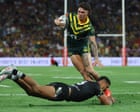
Rugby League World Cup was a triumph in Australia and invisible in the UK

So, that was the Rugby League World Cup. The primary one appears to be that those in charge in Australia – soon to be in charge in England, but more on that shortly – have realised there is value in international rugby league.
No free-to-air coverage and uncompetitive teams meant England fans all but missed a tournament that caught fire in the southern hemisphere
So, that was the Rugby League World Cup. It may have gripped you from start to finish or it may have passed you by without recognising it was even happening. It probably depends on where you are in the world: the tournament showcased many things, but, perhaps most of all, the widening gulf between the two hemispheres.
There have been some magnificent and overwhelming positives. The primary one appears to be that those in charge in Australia – soon to be in charge in England, but more on that shortly – have realised there is value in international rugby league. For too long the NRL has disregarded the international game, but it has come alive again in recent years.
That was typified by a World Cup full of colour and enjoyment. The ending was a familiar one with Australia winning the men’s and women’s tournaments, but the continued rise of Samoa and Tonga, coupled with bumper crowds and a healthy profit for the event, suggests international rugby league is set for a golden few years.
That boom should continue on the road through to the next tournament in 2030, which will take place in the USA and tap into the huge Pasifika population in states such as Hawaii and Utah. The game, though, needs a new men’s champion; no global tournament can truly be taken that seriously when one country has won 10 of the past 11 instalments.
There has been surprise in Australia about how negatively the tournament has been received in England. The early exits for England’s men and women certainly did not help and would have led to a significant switch-off no matter what. But on the same weekend rugby league fans found their flagship international fixture behind a paywall, there was a veritable feast of free-to-air sport in the UK including international rugby union and England’s win in Spain.
The Rugby League World Cup final? You needed a subscription, a different subscription from the one – soon to be two in 2027 when DAZN shares the rights with Sky Sports – you already need to watch Super League on a weekly basis. That all the free-to-air broadcasters decided they were not interested in the World Cup is a big problem for those in charge.
Contrast that with Australia. They had free-to-air coverage, which produced cut-through and allowed storylines to be shown to mainstream audiences. This week, Super League and the NRL will finally sign their partnership agreement that will mean the Australians, led by Peter V’landys who is both the chair and the CEO of the Australian Rugby League Commission, take authoritative control in the northern hemisphere.
Their biggest challenge is arguably convincing TV broadcasters just how good a product rugby league is. They are inheriting a live scenario where the BBC, the international game’s most loyal partner, decided it did not fancy showing the World Cup. If that does not illustrate how much the game needs a helping hand and radical change, nothing will.
Until changes are implemented, the World Cup will continue to look more and more like a Pacific Championships. Investment in England and France is coming, but it also needs a clear strategy to ensure those countries – and others – are able to progress to prevent a repeat of what we have just seen.
The World Cup in summary? For some it showed how the gap is widening and where the NRL must invest its time and money if it wishes to fulfil its strategy of globalising rugby league. But it has also laid the platform for expansion in the men’s and women’s tournaments for 2030 and shown once again why there is value in investing in Samoa, Tonga and Papua New Guinea.
There will be stories and memories that will last for ever, but it has also exposed the gap between the two sides of the world. Restoring international rugby league’s fortunes has been a big achievement by the suits in Australia, but their biggest challenge, bringing the northern hemisphere up to speed in time for 2030, now awaits.
- rugby
- league
- world
- cup
- australia
- triumph
- england
- tournament