The Guardian view on Oxford Street’s pedestrianisation: cities should be designed around people, not cars
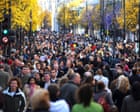
The transformation of Europe’s busiest shopping street should be a case study in making cities greener, less congested and more inviting places to live Sadiq Khan has been trying to pedestrianise Oxford Street since he first became the mayor of London in 2016. The Greater London Authority hopes it will rejuvenate a high street fallen on hard times.
The transformation of Europe’s busiest shopping street should be a case study in making cities greener, less congested and more inviting places to live
Sadiq Khan has been trying to pedestrianise Oxford Street since he first became the mayor of London in 2016. On Monday, after numerous setbacks, his plan will finally come to fruition. The busiest stretch of the nation’s famous shopping street will be closed to traffic in a scheme designed to improve the area and make it more attractive to pedestrians. It should be an emblematic case study in making cities greener, less congested, more inviting places to live and visit.
The Greater London Authority hopes it will rejuvenate a high street fallen on hard times. Since the pandemic, the number of vacant shops on Oxford Street has more than quadrupled. It estimates that the scheme will generate £82m of value a year in the area by increasing footfall and encouraging visitors to linger. This impact remains to be seen, but research from other cities suggests that shops experience higher sales once an area is pedestrianised. Given the prime minister’s focus on rejuvenating British high streets, whose dilapidation is correlated with support for Reform UK, he should be watching with interest.
The benefits of pedestrianisation are far greater than increased shopping. Domestic transport remains the largest contributor to greenhouse-gas emissions in Britain. This sector’s emissions have fallen more slowly than others largely because too many people still rely on cars. Mr Khan’s city is an outlier: 59% of all journeys in Britain were made by car in 2024, while in London cars accounted for 34%. This is hardly surprising when the Treasury spends twice as much on London’s transport system as it does on other regions in England, and the capital’s bus fares are cheaper. In Leeds, which has no mass-transit system, nearly half of people drive to work. Car use cannot be reduced without simultaneously improving public transport.
The critics of pedestrianisation – including Westminster council – suggest it merely displaces traffic elsewhere. But the evidence on this is more nuanced. One study from the University of the West of England suggests the closure of strategic roads causes some traffic to disappear permanently, as people switch to public transport or walk. Low-traffic neighbourhoods (LTNs), the pedestrianisation schemes that were rushed through in the capital during Covid-19 and have since been introduced in Manchester and Birmingham, were fiercely criticised for causing a buildup of road traffic elsewhere. Yet one study of 46 LTNs in London suggested their impact on traffic elsewhere was minimal.
Car-free areas should be accompanied by other policies that reduce pollution on surrounding roads, such as the low-emissions zones introduced in London and Oxford. Mr Khan was criticised by the then leader of the opposition, Keir Starmer, for the expansion of Ulez in 2023, and also suffered racial abuse. He has since been vindicated by research from Imperial College suggesting Ulez has significantly improved the health of primary school children in the capital, whose lung growth had been stunted by pollution.
That Transport for London estimates the pedestrianisation of Oxford Street will have only a minimal impact on nitrogen dioxide emissions, which were already decreasing as a result of Ulez, is testimony to the policy’s success. In 2014, Oxford Street had the highest concentration of nitrogen dioxide pollution in the world. Its pedestrianisation should be an inspiration to other cities to embrace policies that work for people, not cars.
- street
- oxford
- city
- area
- guardian
- view
- pedestrianisation
- people