The Guardian view on sporting triumphs: more than just a game
From Welsh rugby to English football, victories on the pitch can capture a nation’s imagination and briefly make the impossible seem possible The world divides roughly in two: people who like sport and people who don’t see the point. Adrian Conan Doyle (Sir Arthur’s son) had the super-rationalist Sherlock Holmes baffled by why anyone should care that one horse could outrun another.
From Welsh rugby to English football, victories on the pitch can capture a nation’s imagination and briefly make the impossible seem possible
The world divides roughly in two: people who like sport and people who don’t see the point. George Orwell was roundly dismissive – “war minus the shooting”. Adrian Conan Doyle (Sir Arthur’s son) had the super-rationalist Sherlock Holmes baffled by why anyone should care that one horse could outrun another. Yet sport can do something that life rarely does: offer a comprehensible narrative, with a beginning, a middle and, gloriously, an end. Life is convoluted, messy and ultimately hard to assess; sport can offer resolution in 80 or 90 minutes. All of which is a long-winded way of saying: weren’t Wales magnificent in beating the All Blacks on Saturday?
Even those who don’t understand the finer points of the rolling maul can surely grasp why this result matters. For much of the last century, heavy industry and rugby were twin pillars of Welsh national identity. The heavy industry is largely gone, and over the past few years, rugby has looked to be going the same way: a weakened national team; financial problems that threatened to tear apart the domestic rugby set-up in Wales; and the growing appeal of football. Until Saturday, Welsh sports fans looking for a winning finish were better off watching the darts champion Gerwyn “The Iceman” Price than Steve Tandy’s rugby team.
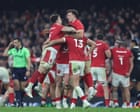
Wales hadn’t beaten New Zealand since 1953; not even the great Welsh teams of the 1970s managed it. Little was expected of a side that had laboured to beat Japan the previous week. The 55,000 crowd at Cardiff’s Principality Stadium was 20,000 short of capacity. Most would have settled for defeat by fewer than 20 points. Instead, Wales won 35-28, with magnificent first-half attacking rugby and a heroic defensive rearguard in the second. It was beyond Welsh supporters’ wildest dreams. Bread of Heaven indeed. A decade from now, 500,000 will claim to have been there.
It feels like a watershed for rugby in Wales – the team and the fanbase believe again. But such is the metaphorical power of sport that romantics hope it can be more than that. Cynics will scoff, but sport can capture a moment. It is not by chance that David Kynaston concluded his recent survey of mid-1960s Britain, Deep into the Sixties, with a detailed analysis of England’s win over West Germany in the 1966 World Cup final. That victory helped define the decade – energised, forward-looking, optimistic. The 2012 London Olympics conjured an impression of the same upbeat mood, even if it was shattered four years later by Brexit.
After Saturday, Wales can dream again. So will English football fans after Sunday’s triumph against Spain, which took place in the World Cup winners’ Madrid back yard and ended the hosts’ historic run of unbeaten matches. Wales have just overcome 73 years of anguish that had witnessed 34 successive defeats to the All Blacks; could England now put an end to 60 years of hurt and counting? English cricket supporters, too, will take heart not just from their one-day win in Adelaide at the weekend but, even more, from the Australian national nervous breakdown following the re-emergence of the “Sandpapergate” scandal.
Orwell would have recognised the tribalism. But sport really is more than just the drama unfolding on the pitch; it is the expression of a shared history, identity and ritual. War minus the shooting – but sometimes in a good way.
- rugby
- sport
- welsh
- guardian
- view
- sporting
- game
- football