Is Israel’s Eisenkot bloc less right wing than Netanyahu?

An Israeli government without PM Netanyahu may be close, but a government without his politics is far less certain.
As the long and complex negotiations to form Israel’s next government drag on, hopes are high that former military chief Gadi Eisenkot will be able to form a coalition that marks a break from the far-right and divisive politics of the previous administration.
The coalition brought together by the now-caretaker Prime Minister Benjamin Netanyahu brought figures from Israel’s far right into government. Beyond the genocidal war on Gaza following the October 7, 2023 Hamas-led attack on Israel, and repeated military strikes against neighbouring countries, the government sought to weaken judicial oversight and pursued an aggressive policy of illegal settlement expansion in the occupied West Bank. There, settler pogroms against Palestinian communities have continued with near impunity.
“Likud sits further to the right than most conservative parties in Europe. Although historically it was thought of as something like the Conservative Party, today it looks like something of a far-right party,” said Roi Zur, an Israeli academic at the University of Essex, who has researched the comparison between Israeli parties and their international equivalents.
In contrast, Eisenkot and his opposition bloc have said that they will repeal the judicial overhaul legislation introduced by Netanyahu, establishing a state commission of inquiry into the security failings ahead of the October 7 attack, and ending the draft exemption offered to many ultra-Orthodox youth in defiance of a 2024 ruling by the Supreme Court.
But will a new government under Eisenkot – made up of a number of right-wing figures – really be any different from what has come before?
As it stands, before any fresh alliances are brokered, there are five main political leaders of the opposition bloc.
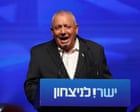
Its leader, Eisenkot, the leader of the Yashar Party, is generally regarded as a centrist security hawk.
Naftali Bennett and Yair Lapid of the B’Yachad Party are considered right-wing and centre-liberal, respectively.
Avigdor Lieberman, the head of Yisrael Beiteinu, is secular and right-wing, while Yair Golan of the Democrats sits as the sole outlier on the left.
Many observers regard Eisenkot’s politics as difficult to read.
While he has been broadly supportive of the genocidal war on Gaza, in which more than 74,600 Palestinians have been killed, and attacks on countries across the region, including the current war on Iran, little is known of his domestic politics.
His Yashar Party’s economic platform points towards a broadly pro-market approach, prioritising tax cuts over wealth redistribution.
On security, there is less ambiguity. Eisenkot is the architect of the Dahiya doctrine, an Israeli military strategy that calls for overwhelming force against areas from which Israel comes under attack.
Eisenkot warned in 2008 that Israel’s destruction of large parts of southern Beirut’s Dahiya area during the 2006 war on Lebanon “will happen in every village from which fire is launched toward Israel”. In March, he said the doctrine should again be used in Lebanon, noting it had “never been more relevant”.
Eisenkot has also firmly rejected the establishment of a Palestinian state, and supports the continued existence of illegal settlements in the West Bank, even though he has pledged to tackle settler violence.
The bloc may be viewed internationally as more moderate than Netanyahu, but its members also largely adopt right-wing positions towards Palestinians.
Bennett, a former settler council chief, opposes Palestinian statehood and has previously said that he favours annexing 60 percent of the West Bank. His political partner, Lapid, backs a two-state solution, but without any firm details, and then only in the long term.
Netanyahu’s former ally and now one of his fiercest critics, Lieberman has been vocal in his support of the expansion of illegal settlements.
Both Bennett and Lieberman have made incendiary comments about Palestinians. Bennett defended cutting off water and electricity to Palestinians in Gaza in October 2023, while Lieberman said in December 2023 that there were “no innocents in Gaza”.
Bennett and Lapid have led a government in the past: their 2021 coalition included the United Arab List (Ra’am), a party representing Palestinian citizens of Israel. But it eventually collapsed the next year, partly because it was split over privileges settlers received in the West Bank.
However, while something can be gleaned from Bennett and Lapid’s time in office, how the contrasting visions of the left-wing Golan and the right-wing Lieberman will work in the same coalition remains to be seen.
“Golan and the party he is heading, the Democrats, are a merger of two Zionist left-wing parties, the centre-left Labour and the harder-left Meretz,” said Or Tuttnauer, interim professor at the University of Mannheim, who has studied the Israeli opposition. “The party holds liberal, progressive, dovish, secular positions.”
In contrast, Tuttnauer said, Lieberman and his right-wing Yisrael Beiteinu party sought to define themselves against others holding similar positions through both his emphasis on secularism and fierce opposition to Netanyahu.
Any country that depends on the military occupation of roughly 7,252 square kilometres (2,800 square miles) of Palestinian and Syrian territory, and rules over some 5.5 million Palestinians who have no vote in the state that controls them, is unlikely to be considered progressive or liberal.
Beyond its foreign policy, however, Israel’s society has been shifting steadily to the right, a trend that polling suggests accelerated sharply following the October 7, 2023 attack.
“Many people have pinned their hopes on Netanyahu leaving, imagining that a moderate or even progressive government would follow,” HA Hellyer of the Royal United Services Institute said. “But the problem was never just Netanyahu. His absence would only expose how far the rest of the Israeli political spectrum, including much of the opposition, shares the same positions on occupation and Palestinian rights.”
“It will take years before Israelis, the public and not just their leaders, accept the case for withdrawing from Gaza, the occupied West Bank, or even Syria and southern Lebanon,” Hellyer said. “Ending the occupation and dismantling apartheid all entail recognising that these things have happened first.”
- netanyahu
- israel
- eisenkot
- bloc
- wing
- government
- politic