Were Young People Removed From Nigeria’s Voter Register?

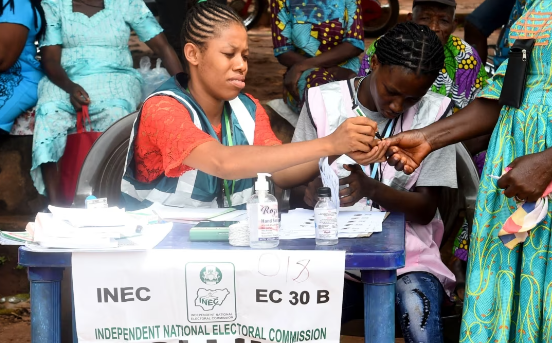
The recent voter registration figures released by the Independent National Electoral Commission (INEC) have raised important questions about the declining number of young people on Nigeria’s voter register. A voter checking a voter register during the Federal Capital Territory area council elections in Abuja.
The recent voter registration figures released by the Independent National Electoral Commission (INEC) have raised important questions about the declining number of young people on Nigeria’s voter register. Let’s look at what the data tells us. According to INEC, Nigeria had 93,469,008 registered voters in 2023, distributed across four age categories: • Youth: 18–34 years: 37,060,399 (39.6 per cent) • Middle age: 35–49 years: 33,413,591 (35.8 per cent) • Elderly: 50–69 years: 17,700,270 (18.9 per cent) • 70 years and above: 5,294,748 (5.7 per cent) The 2026 figures show that the voter register has increased to 103,428,715 registered voters, representing an increase of 9,959,707 voters, and representing 10.66 per cent compared with the 11.27 per cent increase recorded in 2023.
The 2026 age distribution is as follows: • Youth: 18–34 years: 29,777,578 (28.79 per cent) • Middle age: 35–49 years: 43,265,946 (41.83 per cent) • Elderly: 50–69 years: 22,982,900 (22.22 per cent) • 70 years and above: 7,402,291 (7.16 per cent) What Do These Figures Tell Us? 1. While the overall voter register figure for 2026 increased by 10.66 per cent, the number of registered voters aged 18–34 declined by 7,282,821, representing a 19.65 per cent reduction in this age category.
Their share of the register also declined from 39.6 per cent in 2023 to 28.79 per cent in 2026, a decrease of approximately 10.9 percentage points. 2. The number of registered voters aged 35–49 increased by 9,852,355, representing an increase of approximately 29.5 per cent. Does this mean young people were removed from the register? Not necessarily.
Between 2023 and 2026, three years elapsed. Voters who were aged 32, 33, and 34 in 2023 would have transitioned into the 35–49 age category by 2026. This demographic shift could partially explain the decline in the youth category and the increase in the older age category. A voter checking a voter register during the Federal Capital Territory area council elections in Abuja.
However, ageing alone does not fully account for these changes. It is also necessary to examine new additions to the register, particularly the rate of youth registration, and any administrative adjustments. This raises a critical question: Are young Nigerians registering to vote at a rate sufficient to replace those who are ageing out of the youth category?
For historical perspective, Nigeria’s voter register increased from 68,833,476 in 2015 to 84,004,084 in 2019, representing a 22.04 per cent increase. Between 2019 and 2023, the register grew to 93,469,008, an increase of 9,464,924 voters (11.27 per cent). By 2026, it had risen further to 103,428,715, representing an additional 9,959,707 voters (10.66 per cent).
Although the absolute increase between 2023 and 2026 was slightly higher than that recorded between 2019 and 2023, the percentage growth was marginally lower. These figures demonstrate a declining rate of growth in Nigeria’s voter register: 22.04 per cent in 2015–2019, 11.27 per cent in 2019–2023, and 10.66 per cent in 2023–2026. The most recent period, however, covers three years rather than four.
The critical issue, therefore, is not simply whether the voter register is growing, but who is entering the register, how voters are transitioning between age categories, and what these demographic changes mean. My proposal to INEC is to publish a detailed age-cohort analysis explaining changes between the 2015, 2019, 2023 and 2026 registers, including new registrations, age transitions, removal of dead and unqualified persons from the register and other adjustments.
If the decline shows inadequate registration among newly eligible young voters, it must prompt increased investment in youth mobilization for voter registration. If it reflects administrative adjustments, those changes must be clearly documented and explained. Samson Itodo is the Executive Director of Yiaga Africa.
- voter
- register
- cent
- nigeria
- age
- category
- increase
- people