They’re one of the UK’s greatest cult bands – who swore they’d never reunite. What brought Life Without Buildings back together?
They’re one of the UK’s greatest cult bands – who swore they’d never reunite. But after Frank Ocean and TikTok thrilled to Sue Tompkins’ unique vocals, they’re back.
The Scottish quartet existed for just three years at the turn of the millennium. But after Frank Ocean and TikTok thrilled to Sue Tompkins’ unique vocals, they’re back. They explain their fears about ‘spoiling the joy’
‘I’m excited, I’m scared, I’m anxious – that bubbling feeling, like when you’re on a rollercoaster, at the very top, just before the big drop.”
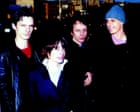
On a drizzly afternoon in July, huddled with her three bandmates in the cramped cupboard that’s the dressing room of Glasgow venue Mono, Sue Tompkins is managing her feelings ahead of her first proper gig with Life Without Buildings in almost a quarter of a century. “Everybody coming is invited, it’s secret, nobody paid much to get in, the profits are going to charity,” adds guitarist Robert Dallas Gray, sat beside her, as much to steady his own nerves as to explain the circumstances of tonight’s show. “I hope people aren’t looking at it like we’re fucking entertainers.”
Sat inches across from them, drummer Will Bradley breaks into a dry chuckle. “We are certainly not going to entertain.”
Life Without Buildings ended too soon, just before a post-punk revival in the early 00s that would have embraced their taut, innovative music, and years before the recent sprechgesang (spoken singing) movement – Dry Cleaning, Yard Act et al – that seemed to draw inspiration from Tompkins’ unique vocals, though her inspired flood of babble and rhythmic poetry has a disruptive, joyful magic that sets her far apart. In three years, they released one sublime studio album and a handful of singles, and played numerous shows, sometimes to packed rooms, often to just five to 10 people, before splitting in 2002 having achieved “only minor cult/niche success”, says Bradley.
Long after their trail went cold, however, this buried treasure of turn-of-the-millennium indie was rediscovered. In 2018, Frank Ocean played The Leanover, their signature track, on his Apple Music show. Then, one morning during lockdown, Beatrice Laus (AKA Beabadoobee) mimed along to the evocative first 11 seconds of The Leanover to entertain her followers on TikTok, who then shared themselves miming to those same 11 seconds (Beabadoobee’s initial TikTok has now been streamed almost half a million times). Two decades on, Life Without Buildings found their audience, who will finally get to see the group play this week, as they briefly reunite for four gigs marking Rough Trade’s 50th birthday celebrations.
“Robert, Will and I started playing music,” says bassist Chris Evans, of the group’s origins in late-90s Glasgow. “But that didn’t work out.” The trio were under the spell of experimental German electronic music, listening to lots of Underground Resistance, techno and post-rockers Disco Inferno. “We’d combine electronics with live guitar and drums,” says Gray. “And it always sounded bollocks.”
They reformatted as a guitar, bass and drums unit, though the music they played was far from traditional, often chasing the same riff for hours at a time. “But everything changed when Sue joined,” says Gray. Tompkins was a member of Elizabeth Go, a local art collective whose number included Cathy Wilkes, Victoria Morton, Sarah Tripp and Tompkins’ sister Hayley, at whose events she would perform from sheets of handwritten and typewritten paper. “She was brilliant,” says Bradley. “We all said, ‘This is it’. There was no doubt.”
They invited her to their practice space, playing song ideas at length, Tompkins selecting pieces she could work with as they pared their riffs back to the melodic bone. The music was “rock’n’roll, but like Television and the Modern Lovers were rock’n’roll, not Status Quo,” says Gray. “It was about doing the unexpected. We were conscious to not be boring.” Some songs took a direction they dubbed “Krautrock Keith Richards”, while others were “tumbling around, falling over themselves”. The Leanover was of this second category and was “the breakthrough. We recorded the demo in my bedroom, Sue with a cheap microphone, the rest of us squashed up on my bed watching her.”
During rehearsals, Tompkins would write on sheets of A4 that she’d later edit at her electric typewriter, which she operated like a musical instrument, creating rhythms within the music by tapping out words and staccato repeated letters she’d later speak/sing. She juxtaposed gnomic phrases and sentence fragments with rhythmic stutters and vocal tics, all seemingly improvised but actually painstakingly scripted. “Sue’s vocals built a structure that was rhythmic and melodic,” says Gray. “Frank Ocean must have recognised a flow he’d heard nowhere else. It’s like Dilla time,” the particular swing of hip-hop producer J Dilla: “Its own thing.”
Her repeating murmur of “if I lose you in the street”, which had enraptured Beabadoobee and her followers, was as haunting as it was impenetrable. “It veers between something meaningful, and not,” Tompkins says. “It’s about love and loss: it could be a child losing a toy, or a person losing a parent or a boyfriend or girlfriend. Even if it sounds nonsensical, it isn’t; there’s sense in it, it has meaning to me.”
Backed by New Town, one of their Krautrock Keith Richards numbers, The Leanover became their debut single on Rough Trade offshoot Tugboat in 2000. “The sum total of our ambitions was to get played on John Peel,” says Gray; the veteran DJ “never picked up on it”, but BBC Radio 1’s Steve Lamacq played New Town enough times for Tugboat to commission an album.
“I was apprehensive,” says Gray, “particularly because you hear stories about engineers being dicks, and what Sue was doing was so unconventional.” But when producer Andy Miller introduced himself by saying, deadpan, that he “taught dolphins to work as security guards”, the group knew they’d found someone following a kindred offbeat. Miller encouraged their invention in the studio; they recorded album closer Sorrow in one take, moments after it was written, its intimacy complementing the song’s fragile, fractured vibe. “Andy hadn’t sorted out the mic-placement or anything,” says Bradley, “but he ran tape anyway. You feel like you’re in the room with Sue, eavesdropping her talking.”
Any Other City arrived in February 2001, a 4/10 drubbing by NME equating it to “the scrape of fingernails on a blackboard”; it would fall to future generations to recognise the band’s idiosyncratic excellence. That month, the group opened for labelmates the Strokes at the Camden Barfly. It was the New Yorkers’ first London headline gig, the tiny room packed to bursting, and they were indeed as magnificent that night as legend remembers. However, they still didn’t possess the maverick, lightning-in-a-bottle magic of their support act, who played one of the most remarkable shows I’ve ever seen, a riot of joy and art that absolutely was entertaining. But Gray had a sense of “Rough Trade’s attention shifting”; certainly, over the months that followed, the Strokes’ accessible, familiar pop made indie rock suddenly bankable, a rising tide that would leave more experimental groups like Life Without Buildings untouched.
The following year, Belle and Sebastian took the group on tour across the UK: audiences heckled them and it was, Gray remembers, “fairly miserable”. They’d begun writing a second album, but Tompkins signalled she was done. “It was like I woke up and realised I was in a band,” she says. “And it was a lovely band. But if I was in a band I wouldn’t be able to do exhibitions; I’d be in the back of a transit van. It was very selfish,” she adds, as her bandmates shake their heads in amiable disagreement.
In the years since, Evans relocated to Brussels, where he works as an artist (currently exhibiting in Amsterdam and Vienna, and next year he’ll release a record with the poet Bianca Stone as Sudden Wealth), while art curator and critic Bradley is director of Oslo gallery Kunsthall. Tompkins and Gray remained in Glasgow, the singer mostly focusing on visual art (though she contributed vocals to Sleaford Mods’ No Touch earlier this year), while Gray has continued to make music, with a marvellous new album by his group Whin and a collaboration with Joseph Quimby of Rhins imminent. Life Without Buildings, however, remained firmly in the past, even as The Leanover began its remarkable second act.
“We’d all decided we were never going to go back to it,” says Bradley. “I really liked it as this half-forgotten, quite beautiful moment in the past. When we split, there was no soul-searching, no regret. When you do something you enjoy, but it’s only minorly successful, but you still build your identity around it, and your future, but you can’t pay the rent and you can’t build a life, and you’re becoming bitter … We’d realised there was a danger of spoiling the joy of it. And it couldn’t exist without that joy.”
Later that night at Mono, however – the musicians quickly slipping into the interlocking melodies and life-affirming rhythms of the songs, Tompkins reading from her reams of A4 and reinhabiting her enigmatic songs – everything that has been precious about Life Without Buildings remains intact and alive. Afterwards, hugging her bandmates outside the venue, in the July Glasgow rain, Tompkins seems giddy, like she just stepped off the greatest rollercoaster of her life.
“It wasn’t without elements of pure fear,” she says. “There was some of that tonight. But I get so energised when they’re playing. There’s something pure about music that is so joyful. I really wanted to enjoy it. And I really did.”
- life
- cult
- sue
- tompkins
- buildings
- band
- building
- quartet