EU, ASEAN pursue deeper trade ties, but hurdles remain as businesses struggle with informal barriers
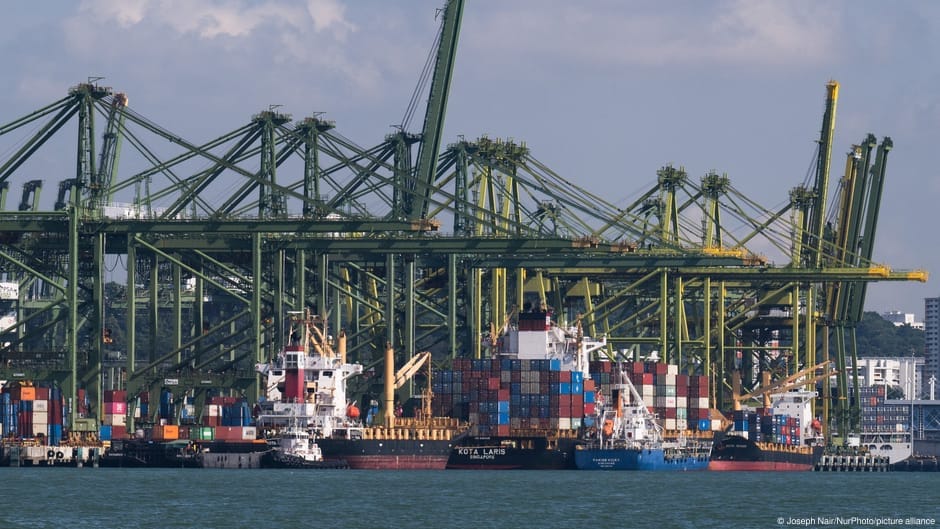
2027 could be a landmark year for EU–Southeast Asia trade, with several deals nearing completion. But the harder task will be to ensure that businesses actually use them.
The European Union and the Association of Southeast Asian Nations (ASEAN) could be heading for a breakthrough year in 2027, when the two sides mark 50 years of diplomatic ties.
A long-awaited trade agreement with Indonesia is expected to take effect, while a deal with the Philippines is nearing completion and negotiations with Thailand and Malaysia are making progress. By the end of next year, the EU could have trade deals in place with six Southeast Asian states, up from just two today.
The anniversary could also revive the long-standing ambition of a broader trade agreement between the EU and ASEAN.
On November 17, the European Commission hosted a dialogue in Brussels to discuss trade relations with Southeast Asia, including progress on existing and pending free trade agreements (FTAs).
But attention is turning to what comes next. "Finalizing FTAs is only the beginning, not the end," Chris Humphrey, executive director of the EU-ASEAN Business Council, told DW.
FTAs can reduce tariffs and remove trade restrictions, but that is of little use if businesses don't know how to use them, he added.
"Unfortunately, in many cases, this is where there is a failure. Communication and training are key," Humphrey said.
For Brussels, the priority should now be to tackle the less conspicuous obstacles to trade, he stressed.
Cutting customs delays, simplifying regulations, and helping smaller European businesses enter unfamiliar Southeast Asian markets will determine whether an FTA succeeds.
"European companies with little or no experience in Southeast Asia would benefit from greater on-the-ground support, particularly practical, firsthand guidance on informal business practices and the unwritten local rules," Alfred Gerstl, an associate professor at Palacky University Olomouc in the Czech Republic, told DW.
One option is to expand the assistance offered by European chambers of commerce, trade delegations, and EU offices in Southeast Asia. This could range from helping firms find distributors to explaining local licensing requirements and how to qualify for preferential tariffs.
In Vietnam, for instance, sustained pressure from Brussels has helped improve market access for European pharmaceutical firms. In Indonesia, the EU has worked on trade facilitation while pressing Jakarta over import restrictions and halal certification requirements, said Camille Nessel, a researcher at the Université Libre de Bruxelles.
Regular consultations with businesses on both sides could also help Brussels spot problems before they become trade disputes.
Trade policy has also acquired a geopolitical purpose in Brussels. "If trade policy is expected to reduce strategic dependencies, we are asking it to deliver on objectives that remain insufficiently defined, let alone demonstrating how to achieve them," Nessel told DW.
The EU wants to reduce its dependence on a handful of suppliers for the minerals needed for batteries and other clean technologies, while Southeast Asian producers, particularly Indonesia, want foreign investors to help develop domestic processing industries rather than merely buy raw materials.
The EU and Indonesia have already clashed over Jakarta's restrictions on nickel exports.
European investment in processing facilities, agreements on environmental standards, and greater regulatory certainty would give both sides concrete gains, said Nessel. "The real value of an FTA is not just opening a market but giving the EU the leverage to keep it open," she added.
Pasha Hsieh, Lee Kong Chian Professor of Law and Jean Monnet Chair at Singapore Management University, said Brussels should prioritize ratifying its investment protection agreements with Singapore and Vietnam.
Signed in 2018 and 2019, respectively, the agreements still require ratification by all EU member states before entering into force. "These delays underline the need to follow through on negotiated commitments," Hsieh said.
The issue is particularly relevant as the EU looks to develop investment protocols in other Southeast Asian states where investors have sometimes faced uncertainty over legal protections. Indonesia, for instance, has terminated numerous bilateral investment treaties, including agreements with the Netherlands and Spain.
A larger question is whether the EU should continue pursuing bilateral deals with Southeast Asian countries or revive its original ambition of a region-to-region agreement with ASEAN.
The EU and ASEAN launched negotiations for a region-wide FTA in 2007 but suspended them two years later amid disagreements over wide economic disparities among ASEAN members and political concerns. Technical discussions resumed in 2017, but little has come of them.
ASEAN already has regional agreements with China and several other economies. Beijing upgraded its free trade agreement with ASEAN in October 2025.
Region-to-region frameworks extend beyond trade. Humphrey, of the EU-ASEAN Business Council, called for negotiations to begin on a region-to-region Digital Trade Agreement and Investment Protection Agreement.
The EU-Singapore Digital Trade Agreement, which entered into force in February 2026, offers a possible model for wider cooperation, he noted, adding that common approaches to customs procedures, supply-chain standards, and green technologies could create greater alignment with ASEAN members that are not yet ready for full FTAs.
"European businesses have long complained of operating at a disadvantage due to the lack of a region-to-region deal. It is high time that both sides elevated their ambitions and embraced the idea of working towards such an agreement," Humphrey said.
The 2027 anniversary would be a convenient deadline for agreeing on what comes next, but Gerstl warned against mistaking another round of diplomatic ceremony for progress.
"There is a risk that attention will focus almost exclusively on the 2027 summit in Singapore and that the group photo will become the defining image of the event, only for momentum to fade in the years that follow," he added.
- trade
- asean
- business
- tie
- hurdle
- barrier
- southeast
- asia