Hoping for Britain to rejoin the EU with Andy Burnham? You may be waiting a long time
Hoping for Britain to rejoin the EU with Andy Burnham? Measured against these great expectations, Burnham’s first big speech on Britain and Europe, delivered on Monday evening amid all the pomp and circumstance the City of London could furnish, must be considered a disappointment.
The PM’s first big speech on the UK and Europe was cautious and disappointing. Don’t expect any great leaps towards a new deal
Ever since Andy Burnham became the British prime minister this summer, people all over Europe have been asking me one question: “Will the UK rejoin the EU?” Sometimes they add: “And if so, when?” None of the intermediate options between the current hard Brexit and Brejoin are of any interest at all to most other Europeans.
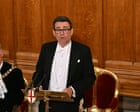
Measured against these great expectations, Burnham’s first big speech on Britain and Europe, delivered on Monday evening amid all the pomp and circumstance the City of London could furnish, must be considered a disappointment. It was both a cautious and a curiously old-fashioned speech.
Cautious in diagnosis: his bold statement that “we have lost more than we have gained in the last 10 years” was immediately followed by “the hard Brexit we were given is not good enough for Britain”. (So a soft Brexit would be fine?) Cautious in prescription: beyond the welcome modest steps to be agreed at this Friday’s UK-EU summit (easier access for food and agricultural products, linking our carbon emissions markets, creating a youth mobility scheme), anything this government does during the term of the current parliament will stay within Keir Starmer’s “red lines” (no rejoining the customs union, single market or freedom of movement). Burnham will, however, explore “options for our long-term relationship” with the EU, “to inform decisions in the next parliament”. Unless we have an early election, that means not before 2029.
This caution is easily explained. Roughly half of his cabinet doesn’t want even to mention Brexit. Roughly half of his MPs are in constituencies that voted leave in 2016. The country at large thinks Brexit was a mistake but dreads the prospect of rerunning the debate and isn’t sure it would vote for rejoining if the UK didn’t have its previous opt-outs, including from the euro and the Schengen free travel area. For all the great expectations that were raised, Burnham himself had actually only said in interviews that he hoped Britain would rejoin the EU in his lifetime. He’s a robust 56-year-old, so that could take us to about 2060.
More surprising was how old-fashioned his speech was, albeit delivered with demotic verve. Here, for starters, was the weary old trope of Britain always having to “lead” in whatever it does (nine references to leading, if my count is correct). Then there’s the curious way in which Britain’s commitment to European defence and support for Ukraine is totally divorced from all the other dimensions of European security and strength, which self-evidently involve the EU. Instead, there’s a relentless narrow focus on what’s good for Britain economically. At the heart of his speech was what he called the “Makerfield test” – that is, what would deliver economic benefits for the hard-pressed people of his constituency of Makerfield, which in 2016 voted to leave the EU.
Oddest of all was the way he harked back to a 1948 speech in which Winston Churchill conjured Britain’s position at the intersection of three majestic circles. Gliding over the fact that the first circle Churchill mentioned was “the British Commonwealth and Empire”, Burnham talked at some length about the Commonwealth before coming to Europe. For obvious reasons (don’t offend the egomaniac in the White House!), he also glided over the fact that Churchill’s second circle was “the English-speaking world”, with its superpower being the US. Yet if we are highlighting, as Burnham did, how the world has changed since 2016, then the drastic change under Donald Trump in the US approach to its allies, including Britain, should be top of the list. Oh, and by the way, Churchill’s third circle was “United Europe”, which he talked of in visionary terms long before it ever existed. Now, with something called the European Union, much of Europe is at least halfway there.
Unlike in Churchill’s speech, in fact unlike in everything that great British and European leader said and did, here there was no sense of a wider European story in which Britain has always played an important part. Instead, Burnham spoke of Britain’s reset “with Europe”, as though Britain were not part of Europe and “Europe” only means the EU. The most European things in London’s Guildhall on Monday evening were the Polish vodka served by the Polish-South-African-British lord mayor of London, Bronek Masojada, and a few words in Dutch that he addressed to the prime minister’s wife, Marie-France van Heel.
But enough about the words. What of the actions to follow? I’m not sure how long these conversations with EU partners about “options” need to last. An hour or two might suffice. For the EU has repeatedly spelled out the current ones as it sees them. If you want a nice summary, look at the visual “staircase” of options prepared by the now sadly closing UK in a Changing Europe thinktank. But don’t get me wrong: continuing to explore all options until the next British election is the right thing to do, not least for one simple reason. After Europe’s megacycle of elections in 2026/27, an EU with, say, President Marine Le Pen in France, a coalition of centre-right and far-right parties in Spain, hard-right governments in Poland and Italy, and the AfD making the political running in Germany, may be a very different proposition.
Rationally speaking, I have no doubt that it would be much better for both Britain and Europe were the UK still to be a full member of the EU. Britain has many strengths that Europe needs: most of its best universities, leading AI startups, financial services, creative industries, supposedly super spooks (even if they don’t all resemble Robert Pattinson as James Bond). But the politics on both sides of the Channel will make this very difficult to achieve.
Meanwhile, Burnham’s tentative reopening of the issue has already led to the launch of not one but two anti-Brejoin pressure groups, one called Stay Out and the other mysteriously named Enough Official. Backed by some of the surviving old Brexit warhorses, they are already claiming that to rejoin the EU would cost Britain £750m a week. As in a nightmare, one glimpses the prospect of Boris Johnson, Michael Gove, Jacob Rees-Mogg and – gawd help us – Liz Truss tottering, like a gaggle of the undead, out of a red battlebus on the side of which is blazoned “Rejoining the EU would steal £750m a week from the NHS”.
Silver-tongued Gove, the Artful Dodger of British politics, the Iago of Brexit, now warns us that any move towards rejoining would “commit the country to another decade of fractious negotiations”. But that’s what we’re in for anyway, because both Britain and the EU will keep changing and therefore the relationship between the UK and its largest trading partner will inevitably be the subject of constant, difficult negotiations. And guess who gave us this dreary prospect? Gove, Johnson and all that gang. For all the criticisms I have made of his first big, not very European speech about “Europe”, give me Burnham any day.
Timothy Garton Ash is a historian, political writer and Guardian columnist. His new book, Europe in 7½ Chapters, is out now
- burnham
- britain
- andy
- speech
- europe
- time
- leap
- deal