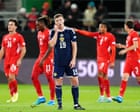
Pocognoli’s aspiration for how Scotland must play is in danger of becoming unworkable

Successive 4-0 defeats by Belgium and Russia in 2019 left Clarke with the sense he should have stayed in club management. There are, however, fundamental differences between the story of Clarke and that being delivered by Sébastien Pocognoli.
The 4-0 debacle against Switzerland has added to the tactical concerns about the head coach’s suitability, just six games into the job
The Scottish Football Association can only cling to a lesson from the past when assessing a worrying international window. Steve Clarke was beleaguered during his early games in charge. Successive 4-0 defeats by Belgium and Russia in 2019 left Clarke with the sense he should have stayed in club management. A revival meant Clarke led his country to three out of four tournaments.
There are, however, fundamental differences between the story of Clarke and that being delivered by Sébastien Pocognoli. Clarke was a pragmatist, whose decades in coaching suggested he had the wherewithal to revive Scotland. Pocognoli, six games into his tenure, is in danger of lurching in to the territory of dreamy ideologue whose aspiration for how Scotland must play is unworkable. The meek nature of Scotland’s collapse in the 4-0 loss to a second-string Switzerland was lamentable. The Belgian’s assessment, with overpraise a key theme, raised eyebrows.
Pocognoli’s team scored five goals in six Nations League games, four coming against North Macedonia. They drew blanks in three fixtures. The concession of 10 depicts a team soft against set pieces and open play. Scotland have wingers who are not appropriately deployed because of dedication to a system. They have an obvious shortage of centre-backs yet Pocognoli picks three at a time. The midfield lacks balance. Not one player under Pocognoli’s watch is consistently excelling.
Pocognoli is obstinate in respect of his tactics. At club level this can work owing to daily work on a training pitch. Scotland are wedded to a 3-4-2-1 that fits too few of their players. There is no transfer window capacity to change that. Pocognoli’s insistence upon his “philosophy” sets off alarm bells. Although his English is strong, it is far from perfect, which raises questions about communication. Scotland do not look well drilled or clear in approach, which was plain in the unimpressive home win against North Macedonia even before the Switzerland debacle.
There is no detailed body of work to suggest Pocognoli can adapt or oversee improvement. He achieved great success in Belgium, winning the title at Union Saint-Gilloise, before a brief spell at Monaco. The Scottish FA’s deep faith in this 39-year-old, amid all manner of waffle about metrics and analytics, was on the basis of just over 100 games as a manager. It remains probable that the association erred in not sourcing a coach with dugout experience at a country of similar scale to Scotland. This always had the whiff of trying to be too smart by half.
The best Scotland sides are unapologetically horrible to play against, physical, energetic and direct. Shortcomings in skill are offset by attitude. Pocognoli’s version is the opposite on all fronts, ponderous and timid. The Tartan Army, hardly a ferociously demanding lot, have failed to demonstrate any excitement about Pocognoli.
This counts as no ode to Clarke. After seven years, change was required. It was the turn taken by the Scottish FA in implementing a new strategy that looks increasingly dubious.
Footballers are typically selfish beings. For now it suits the Scotland squad – and is fair – to state Pocognoli requires time and that they are behind him. Not only did the body language amid the unravelling in St Gallen suggest otherwise, those players are likely to adopt a different position if focus turns towards them. Scotland’s contingent is heavy on influential, experienced players.
There is no sense of the Scottish FA dispensing with Pocognoli at this point. Not only would such a move be premature, it would deliver an admission of failure that those running the governing body are never keen on providing. They enjoy the trappings and profile provided by the national team without anything like the adjacent accountability. They are assisted in this context by domestic football obsession within the country. There will be grumblings about Pocognoli for a brief period this week before the theme is placed into cold storage.
Next month’s Uefa 2028 qualifying draw, where Scotland will appear from pot three, carries intrigue and danger for Pocognoli. The assumption that Scotland will feature in the tournament is undermined by performances; England, Scotland, Wales and the Republic of Ireland are co-hosting and a maximum of two spots are open for any of those nations who do not qualify. Not playing in a competition where games will be staged in Glasgow would count as a humiliation for the Scottish FA.
If Scotland face competitive games rather than friendlies in March, which will be determined after the draw, Pocognoli needs stark improvement. Without it, his paymasters would then have a decision to make while looking to keep Euro 2028 dreams alive. The situation is already that acute.
Pocognoli was not part of the Scotland party that landed in Glasgow from Zurich on Tuesday. His family have remained in Belgium. Alone with his thoughts on his journey home, Pocognoli must have pondered the harshness of his new environment. He has the sternest of challenges to douse legitimate background noise.
- scotland
- pocognoli
- clarke
- aspiration
- danger
- game
- switzerland
- debacle