business

Naira weakens to N1,470/$ at parallel market
Naira weakens to N1,470/$ at parallel market

At the Nigerian Foreign Exchange Market (NFEM), the official window, the naira also weakened to N1,363.23 per dollar. In a related development, the CBN and the Nigerian National Petroleum Company Limited (NNPC) on Wednesday signed a Memorandum of Understanding to strengthen foreign exchange inflows, energy financing and macroeconomic stability.

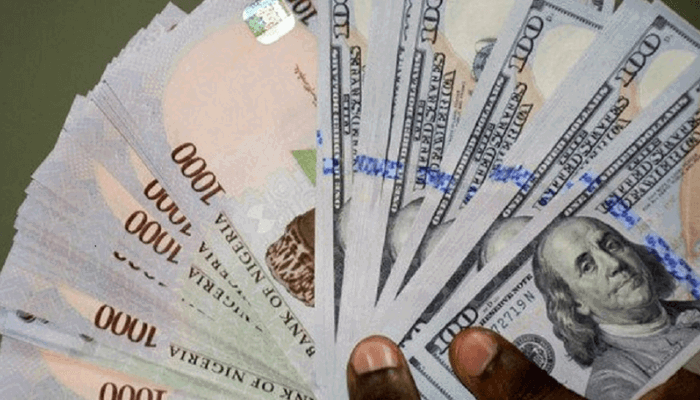
The naira depreciated to N1,470 per dollar at the parallel foreign exchange market on Wednesday, its weakest performance since January 28. The latest rate represented a N25, or 1.73 per cent, decline from the N1,445 per dollar quoted on Tuesday. Currency traders, popularly known as Bureau De Change operators, in Lagos quoted the buying rate at N1,450 per dollar and the selling rate at N1,470.

The local currency had traded at N1,430 per dollar on Monday, compared with N1,390 on November 13, representing a depreciation of N40, or 2.88 per cent. At the Nigerian Foreign Exchange Market (NFEM), the official window, the naira also weakened to N1,363.23 per dollar. Data from the NFEM showed that the currency depreciated by N7.43, or 0.55 per cent, from the N1,355.80 per dollar recorded on Tuesday.

Meanwhile, Nigeria’s foreign exchange reserves stood at $43.64 billion as of November 14, compared with $45.56 billion recorded on January 2. The figures, obtained from the Central Bank of Nigeria (CBN), indicated a decline of $1.92 billion, or 4.21 per cent, in the country’s external reserves since the beginning of the year. In a related development, the CBN and the Nigerian National Petroleum Company Limited (NNPC) on Wednesday signed a Memorandum of Understanding to strengthen foreign exchange inflows, energy financing and macroeconomic stability.

  • naira
  • market
  • dollar
  • exchange
  • cent
  • rate
  • currency
  • january

Summaries and tags are generated automatically. Stay informed with VidiaNews.

Related news

MPC cuts policy rate to 11% from 14 percent
business

MPC cuts policy rate to 11% from 14 percent

The Monetary Policy Committee (MPC) of the Bank of Ghana (BoG) has cut its Monetary Policy Rate by 300 basis points to 11 per cent, as improving economic conditions and declining market interest rates provide room for further easing of monetary policy. The reduction from 14 per cent was announced by Governor of the Bank of Ghana, Dr Johnson Asiama, following the 133rd Monetary Policy Committee meeting held from November 16 to 18, 2026.

Read →
MPC reduces policy rate to 11% from 14 percent
business

MPC reduces policy rate to 11% from 14 percent

The Monetary Policy Committee (MPC) of the Bank of Ghana (BoG) has cut its Monetary Policy Rate by 300 basis points to 11 per cent, as improving economic conditions and declining market interest rates provide room for further easing of monetary policy. The reduction from 14 per cent was announced by Governor of the Bank of Ghana, Dr Johnson Asiama, following the 133rd Monetary Policy Committee meeting held from November 16 to 18, 2026.

Read →
Cedi loses ground as depreciation slips further to 10.6% – BoG data
business

Cedi loses ground as depreciation slips further to 10.6% – BoG data

The Ghana cedi is coming under renewed pressure, with its year-to-date depreciation against the US dollar reaching 10.6 per cent in November, up from 9.5 per cent in September. Mr Kruiniger pointed to changes in foreign exchange intermediation involving the Bank of Ghana and the Ghana Gold Board, warning that the shift, together with lower gold earnings and the accumulation of reserves under the Ghana Reserve Accumulation Programme, could tighten dollar supply.

Read →
business

NNPC, CBN sign deal to boost oil production to 3m bpd

By Udeme Akpan The Nigerian National Petroleum Company (NNPC) Limited and the Central Bank of Nigeria (CBN) have signed a Memorandum of Understanding (MoU) to strengthen foreign exchange inflows, improve financial discipline and attract investment into the country’s energy sector. The agreement, signed at the CBN headquarters in Abuja on Wednesday, is also expected to support NNPC’s ambition to increase Nigeria’s crude oil production from the current 1.8 million barrels per day to three million barrels per day.

Read →