Birmingham council granted interim ban on union jacks on lamp-posts
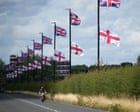
High court judge issues order against Raise the Colours over flags on council-owned street furniture The campaign group Raise the Colours has been temporarily banned from placing union jacks on lamp-posts and roundabouts in Birmingham after a legal challenge by the local council. The high court judge Emma Kelly granted an interim injunction banning the placing of all flags on council-owned street furniture without prior permission in a judgment issued on Wednesday, Birmingham city council said.
High court judge issues order against Raise the Colours over flags on council-owned street furniture
The campaign group Raise the Colours has been temporarily banned from placing union jacks on lamp-posts and roundabouts in Birmingham after a legal challenge by the local council.
The high court judge Emma Kelly granted an interim injunction banning the placing of all flags on council-owned street furniture without prior permission in a judgment issued on Wednesday, Birmingham city council said.
The council, run by a minority coalition led by the Liberal Democrats, sought the injunction against seven people identified as supporting or participating in the affixing of flags in the city, including Ryan Bridge, a co-founder of Raise the Colours and “persons unknown”.
The application for an injunction, which attracted national attention and follows similar action by Oxfordshire county council, argued the actions of the flag activists had caused danger, alarm and distress.
People associated with Raise the Colours, which describes itself as a grassroots movement, have been placing union jacks and St George’s flags on public infrastructure across the country since August last year.
The group’s website states it is a “campaign to cover Britain in symbols of unity and patriotism”. However, others have accused the group of racism and spreading anti-immigration rhetoric – claims it has previously denied.
In its claim to the high court, Birmingham city council said the defendants had travelled across the city “unlawfully affixing flags” and had confronted residents who attempted to remove them.
“In doing so, they are engaging in tortious and criminal behaviour, which is both antisocial and dangerous,” the claim read, adding that the behaviour had caused “danger” and “alarm” to residents.
The council said residents of Birmingham had suffered “fear, anxiety, intimidation, harassment,” been put at “serious risk of harm”, and some had suffered physical injuries, including a broken leg.
The case was adjourned in early September after the judge said she was “troubled by the lack of clarity” from the council “against the individual defendants”, and a further hearing was scheduled at the end of September.
Bridge opposed the injunction and read a written statement to the court. He said: “For me, the union flag represents home, identity, belonging, national identity, British culture and patriotism.”
His lawyer, Liam Wells, argued that the injunction would have a “chilling effect” on human rights and that erecting union jacks and St George’s flags was an expression of his political views.
Wells said the interim injunction would risk “silencing people in their political views and expression of political opinions” and the council had failed to prove Bridge had acted unlawfully.
Three local residents, Adam Biggs, Mark Hudson and Tony Kaye, joined the case representing ‘persons unknown’ opposing the injunction bid, and expressed concerns it would ban people flying flags for pride and other campaigns.
The council’s cabinet member for equalities, communities and social justice, Jane Baston, said on Wednesday the local authority was grateful for the judgment and it was an “important step”.
“We have taken a proportionate and evidence-led approach throughout this case. Our priority has always been to protect public safety, supporting the welfare of our staff and contractors, maintaining community cohesion and ensuring public funds are used responsibly,” she said.
In a video uploaded to Facebook, Bridge said he was “gutted” and “devastated” by the decision, including the fact that the injunction granted power of arrest against him and others.
He said Raise the Colours was “not about race, colour, creed” but about opposing “illegal invaders breaking in our country, jeopardising our borders, on the rubber dinghies”.
At the Reform UK conference in Birmingham in September, Nigel Farage promised to help Bridge in his legal fight if the party was able to do so.
In response to the judgment, Reform’s leader in Birmingham, Jex Parkin, said the council had its “priorities entirely wrong” and had pursued an “ideologically driven case against residents proudly displaying our national flags – at huge public expense”.
The leader of the local Conservatives, Robert Alden, also criticised the injunction and said the council was “punishing ordinary Birmingham residents who simply want to show pride in where they live”.
He said: “Amidst a 23-month bin strike, loss of roads funding, and mounting litter on our streets, the council has chosen to make this court action a priority.”
The group Brummies United Against Racism, which campaigned for the injunction, welcomed the judgment. Members of the group told the Guardian earlier this year they had presented evidence of incidents involving Raise the Colours to the police and council officers.
The group said it was “not opposed to this country’s flag” and many of its supporters “see the flag as a symbol of celebration and unity”. “However, we are firmly opposed to those who seek to use the flag to further an agenda of hate and who dress up racism as patriotism,” a statement read.
A further hearing in the case will take place on Thursday.
- council
- birmingham
- union
- ban
- jack
- lamp
- post
- court