Tricks! Traps! Riddles! Jan van Eyck’s portraits look vividly real – but are full of secret messages. What do they mean?
Jan van Eyck’s portraits look vividly real – but are full of secret messages. The Portraits review – a jewel box of phenomenal death-defeating paintings At the Barbican Art Gallery in London, there is an exhibition of some of the white paintings made by the US artist Robert Ryman over 60 years from the 1950s.
The more you gaze at these 10 surviving works, with their cryptic inscriptions and even fool’s gold, the more the Flemish master trips you up – but being laughed at like this is all part of the glorious pleasure
Van Eyck: The Portraits review – a jewel box of phenomenal death-defeating paintings
At the Barbican Art Gallery in London, there is an exhibition of some of the white paintings made by the US artist Robert Ryman over 60 years from the 1950s. The paintings are square, because a square is neutral, and he didn’t want viewers associating them with the visual language of landscape or portrait. For Ryman, his paintings resolutely were what they were, which is to say, white paint applied to various surfaces and fixed to the wall. Not “windows” through which one could glimpse another world.
At the National Gallery, a couple of miles across town, is an exhibition of 10 works by the 15th-century Flemish painter Jan van Eyck. With one exception – the Arnolfini portrait, which is a one-off in all kinds of ways – they are all A4-size portraits, each angled so that we see more of the left than the right side of their faces. Aside from the likenesses of the people who paid for them in some of his religious paintings, including the Ghent altarpiece, these are the sum total of Van Eyck’s surviving portraits.
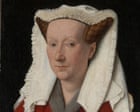
In a manner profoundly different from Ryman’s works, Van Eyck’s portraits pull you from our world into his. The precision of his physiognomies is dizzying. In his portrait of his wife, Margaret, recently conserved and on loan from Bruges, she regards you with a steady gaze, her lips firm and decisive. Between her cheek and ear is a blemish, a slight discolouring of the skin; her left eyebrow is bisected by a scar. Her headdress contains seven layers of frothing lace that you want to pinch between your thumb and finger. What must it have been like, to look back at this vision of yourself, in a world in which mirrors were luxury items (and mostly convex, like the one that famously hangs at the back of the Arnolfini portrait)?
We know it’s her, because a very detailed inscription in the painter’s hand on the original frame tells us that “my husband Jan completed me on 15 June 1439” and that “my age is 33 years”. By some stroke of painterly enchantment, is it Margaret herself addressing us? Or is the “me” the painting – a mere arrangement of oil paint on a panel of Baltic oak? The inscription concludes with the words “as I can” – Van Eyck’s motto, a phrase that hovers between extreme modesty and great boastfulness.
All the portraits have something of this uncanny hyper-realistic quality. The pockmark on the slightly shiny, reddish young skin. The lines around the eyes and crinkled cheeks of the old scholar in his red robe, and his ear, purplish with age. The scar between the eyes of the stubbled Baudouin de Lannoy, who worked alongside Van Eyck at the court of Philip the Good, the Burgundian ruler of the Low Countries. The individual hairs of a fur collar as they brush the skin of the neck; the intricate whorls of an ear. You feel that if these people reached out their beringed fingers and tugged you through the frame, you could walk about with them, in the streets of Ghent or Bruges of the 1430s.
Perhaps the most arresting of these faces is the portrait of Jan de Leeuw, who, like Margaret, gazes straight at the viewer. He has such a modern-seeming face that it’s hard to shake the impression that he might have sat beside you on the morning commute. Like Margaret, he has his original frame, around which Van Eyck has painted words that translate as: “Jan de Leeuw who, on Saint Ursula’s day, opened his eyes for the first time, 1401. Jan Van Eyck has counterfeited me. It can be seen when he began 1436.” Beautiful precision, all the more satisfying because the Van Leeuw in question can be found in Bruges’ city archives: from a family of goldsmiths, he was himself the inspector of the goldsmiths’ guild at the time of the portrait. Everything checks out: he’s holding a gold ring.
Except that it doesn’t. Like all the works in the exhibition, its apparent “truthfulness” turns out to be a trap, its mirror-like reality a game of illusion and deceit. “He counterfeited me” – the word is “gheconterfeit” – is such a strange word to use, especially of a man who assessed the quality of gold. In its 15th-century context, it was an ambiguous word, says show’s co-curator Nicholas Flory, also “used in documents to describe a true likeness or reliable copy of a real thing”.
But Van Eyck is also deeply unreliable. The painted words are a trompe l’oeil, convincing you they are inscribed in brass. The man’s name, which means “lion”, actually appears as a cute pictogram, as a little joke. To add to the confounding, certain letters of the inscription are made to look as if they are standing out in relief. If you take these and treat them as Roman numerals, they add up to the dates crucial for the painting: 1401 and 1436. In other words, the portrait, which at first seduces with its “reality”, turns out on second glance to be a highly artificial, self-conscious construct. The paint counterfeits metal for its goldsmith sitter, and sets puzzles for the viewer. The ring De Leeuw is holding is so terribly real – and also, so desperately fake.
The Arnolfini portrait is another example of apparent clarity melting swiftly away to complete bafflement. It is one of the best known works in the National Gallery, so familiar to British art lovers that it is possible to forget how strange it is. For centuries, this image of a man taking hold of a woman’s hand was known as the “Arnolfini marriage”, because it was assumed to commemorate an actual wedding ceremony. In the 1930s, Erwin Panofsky posited that every item in the busy domestic interior (the oranges, the wooden overshoes, the mirror, the dog, the burning candle and the guttering candle in the beautifully painted chandelier) was weighted with matrimonial symbolism.
But in truth, no one even knows for sure whether it represents members of the mercantile Arnolfini family (the identification was made based on 16th-century inventories in which the picture said to portray “Hernoul le fin” or “Arnoult Fin”, which were thought to be corruptions of the name Arnolfini). And more recently, many critics have pulled back to accept a more straightforwardly materialist interpretation of the scene: the oranges, the ridiculously voluminous green dress, the fine furnishings, are all markers of status, rather than symbolic as such.
As for the inscription – it reads: “Johannes de eyck fuit hic [was here] 1434”. Again, it seems so clear – but where on earth is “here”? Does it mean Van Eyck was witness to some actual event that he depicted? Or that he painted himself as one of those figures dimly visible in the convex mirror? Or that the main figure is actually a self-portrait, and that this pale man with the large hat and flared nostrils – also the subject of a second portrait in the show – is Van Eyck himself? The inscription breaks the fourth wall: it seems to be hovering on the picture plane itself. So is “here” the metaphysical “here” of the artist’s imagination?
There is one certain self-portrait of Van Eyck, and that, characteristically, is another trick. It is not in this exhibition, but rather in a religious work in the Groeningemuseum in Bruges, the Virgin and Child With Canon Joris Van der Paele. Van Eyck hid in his painting in a tiny image of himself – identifiable by his paintbrush – reflected in the metal shield of Saint George. The ageing canon has removed his spectacles, perhaps the better to appreciate the supernatural vision of the Virgin and child.
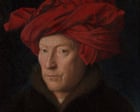
The National Gallery’s show opens with a work from its own collection that is frequently regarded as a self-portrait. The realist details are bewitching, intimate: the bloodshot red eyes, the fine lines around them, the stubbled cheeks, the exuberantly painted red hat. On its original frame is painted a signature (“Jan van Eyck made me on 21 October 1433”) along with the motto “as I can” – the position of which, where one would often find the name of the sitter, helps build the case that the work depicts the painter himself. Here, the writing appears to be deeply incised into the surface, playfully implying that the frame is of solid gold, rather than the gilt that it really is.
The more you crane and gaze at these paintings, admiring the wrinkles and the spots and the all-too human flesh, the more you trip up on Van Eyck’s tricksiness. The slippage between being fooled by the illusion and recognising that you are being fooled is part of the pleasure. The more you look, the more you feel you’re having a conversation with the painter – and that he is having the last laugh.
- van
- eyck
- portrait
- painting
- jan
- work
- portraits
- gallery