Why is Pete Hegseth strengthening US military ties with Venezuela?

Hegseth's new military deal with Venezuela raises questions about US influence, regional security and Maduro's removal.
Hegseth unveils new US-Venezuela military deal
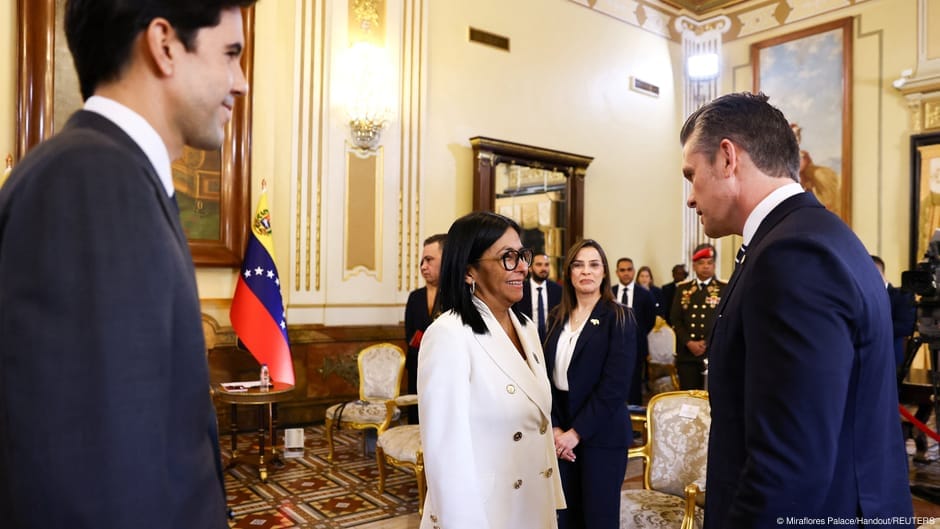
United States Defense Secretary Pete Hegseth has announced a new cooperation agreement with Venezuela’s interim government to facilitate military cooperation between the two countries.
The Pentagon chief’s announcement came during an unannounced visit to Caracas on Wednesday. The US says the agreement will help fight drug trafficking and improve security in the region. Venezuela says it will help strengthen its military without compromising its sovereignty.
But why is an agreement happening now, and what does each side stand to gain?
The US and Venezuela have agreed to strengthen military cooperation in several areas, including joint training, intelligence sharing, military equipment and border security.
Hegseth met Venezuela’s interim President Delcy Rodriguez and Defence Minister Gustavo Gonzalez Lopez in Caracas. He said the agreement would allow the two countries’ armed forces to work together to combat drug trafficking and armed groups operating in Venezuela.
Rodriguez described Hegseth’s visit as an extraordinary step in relations between the two countries.
She said renewed military cooperation would help improve troop training, modernise equipment and give armed forces access to new technologies.
Her government said the country’s armed forces, known as the Bolivarian National Armed Forces (FANB), would benefit directly from the agreement.
However, the full terms of the agreement have not been made public, including details of how the two countries would carry out joint military operations.
The Trump administration said closer military cooperation with Venezuela will help fight drug trafficking and armed groups, and improve security in the region.
Hegseth said the agreement should help Venezuela regain control of areas where armed groups and drug trafficking networks operate.
But political analyst Carlos Pina said the timing of the visit is important, particularly after the Democrats won the midterm elections in the US.
“I think many of the things happening between the United States and Venezuela are closely related to the November 3 election results,” Pina said.
He explained that the Democrats have already said they aim to increase scrutiny of US foreign policy towards Venezuela, including the agreements reached with Caracas during 2026, after US forces abducted then-President Nicolas Maduro and took him to New York. The US has since, in effect, taken control of Venezuela’s oil industry — the country has the world’s largest oil reserves.
Pina also pointed out the recent attempt to impeach Hegseth. “I think this Hegseth visit also falls within that framework, to get ahead of what will be the debate in the new US Congress.”
On November 10, the House of Representatives voted 211-204 against impeaching Hegseth for now, but Democrats could try again after January, with their new majority in the House.
The November resolution against Hegseth, introduced by Republican Thomas Massie, included eight articles of impeachment related to the US-Israel war on Iran, military strikes on suspected drug-trafficking boats and the January operation that ousted Maduro from power.
Massie said Hegseth ordered an act of war against Venezuela without congressional authorisation. He argued that the operation went beyond arresting Maduro on drug trafficking charges and was also intended to give Washington control over Venezuela’s oil reserves.
“Secretary Hegseth executed unlawful orders effecting the removal of the President of a sovereign nation, placed boots on the ground, conducted preparatory bombardments, inflicted substantial casualties, and subsequently caused regime change, each of which constitutes acts of war,” Massie said in the impeachment resolution.
Pina believes Hegseth’s visit is partly aimed at defending Trump’s policy in Venezuela before Democrats take control of Congress in January.
“Hegseth goes to Venezuela, which is probably one of Trump’s few foreign policy successes, to show the American public that the plan they are carrying out in Venezuela benefits US national interests,” he said.
Rodriguez and her government welcomed the agreement, saying it will help strengthen the country’s forces and improve its training and access to technology.
Venezuelan officials have also stressed that the cooperation must respect the country’s sovereignty and constitution.
But analysts say the agreement may also signal Rodriguez’s efforts to remain in power following Maduro’s ousting.
“The simple answer is that they want to remain in power as long as possible,” Phil Gunson, a senior analyst at the International Crisis Group, told Al Jazeera.
He said Rodriguez’s government faces considerable pressure from Washington. “If they decline to cooperate, they have been told they will suffer the same fate as Maduro, or worse.”
He also pointed to Washington’s financial leverage over Caracas.
“The US currently controls most of Venezuela’s foreign earnings, in the form of revenue from oil sales, and can cut off the funds whenever it wishes,” Gunson said.
Since Maduro’s ousting in January, revenue from Venezuelan oil sales has been deposited into US-controlled accounts, with Washington supervising the release of funds to Caracas.
According to a Department of State report released on November 12, more than $12bn from Venezuela’s oil and other natural resources passed through these accounts between January and September.
The US government said nearly 99 percent of the money had been disbursed mostly to individuals and businesses in Venezuela through commercial banks. But the agreement means Caracas depends on Washington to approve the release of money from these accounts, potentially giving the Trump administration tools to put pressure on Rodriguez’s government.
Pina described the Venezuelan government’s approach as “a calculation of survival”.
“They are capable of yielding in certain areas to the US government, as long as their hold on government is not affected or threatened,” he told Al Jazeera.
Pina also said Rodriguez was trying to buy time, particularly as Democrats prepare to take control of the US Congress in January.
“She gains time,” he said, suggesting that greater congressional scrutiny of Trump’s Venezuela policies could eventually give Caracas more room to negotiate.
One of the key questions, say analysts, is whether closer cooperation with Washington could lead to changes within Venezuela’s armed forces, many of whose senior officers served under Maduro.
Gunson said much would depend on Washington’s intentions.
“Will Washington seek to reform the security forces, whose leaders it has accused of drug trafficking, human rights abuses and collaboration with Colombian guerrillas and other armed groups?” he said.
He also explained Venezuela’s military is not in a position to resist US influence.
“In its current state, the military as an institution is not in a position to resist US influence, for good or ill,” he said.
But he explained that some senior officers could try to sabotage the process if they feared prosecution or losing their positions.
Separately, Venezuelan Defence Minister Gonzalez Lopez also issued his first statement since taking office.
He said the new relationship follows the “painful events of January 3”, when US forces removed Maduro from power.
Gonzalez Lopez said military cooperation with Washington would follow Venezuela’s constitution and respect the country’s “sovereignty, independence and territorial integrity”.
He also stressed that Venezuela’s armed forces would retain control over their own leadership, command and operations.
There is no clarity on the terms of the agreement.
But Pina said the agreement seems to focus on limited military cooperation, particularly operations against armed groups and drug trafficking networks along the Venezuela-Colombia border.
Pina said the two countries could carry out joint military operations, including air raids against armed groups operating in the area.
But he believes Venezuela’s military will be reluctant to give the US a much larger role.
“The Venezuelan armed forces are not going to concede beyond that,” he said.
Pina argued that Washington needs a stronger military presence in Venezuela if it wants to maintain its influence over the country’s political transition, particularly because armed forces remain under the governing party’s control.
The agreement could affect other countries, particularly neighbouring Colombia, which shares a long border with Venezuela.
Several Colombian armed groups operate on both sides of the border, including the National Liberation Army (ELN), which has been fighting the Colombian government for decades.
Pina said the joint military operations could weaken these groups and reduce their ability to operate across the border.
However, on Wednesday, The New York Times reported that Colombian President Abelardo de la Espriella had rejected a US proposal to allow joint military operations on its territory.
But De La Espriella denied the NYT report, saying Colombia wanted to strengthen military cooperation with Washington, although the presence of foreign troops would require congressional approval.
Hegseth also rejected the report, calling it “totally false”.
Gunson said Trump sees Venezuela as a major success and as a model for US relations with Latin America. But he said the results of the midterm elections could change how governments in the region respond to Washington.
“Governments in the region that seemed bound to fall into line with the US hemispheric security policy may start to think again,” Gunson said.
Pina also believes the agreement with Venezuela could raise concerns in other Latin American countries, including Mexico, about the possibility of US military operations on their territory.
“I think what happened with Nicolas Maduro marked a before and after in Donald Trump’s regional security policy,” Pina said.
He argued that the January operation showed Washington was prepared to use military force to pursue its interests, even when such actions could violate international law.
But Pina questioned whether the agreement represents a long-term change in US policy towards the region, or is primarily a political response to the recent attempt to impeach Hegseth.
- hegseth
- venezuela
- pete
- tie
- deal
- question
- influence
- security