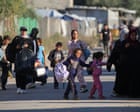
Gaza Syndrome: Why Israeli soldiers’ trauma erases Palestinian victims

Israeli soldiers describe the psychological toll of the genocide in Gaza, yet many express no remorse.
Cost of War: The trauma Israeli soldiers bring home from Gaza | Al Jazeera Originals
Editor’s note: This article contains references to suicide and graphic descriptions of combat.
If you or someone you know is at risk of suicide, support is available through international crisis helplines.
“I think our army is the most moral army in the world.”
Itay Sagi, a reservist in the Maglan unit, describes killing Hamas fighters inside Israel after October 7, 2023.
“I didn’t choose to kill people. I had to,” he says.
His grief is for his friends. Sagi wants to go back and fight. He does not mention the Palestinians killed in Gaza.
Boris Shtonda, who served with an Israeli special forces unit, lost a leg when an explosive device detonated inside a building in Gaza in November 2023, killing four of his friends.
“We lost our friends, we lost our families, we lost everything,” he says.
The Israeli soldiers in the film “Gaza Syndrome” speak of nightmares, panic, addiction and Israelis who died by suicide. They speak, too, of wanting to return to fight. In hours of testimony, the Palestinians of Gaza are almost entirely absent.
The overwhelming weight of Israel’s war has fallen on Palestinians in Gaza: their children, homes and hospitals. Israeli forces have killed at least 74,700 Palestinians, including more than 21,000 children, according to Al Jazeera reporting. In September 2025, an independent UN Commission of Inquiry concluded that Israeli authorities and security forces had committed genocide in Gaza. The soldiers in this film are part of those forces.
Guy Zaken, a military bulldozer driver, told an Israeli parliamentary committee that soldiers had to “run over “‘terrorists’, dead and alive, in the hundreds”. His co-driver, Eliran Mizrahi, spent 186 days in Gaza demolishing homes and died by suicide two days before he was due to return. “He got out of Gaza, but Gaza did not get out of him,” his mother told CNN.
The question is not whether the Israeli soldiers’ psychological injuries are real. It is what psychological injury means when it is joined to denial, impunity and the absence of remorse.
In The Wretched of the Earth, the mid-20th century psychiatrist and political philosopher Frantz Fanon observed that colonial violence inflicts severe psychiatric trauma on both the colonised and the perpetrators. When soldiers carry out systematic destruction and violence, the psychological toll cannot be separated from the political structure that enables and ignores it.
An Al Jazeera Investigative Unit examination of more than 2,500 Israeli soldiers’ social media accounts documented wanton destruction, abuse of detainees, and the use of Palestinian civilians as human shields.
The scale of the psychological crisis is growing. Nearly 30,000 Israeli soldiers and security personnel wounded since October 7 have entered the Defence Ministry’s rehabilitation system, the ministry said in October.
About 63 percent have psychological injuries, with thousands formally diagnosed with post-traumatic stress disorder (PTSD) and acute stress reactions following prolonged combat exposure. The Israeli army says 22 soldiers died by suicide in 2025, one more than in 2024, up from 17 in 2023. An Israeli parliament Research and Information Center report recorded 279 suicide attempts between January 2024 and July 2025. Combat soldiers accounted for 78 percent of the deaths by suicide in 2024.
Mohanad Mustafa, a scholar of Israeli society, told Al Jazeera Israel faces “a psychological crisis among thousands of soldiers, but no moral crisis”.
He says many soldiers feel no remorse for violations of international law. “This indicates a very significant moral decline in Israeli society.”
Israel’s public culture has helped make that denial possible. Oren Ziv, an Israeli journalist with +972 Magazine, says soldiers he interviewed described “an atmosphere of revenge, that everything is allowed”. They could shoot if they saw movement, he says, or if they were bored, and “nobody will investigate it”.
Daniel Bar-Tal, a political psychologist, says soldiers in Gaza still confront Palestinian suffering “to some extent”, even when they deny it or refuse to see it.
This suppressed awareness, he said, creates a quiet, internal fracture, a psychological burden that deepens precisely because the trauma cannot be fully acknowledged or resolved without confronting the suffering of those they harmed.
Ashira Darwish, a Palestinian trauma therapist and survivor of severe trauma and torture who created Active Meditation to heal from full-body paralysis, believes Israeli soldiers can enter Gaza, shoot children and burn homes only by suppressing their own humanity. She and other trauma experts emphasise that returning reservists undergo a severe psychological transition when re-entering civilian life after engaging in continuous combat.
“Someone who can exterminate an entire people while sitting there laughing will carry a psychological impact.”
Darwish describes reservists returning from Gaza to a hospital, office or school within a week or two. She warns of anger, substance addiction, domestic conflict, and sudden outbursts of violence as untreated combat trauma manifests in everyday interactions. “Where are they supposed to go with everything they have done?”
Israel’s Observatory on Femicide recorded 34 femicides in 2025, a 48 percent rise from 23 in 2024. Firearms were the most common weapon for the first time. Women’s groups warned early in the war that combat trauma and expanded access to guns could heighten the risk of domestic violence. There is no official data proving that returning soldiers caused the rise, and the Observatory found no link between licenced guns and femicide. The warning is about a society saturated with weapons, fear and impunity, not a claim that every soldier becomes violent at home.
In Qusra, a Palestinian village south of Nablus in the occupied West Bank, the film finds the other end of that impunity. Abdul Azim al-Wadi, a former head of the village council, says Israeli settlers killed his brother Ibrahim and nephew Ahmad, shot two of his sons and burned his son’s and daughter’s homes.
“The occupation army is the continuation of the settlers’ attacks,” he says. “They play the role together.”
Israeli settlements in the occupied West Bank are illegal under international law.
The same impunity is visible in Gaza. In NAZA, a documentary built on anonymous testimony from Israeli soldiers and intelligence personnel, sources describe civilian deaths factored into military decisions and targets watched inside their homes. The Israeli army called NAZA a “manipulative depiction of reality”.
In March, Israel dropped charges against five soldiers accused of sexually abusing a Palestinian detainee at the Sde Teiman detention facility.
A few do not accept the orders to serve in the army. Itamar Greenberg chose military prison over conscription. Iddo Elam said: “I do not want to hold a weapon towards innocent people.”
Their refusal matters because it shows the violence is not inevitable, and neither is the story Israel tells about it.
Bar-Tal offers his country a choice: “Cut the violence or cut the narrative.”
- gaza
- syndrome
- soldier
- trauma
- victim
- toll
- genocide
- remorse