Race to replant five South African baobabs after export blocked
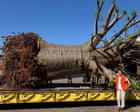
The trees, intended for an unnamed buyer in Georgia, were reportedly dug up without the necessary permits Environmentalists in South Africa are racing to replant five centuries-old baobabs after the 20-tonne trees were dug up by an exporter, who tried to ship them thousands of miles to Georgia. The baobabs arrived at a reserve in Timbavati, in north-eastern South Africa, on Wednesday, where they will be replanted and supported by cables to help them recover.
The trees, intended for an unnamed buyer in Georgia, were reportedly dug up without the necessary permits
Environmentalists in South Africa are racing to replant five centuries-old baobabs after the 20-tonne trees were dug up by an exporter, who tried to ship them thousands of miles to Georgia.
The baobabs arrived at a reserve in Timbavati, in north-eastern South Africa, on Wednesday, where they will be replanted and supported by cables to help them recover. The trees had been stranded at a warehouse in Durban since July, when they were intercepted by authorities who said they had been moved without the necessary permissions.
The department of forestry, fisheries and the environment confirmed the trees had been destined for Georgia but did not name the buyer.
The case echoes an episode in Kenya four years ago, when eight baobabs were uprooted to be exported to Shekvetili Dendrological Park, owned by Bidzina Ivanishvili, an influential Georgian billionaire and the country’s former prime minister. Ivanishvili has filled the park with ancient, giant trees from Georgia, transporting them by boat along the Black Sea.
The export of the Kenyan baobabs was initially blocked after an outcry by environmentalists, who condemned their export as biopiracy, but later allowed to go ahead.
Otherwise, such exports are very rare, say experts. David Newton, programme office director for east and southern Africa for Traffic, an NGO that monitors the trade in wild animals and plants, said: “It is very unusual to see baobabs being used as ornamental plants … mainly because they are exceptionally difficult to dig out of the ground and transport, and then to successfully re-establish.”
Sarah Venter, founder of the Baobab Foundation, who has led efforts to replant the South African trees, said she believes they have a good chance of surviving if they are replanted quickly. The winter months of May to October, when the trees lose their leaves and are dormant, is a good time to move them.
“As soon as spring starts [in November], the trees use their water to flush their new leaves, and that’s when we need to get them into the ground as soon as possible,” she said.
The rescue mission has faced delays because of the challenges associated with moving such large trees, which are transported on special trucks capable of carrying abnormal loads. The five baobabs weigh between 19 and 29 tonnes, have a diameter of up to 4.5 metres (15ft) and a height of up to 12.5 metres.
Baobabs, known as the tree of life, are protected under South African law, which means a permit is required to cut or disturb them.
“A baobab isn’t just part of an ecosystem, it is an ecosystem in itself,” said Wambui Ippolito, a landscape designer, lecturer and horticulturist from Kenya. “These trees are biodiversity anchors.”
Animals ranging from bats and bush babies, to grey-headed parrots and the southern ground hornbill shelter in its cavities, while elephants, monkeys and warthogs feast on its fruit.
The trees have huge cultural importance, added Ippolito. “It has always been a sacred tree in Africa. It doesn’t matter where you go: Senegal, Mali, Ghana – wherever you go, if there is a community around a baobab tree, that tree is sacred,” she said. “Somebody’s great-great-great-great-great-grandparents sat under that tree, and it is part of human history in that area.”
Baobabs have shallow roots, which means they do not need to be planted very deeply, and these regrow fairly quickly, said Venter. Once replanted, the trees will be stabilised with cables and protected by electric fences to prevent damage from elephants.
The trees are thought to be between 200 and 300 years old. “Baobabs easily reach 1,000 years old, so they’ve got a few hundred years ahead of them if they survive,” said Venter.
A criminal case has been opened against the owner of a landscaping company allegedly responsible for the illegal harvesting and transportation of the trees.
Find more age of extinction coverage here, and follow the biodiversity reporters Rebecca Ratcliffe, Phoebe Weston and Patrick Greenfield in the Guardian app for more nature coverage.
- south
- baobab
- tree
- race
- export
- georgia
- africa
- buyer