Sudan: War crimes perpetrators roam freely as massacres intensify
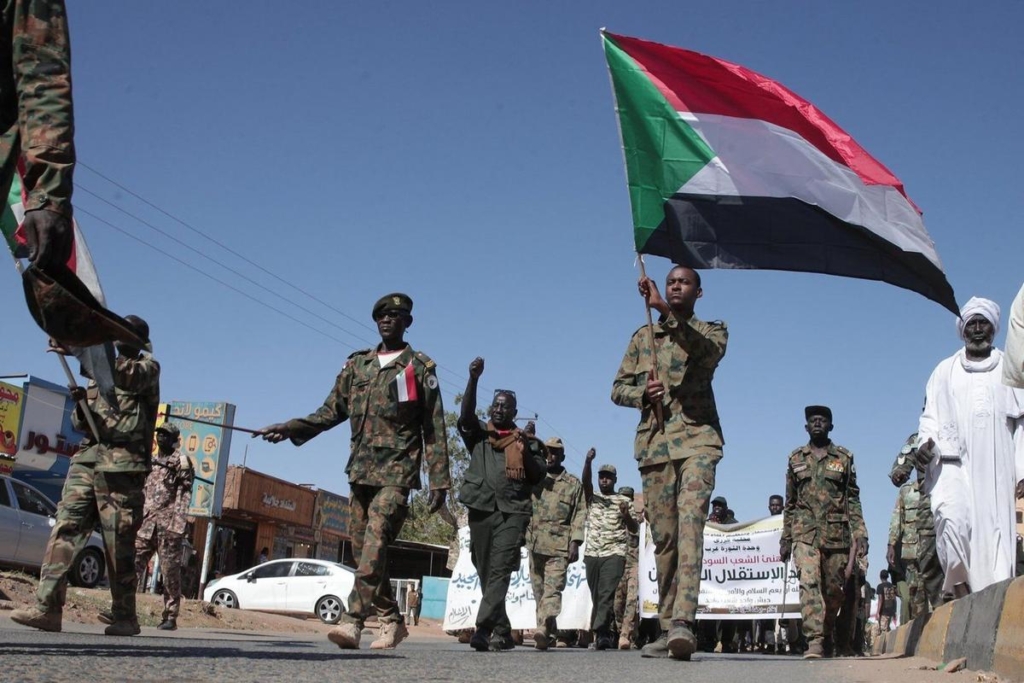
The appearance of Ahmed Haroun, Sudan’s former minister and an Islamist figure under former President Omar al-Bashir, speaking about politics and the war from areas under army control, sparked widespread public anger. Awatif al-Jaali, a member of Haroun’s defence team, told Asharq Al-Awsat that she ruled out the possibility that his detention was linked to arrangements for his transfer to the International Criminal Court, which is seeking him over accusations of committing war crimes in the Darfur region during the Bashir era.
Violations are escalating in Sudan’s war, which has been raging since mid-April 2023 between the army and the Sudan Founding Alliance (Tasis), and has triggered one of the world’s largest humanitarian crises.
A report by the Office of the United Nations High Commissioner for Human Rights documented an escalation in violations against civilians in Sudan during the first half of 2026, with drones emerging as the deadliest weapon. It recorded the deaths of at least 1,390 civilians between January and June, warning that the actual toll was higher due to difficulties accessing conflict zones and the inability to verify all casualties.
According to the report, 1,254 civilians were killed during military operations, while another 136 died in unlawful killings, including field executions and arbitrary killings. Kordofan was the hardest-hit region, recording 905 deaths.
Among the most significant incidents cited in the report was the bombing of Al-Daein Teaching Hospital in East Darfur on March 20, which killed 64 civilians and injured 89 others, including healthcare workers. Local and rights organisations attributed the massacre to the air force operating under the Port Sudan authorities.
Coinciding with the release of the report, 15 civilians were killed, including four children playing football, in an airstrike by the Sudanese army targeting the village of Abu Qalb in Abu Zabad locality, West Kordofan State. The latest incident reflects the expanding use by the Sudanese army of drones and airstrikes in populated areas, and the mounting toll on civilians.
In a statement, the Kordofan Observatory said an army drone struck a football pitch inside the village on Sunday afternoon, killing four children before the bombardment extended to civilian homes, some of which were completely burned down, killing several residents.
The attack also left others injured, killed livestock, and destroyed property and livelihoods. The bombardment extended to the nearby area of Jarr al-Asal, close to Abu Qalb, although no casualties were reported there. Meanwhile, the city of Ghubeish was subjected to a series of drone-launched missile strikes, according to the observatory.
As the war in Sudan continues, unarmed and innocent civilians face death not only from drone strikes, sniper fire and artillery shells, but also from toxic gases that suffocate and extinguish life.
Despite these crimes, documented by local and rights organisations, the Sudanese army refuses to open investigations or hand over those involved, because its commanders are themselves deeply implicated in these crimes.
The appearance of Ahmed Haroun, Sudan’s former minister and an Islamist figure under former President Omar al-Bashir, speaking about politics and the war from areas under army control, sparked widespread public anger.
In April 2007, the International Criminal Court (ICC) issued an arrest warrant against him, charging him with 42 counts: more than 20 war crimes and 20 crimes against humanity. The Court says he was responsible for attacks carried out between 2003 and 2004 against civilian villages whose residents were killed and raped by government-affiliated militias allegedly operating under his supervision.
In the latest development, a rights organisation reported the arrest of an activist in Blue Nile State following his calls for Haroun to be handed over to the International Criminal Court, according to the German Press Agency. The report raised numerous questions.
Awatif al-Jaali, a member of Haroun’s defence team, told Asharq Al-Awsat that she ruled out the possibility that his detention was linked to arrangements for his transfer to the International Criminal Court, which is seeking him over accusations of committing war crimes in the Darfur region during the Bashir era.
Al-Jaali said her client was arrested while travelling from the eastern Sudanese city of Kassala to the capital, Khartoum, by a security agency whose identity remains unknown. She stressed that the defence team had no information about his place of detention or the circumstances surrounding his arrest.
She added that the defence team intended to submit a request to the judicial authorities to allow its lawyers to meet their client and establish the reasons for his detention and the identity of the body that ordered it, before determining the next legal steps. She noted that the defence team includes lawyers from inside and outside Sudan.
As reports of his arrest gained traction, Massad Boulos, the US president’s senior adviser for African and Arab affairs, said the United States had “taken note of the arrest of Ahmed Haroun, the former state minister at Sudan’s Ministry of Interior and one of the prominent leaders of the Islamist-oriented National Congress Party, which previously held power.”
The United States imposed sanctions on Haroun over his role in committing grave violations against Sudanese civilians. It stressed the need to confront the role of violent extremist networks and groups linked to the Muslim Brotherhood in fuelling the conflict, while underscoring the importance of holding all those involved in perpetuating violence in Sudan accountable, according to Boulos.
The head of the Umma Party accused the announcement of the arrest of Ahmed Haroun, a leader of the National Congress Party and the Islamic Movement, of being nothing more than a political attempt to contain international and regional pressure. He questioned the Sudanese authorities’ seriousness about detaining Haroun and handing him over to the International Criminal Court.
The Umma Party leader said Haroun’s recent statements had been marked by a high degree of confidence and clarity, reflecting, in his assessment, the existence of a political and military partnership between Islamists and Sudanese army commander Abdel Fattah al-Burhan, both in the exercise of power and in the course of the ongoing war.
He added that Haroun’s remarks were not merely passing political positions, but contained indications of the nature of the relationship between the army leadership and the Islamist current, as well as what he described as overlapping interests between the two sides in managing the political and military landscape since the outbreak of the war.
What happened with Haroun also applies to Naji Abdullah, a leader of Sudan’s Islamic Movement, who announced last March his support for Iran in its war against the United States and Israel.
He threatened to send Sudanese Islamist battalions to fight alongside Iran in the event of a ground intervention. He also declared that they did not recognise the United Nations, the Security Council or regional organisations, and disclosed that they possessed advanced generations of drones. His remarks triggered widespread anger across Sudanese circles, prompting the Port Sudan authorities to publicise his arrest over those statements.
The armed forces disavowed Naji Abdullah and the group that appeared with him in the video. In a press statement, they said the group seen in circulating footage wearing military uniforms and chanting in support of the Gulf war did not belong to the armed forces, and threatened to take legal action against its members.
However, Abdullah appeared again in the Bao area of Blue Nile State, showcasing Islamist battalions participating in the fighting, foremost among them the al-Baraa bin Malik Brigade, which the United States has designated as a terrorist organisation and against which several European countries have imposed various sanctions.
Naji Abdullah spoke of receiving reports from Sudanese security agencies and issued threats against Ethiopia, suggesting that the Islamic Movement could target Sudan’s neighbouring country. He also portrayed the war in Sudan as a confrontation with the United States, Israel and the Jews.
This development reinforces the view that his purported arrest was merely a staged performance, and that the same may apply to Haroun.
- sudan
- war
- civilian
- crime
- army
- report
- drone
- court


