Spuds in space: scientists say potatoes could be key food source for future moon base
New report details how potatoes were successfully cultivated in simulated lunar soil The humble potato could be the key to sustaining human life on the moon, according to a new scientific report asserting that prolonged lunar exploration will depend on life support systems capable of producing food there. Potatoes are an ideal candidate for farming on the moon, scientists on a project backed by the US space agency Nasa concluded, after they succeeded in growing them in simulated lunar soil.
New report details how potatoes were successfully cultivated in simulated lunar soil
The humble potato could be the key to sustaining human life on the moon, according to a new scientific report asserting that prolonged lunar exploration will depend on life support systems capable of producing food there.
Potatoes are an ideal candidate for farming on the moon, scientists on a project backed by the US space agency Nasa concluded, after they succeeded in growing them in simulated lunar soil.
The authors of the resulting US study produced a report titled “Growth and molecular responses of potato to lunar regolith simulants”, published in the journal npj Microgravity, with regolith referring to the kind of blanket of loose stones and dust covering solid rock that is found on the surface of the moon, Mars, asteroids and parts of Earth.
“Potatoes provide more calories per land area than many other crops,” said Oregon State University plant biologist Aymeric Goyer, who led the study. “They are nutritious – they provide more potassium than a banana, are rich in vitamin C, have good proteins – and they have a high satiety index.”
The experiment envisions lunar greenhouses in the future. The scientists were able to grow viable potatoes that are safe to eat, emphasizing that “it is essential to ensure that the food produced is edible”.
The researchers used “lunar regolith simulants”, or engineered, Earth-based materials to replicate the properties of moon dust and soil, adding varying levels of vermicompost, an organic soil amendment made when composting worms – typically red wigglers (Eisenia fetida) – break down food scraps and organic waste, to conduct the experiments.
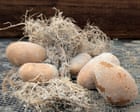
The study involved the modoc potato, an early-maturing cultivar with reddish skin and white flesh. The report comes as both the US and China have announced plans to establish long-term or permanent bases near the lunar south pole. Nasa hopes to return astronauts to the moon’s surface in 2028, while China aims for the same before 2030. Long-term bases may follow and probably could not be supplied with all its food needs from the Earth alone.
Goyer said that lunar regolith of dust and rock “does not contain any nitrogen, so no crop would grow without supplementing it”, and potatoes planted in lunar material without vermicompost produced almost no roots or tubers.
Potatoes grown with as little as 5% vermicompost, however, grew some roots and tubers. But at 30% vermicompost, the yield was identical to potatoes grown under the same conditions in the Earth’s soil.
Goyer acknowledged that researchers had tested but had not yet tasted the sample potatoes, which were grown in small pots and yielded potatoes of less than a third of an ounce (10 grams), even in Earth soil. “We used what we harvested for lab analyses,” he said.
A second study, he said, used larger pots in which researchers “obtained potatoes of size you typically see at the store”.
A 2017 study at the International Potato Center in Peru, where potatoes originated as a tuber native to the Andes, concluded that the plant could sprout on Mars. The study used a potato tube in a container that mimics Martian temperatures and atmospheric conditions.
Earlier this year, Nasa astronaut Don Pettit showed off a potato named “Spudnik” he had grown in the bottom half of a plastic containment bag in space. In the microgravity environment of the International Space Station, Space.com noted, the purple potato’s sprouts grew straight up into the air.
“In the weightlessness of orbit, roots generally head towards moisture but sometimes they get confused and grow ‘upwards’,” Pettit wrote. The astronaut acknowledged a debt to the feature film The Martian in which a marooned astronaut played by Matt Damon figures out a way to grow and live off potatoes.
The latest study noted that lunar regolith alone is hostile to crops due to its heavy metal content.
“Without organic matter, potatoes take up too much heavy metals, which can become toxic for the plants. Organic matter helps make heavy metals less available to the plants, so plants do not over-accumulate them,” Goyer said.
But potatoes are not the only contender for a crop that can can be grown on the moon. A study published in March documented chickpeas grown in lunar regolith supplemented with vermicompost.
“People are also working with tomatoes, lettuce and legumes like alfalfa,” Goyer said.
Oregon State space biologist and study co-author David Handy said what can be grown on the moon could also benefit life on Earth.
“The technologies that are invented as a result can be used to produce food in regions of low agricultural output that are reliant on shipments, such as inner cities and desert communities,” Handy said, adding that continued research using lunar-type soil “will lead to techniques that can be used to improve soil quality, as well as remediate contaminated soils to improve sustainable agriculture here”.
Reuters and the Associated Press contributed reporting
- moon
- space
- potato
- food
- scientist
- source
- base
- report