New Ukraine talks including Europe to be held 'soon' — Merz
Germany's Chancellor Friedrich Merz says European leaders could take part in fresh Ukraine talks on "neutral ground." The UK and EU countries have urged a seat at the table in meetings between the US, Russia and Ukraine.
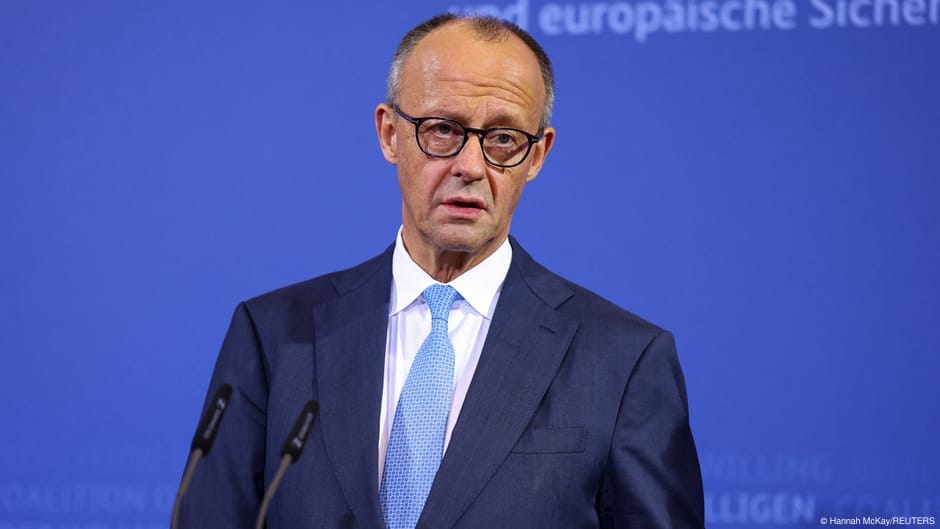
German Chancellor Friedrich Merz said on Friday he believes new talks regarding Russia's invasion of Ukraine with European leaders taking part will occur "soon."
"Of course we are prepared to hold talks with Russia, we have always said this. These talks are now set to take place soon," Merz said after a meeting of Ukraine's allies in Berlin. He did not give a concrete date for the next talks, but said Europe's interests would be represented by Germany, France, the UK, Poland and Italy.
Ukrainian President Volodymyr Zelenskyy was present at the Coalition of the Willing summit in the German capital, along with British Prime Minister Andy Burnham, French President Emmanuel Macron, US President Donald Trump's son-in-law Jared Kushner and US Special Envoy Steve Witkoff.
Merz said the talks including Europe would take place on "neutral ground," such as the United Arab Emirates.
Merz along with other European leaders have been critical of meetings between US, Ukrainian and Russian representatives regarding the conflict, arguing that Europe needs a direct seat at the negotiating table.
Russia's invasion of Ukraine began in February 2022, with the Trump administration prioritizing an end to the war.
Trump took part in a bilateral meeting with Russian President Vladimir Putin in Shenzhen, China on Friday, with Trump saying the two leaders would discuss the war in closed-door talks. Putin acknowledged that Europeans want a seat at the table, and said Russia invited European leaders to Moscow.
"We understand that discussing issues linked to security in Europe is pointless without Europeans," Putin said, while rejecting any military cooperation between Europe and Ukraine.
Trump also took part in a historic trilateral meeting with Putin and Chinese President Xi Jinping.
The Trump-Putin-Xi meeting raised fears that the US, Russia and China are looking to carve up the world into spheres of influence. It drew comparisons with the February 1945 Yalta Conference, where US President Franklin D. Roosevelt, UK Prime Minister Winston Churchill and Soviet Union leader Joseph Stalin discussed Europe's future as Nazi Germany's defeat was imminent in World War II.
Following the Trump-Xi-Putin summit, Merz said a "Yalta format cannot bring peace" to Ukraine. He downplayed the Shenzhen summit between the three leaders as a "photo opportunity."
Merz handed out pieces of the Berlin Wall to leaders at the Coalition of the Willing summit, saying the Yalta structure had brought "oppression, insecurity and a lack of peace."
"This is exactly what Yalta stood for," Merz said.
The Yalta format sought to divide post-war Germany into four zones: US, UK, France and the USSR. This later led to the construction of the Berlin Wall dividing the city into West and East Berlin, with city residents attempting to cross the barrier shot dead by border guards.
- ukraine
- merz
- talk
- europe
- germany
- chancellor
- friedrich
- leader