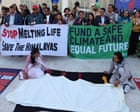
COP31: Expert calls for united African front in climate negotiations

Hannington Owegi, secretary-general of the Participatory Ecological Land Use Management (PELUM) Association Regional Secretariat, said African countries were struggling to translate their shared climate concerns into a sufficiently coordinated negotiating position
Hannington Owegi, secretary-general of the Participatory Ecological Land Use Management (PELUM) Association Regional Secretariat
An African development expert has warned that competing national interests and inadequate coordination among African countries could weaken the continent’s influence in global climate negotiations, particularly its push for climate finance and a fair transition away from fossil fuels.
Hannington Owegi, secretary-general of the Participatory Ecological Land Use Management (PELUM) Association Regional Secretariat, said African countries were struggling to translate their shared climate concerns into a sufficiently coordinated negotiating position.
In an interview with PREMIUM TIMES at the ongoing 31st United Nations Climate Change Conference (COP31) in Antalya, Türkiye, Mr Owegi said differences in countries’ economic and energy priorities should not prevent them from identifying common interests and negotiating collectively.
“We tend to think that African diversity is a weakness. It is not. But within the African continent, we are fragmented. The negotiations are fragmented. We don’t seem to be agreeing,” he said.
He added that civil society organisations advocating climate action were also fragmented, making it difficult to build the collective pressure needed to influence negotiations.
African countries have repeatedly called for a just and equitable energy transition that recognises their development needs, including access to affordable electricity, industrialisation, employment and poverty reduction.
However, the continent’s energy and economic circumstances vary considerably.
Countries such as Nigeria, Angola and Mozambique have significant oil and gas interests, while others have different levels of dependence on fossil fuels and varying capacities to develop renewable energy.
For countries with substantial petroleum resources, moving away from fossil fuels raises questions about government revenue, foreign investment, employment and the future of their energy industries.
At the same time, many African countries face limited electricity access, high energy costs and inadequate infrastructure, making the choice of energy pathways a major development concern.
These differences complicate discussions about how quickly countries should move away from fossil fuels and what support they would require to do so.
Mr Owegi said competing priorities were weakening Africa’s negotiating strength, but noted that countries could still agree on common demands even where their national circumstances differed.
“Different priorities should not break us, but rather unite us,” he said.
He identified climate finance, agricultural production and productivity as areas around which African countries could develop a common negotiating strategy.
Mr Owegi, however, said he could not speak specifically to the motivations or negotiating priorities of individual oil-producing countries because his organisation did not work directly in those countries.
Instead, he suggested that regional economic communities should play a stronger role in helping countries coordinate their interests before international negotiations.
He said countries could first agree on shared priorities within their respective regional blocs and use those positions to develop a stronger continental approach.
Despite the differences in national circumstances, African countries have an established negotiating structure through the African Group of Negotiators (AGN), which coordinates the continent’s positions in United Nations climate negotiations.
Ahead of COP31, the group developed an action matrix outlining priorities and responsibilities across areas including adaptation, climate finance, agriculture and just transition.
The group’s priorities reflect the continent’s longstanding argument that its development needs must be considered in global climate decisions, particularly because it contributes relatively little to greenhouse gas emissions but faces significant consequences from rising temperatures.
According to the United Nations Economic Commission for Africa (ECA), the continent contributes less than four per cent of global greenhouse gas emissions but faces some of the heaviest climate impacts.
The commission estimates that Africa needs about $277 billion annually to implement its climate plans, but only about 11 per cent of that amount is currently met. It also says that just $3 to $4 out of every $100 in global climate finance reaches the continent.
These funding gaps have made climate finance one of Africa’s most important negotiating priorities.
At COP31, the AGN has continued to call for adequate, predictable and accessible funding, particularly grant-based and highly concessional finance, to support adaptation and the implementation of countries’ climate commitments.
On 18 November, the group’s chair, Antwi-Boasiako Amoah, reiterated that climate finance, adaptation and a fair, adequately financed just transition remained central to Africa’s negotiating demands.
The group has also argued that transition pathways must reflect the different development circumstances of African countries and should not compromise their legitimate aspirations for energy access and industrialisation.
However, Mr Owegi believes that agreeing on common priorities is only part of the challenge; African countries must also coordinate their approaches well enough to influence the outcome of negotiations.
Mr Owegi also said Africa should approach the energy transition as a broader development process rather than a discussion focused exclusively on replacing fossil fuels with renewable energy.
He added that the transition should include changes in agricultural production, food systems and infrastructure, particularly because these sectors are closely connected to livelihoods and economic development across the continent.
“Energy transition should not be looked at from one pillar of fossil fuel,” he said.
He argued that treating energy, agriculture and infrastructure as separate issues could undermine efforts to achieve a transition that addresses the needs of African communities.
For him, a fair transition should consider how countries can improve agricultural productivity, expand access to electricity, develop infrastructure and create economic opportunities while responding to climate change.
The International Energy Agency (IEA) has identified energy access, investment in clean energy infrastructure and the development of local energy industries as important considerations for Africa’s transition.
Mr Owegi said African countries should continue pressing for a just transition but move beyond repeated discussions towards concrete agreements and implementation.
He noted that the concept had featured in international climate discussions for decades, yet countries were still struggling to agree on how to translate it into action.
- climate
- expert
- negotiation
- hannington
- owegi
- secretary
- participatory
- ecological