Better educated than ever – yet Germany's Gen Z is being shut out of its own future
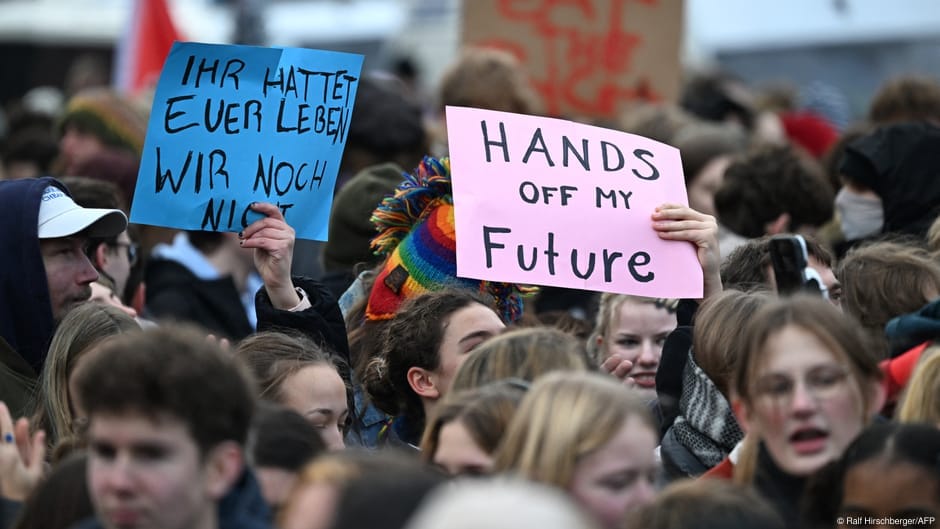
Never before have young people faced so many challenges. Young Germans are asking: Will I be better off later in life than my parents are now?
It is becoming increasingly difficult for young people in Germany to find a job after finishing professional training or university. And finding an affordable place to live in a big city and finally starting to live independently is nearly impossible.
Nor do young people feel that politicians are finally taking action on issues that matter to them, such as climate protection. The climate conference in Antalya, Turkey, is a case in point. It therefore shouldn't be a surprise that young people across Europe are taking to the streets this Friday to make their voices heard. In Germany, Gen Z protests took place in 73 cities, coinciding with World Children's Day.
What particularly infuriates young people is being talked about rather than spoken to. Equally infuriating is seeing their protests branded as criminal before they have even begun, all because of the actions of a small minority.
One example from the political realm was when the youth wing of the conservative Christian Democratic Union/Christian Social Union (CDU/CSU) party in Berlin-Mitte suggested deploying the German army against demonstrations.
It can also be seen in the media, such as when Bild, Germany's highest-circulation tabloid, ran the headline: "Young, male, known to the police — who rioted after the demonstrations and where chaos threatens today."
"Young people are taking to the streets because they feel they are not being heard. And, of course, that feeling is strongly reinforced when the press devotes no more than a brief paragraph to their demands while focusing the rest of its coverage on how these protests could become problematic," says Erik Sczygiol, who until recently was deputy secretary-general of the Federal Conference of Student Representatives. "Of course, any potential security concerns need to be addressed, but they should not overshadow media coverage of the protests," he argues.
However, eighteen-year-old Erik Sczygiol is an exception. He was invited to participate in the launch of the World Population Report in Bonn alongside representatives of the United Nations Population Fund (UNFPA) and the German Foundation for World Population (DSW).This year's report is particularly noteworthy because it focuses on Gen Z. The report is titled "Succeeding Generations: Empowering young people to chart the future."
The United Nations surveyed 109,000 people across 73 countries. Some of the findings are encouraging. Young people worldwide are better educated than any generation before them. Today, 78% of adolescents complete at least upper-secondary education. Yet finding a job is becoming increasingly difficult, while informal employment is on the rise across the globe.
This economic uncertainty has far-reaching consequences for young people. According to the report, financial independence is often not achieved until one's mid-to-late twenties, and a stable partnership and parenthood are often not realities until one's early-to-mid thirties.
Nor do young people have a seat at the political decision-making table when it comes to shaping future reforms in the labor market, housing or climate protection. Florian Brod, 25, points out: "Almost half of the world's population is under 30, yet only 2.6% of parliamentarians worldwide are under 30."
Young people need and want change to protect their livelihoods and those of future generations. "Yet those who will have to live longest with the consequences of today's decisions are precisely the ones who have hardly any representation in the political decision-making process," says Brod.
At least Brod is somewhat closer to the political decision-making process. He has served as a Youth Delegate for Sustainable Development for almost two years. In this role, he represents the interests of young people in Germany at United Nations conferences. This is certainly an important step towards giving his generation a greater say in political processes.
Nevertheless, both Florian Brod and Erik Sczygiol, who represents students, have had similar experiences. They often participate in conferences and panel discussions and are invited to submit their opinions, but these invitations often amount to little more than symbolic gestures.
"Having access to an international conference is a first step. But without substantive briefings ahead of the conference, without involvement in preliminary negotiations and, in some cases, without access to negotiation texts, there is little opportunity for us to help shape the outcome. When young people see their demands making little headway politically while they are simultaneously excluded from the search for solutions, frustration inevitably builds," says Brod.
Sczygiol adds: "We often get the feeling at the Federal Youth Conference that we were invited simply to provide a nice photo opportunity. We may be sitting at the table, but often only once a bill has already gone through 17 different drafts and is just days away from its final vote in the Bundestag. By that stage, young people have virtually no say in changing anything, and their voices are barely heard. Their contributions are often simply dismissed with: 'Well, that's just typical youthful nonsense.' And that is something that really frustrates young people."
Medical student Amélie Belosevic knows that feeling all too well. She served as Germany's Youth Delegate at the World Health Assembly in Geneva this May. Twenty-five countries sent youth representatives, which Belosevic sees as a clear step forward. However, she has one criticism. According to the United Nations Population Fund, 90% of the world's 1.8 billion young people live in the Global South. Yet, the region was represented by only eight delegates. As a result, Africa, Latin America and large parts of Asia were left virtually voiceless.
Her demands for Germany include better job prospects for young people entering the workforce and sustainable pension systems 40 years from now. "For a very long time, people have said, 'I believe my children will have a better life than I do.' But that is no longer necessarily true. So it makes sense then that those who feel the greatest anxiety about the future are the people who have most of their life ahead of them. Sometimes, people don't understand that. We, young people, need to be able to believe in our future again!"
- gen
- future
- germany
- people
- challenge
- young
- germans
- life