politics

Xi, Putin and Trump walked into a room and one walked out the biggest winner

Xi, Putin and Trump walked into a room and one walked out the biggest winner

Donald Trump, Xi Jinping and Vladimir Putin's "declaration of peace" is less about world peace than the peace of mind of powerful men.

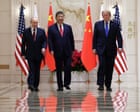
The image of Donald Trump, Xi Jinping and Vladimir Putin seated together, talking for the very first time, is a monumental moment in history.

But the striking photo is likely to be the only lasting impression from the powerful trio's trilateral meeting in China.

The outcomes, or lack thereof, will become a footnote on a history page, instead of the main event.

The presidents of America, China and Russia came into the trilateral summit with very different motivations and, even before the meeting, the expectations of a major diplomatic breakthrough were low.

But three consequential global topics had been placed on the agenda: nuclear disarmament, the war in Ukraine, and the war in Iran.

With some of the world's most powerful and influential men coming together, and the world watching closely, there was always a chance for a surprise outcome.

After 90 minutes behind closed doors the leaders went their separate ways and released a joint "declaration of peace" statement, outlining their shared talking points.

The contents of the communique may have caught some off guard, with its pledge to reform the United Nations, its critique of the International Criminal Court, and an agreement that nuclear war must never be fought.

But the brief note was in fact a (very) short list of the few things the leaders could actually agree on, revealing just how far apart they still are on so many critical issues.

What good is a declaration of peace, with no plan to achieve it?

Even on the issue of nuclear non-proliferation, the three couldn't agree to future talks.

Mr Trump himself conceded that a mutual agreement to limit nuclear weapons would be hard to achieve in the future.

Finding a resolution to the deadly and intractable conflicts in Ukraine and Iran also remained untouched by the trio, which, to some people, might seem like a good place to start when trying to map out a "declaration of peace".

So, what was the point of the meeting and how could the three leaders possibly be hailing it such a success?

It was, in fact, an optics bonanza that allowed each president to emerge with a personal victory, without giving any concessions.

Mr Trump was lavished with the attention and praise he relishes, particularly after his crushing domestic defeat in the midterm elections.

The US leader got to stand side by side with the strongmen he openly admires on his path to building a foreign policy legacy. He even declared at the start of the meeting: "We're making history."

The summit was also a diplomatic coup for China's President Xi Jinping.

As the organiser and mediator making that history happen, the symbolic event furthered Mr Xi's ambitions to be seen as a diplomatic powerbroker.

Beijing would be celebrating the smooth conclusion of the summit as evidence of Mr Xi's growing influence, as the only person who could bring these three countries together, all without getting pressure on a sensitive issue such as Taiwan.

But perhaps the biggest winner out of the meeting was Vladimir Putin.

The Russian president, who is subject to an International Criminal Court (ICC) arrest warrant over alleged war crimes, has been ostracised from the world stage and become a global pariah since his invasion of Ukraine.

Now, he has been invited back to the top table of global politics, in a very public way, and given equal stature with two superpowers.

Mr Trump even praised Mr Putin and called him "my friend", later telling Europe it could save money and lives by ending the war with Russia, according to Politico.

The Russian leader's influence can also clearly be seen in the "declaration of peace" action points, which largely align with Mr Putin's priorities and push back against institutions that have been critical of him, such as the ICC.

All of this, without the autocrat making any compromises on the war in Ukraine.

It's no wonder Mr Putin was reportedly in a "brilliant mood", according to a Kremlin aide, when asked about the meeting.

The irony of Putin preaching about peace, when the war in Ukraine continues to kill record numbers of civilians, is perhaps one of the only real concrete outcomes of this whole event.

  • putin
  • trump
  • peace
  • room
  • winner
  • donald
  • jinping
  • vladimir

Summaries and tags are generated automatically. Stay informed with VidiaNews.

Related news

Friend zone: humiliated by US voters, Trump basks in company of autocrats
politics

Friend zone: humiliated by US voters, Trump basks in company of autocrats

The US president rated his summit with Xi Jinping and Vladimir Putin as 12 out of 10 but China and Russia had the most to celebrate He got by with a little help from his friends. The US president, reduced to lame-duck status at home by a humiliating midterm election defeat, returned to the global stage in a meeting with two strongmen in Shenzhen, China, that critics described as a new low for America’s claim to moral authority.

Read →
‘I agree with the president’: incoming senator Abdul El-Sayed seeks to help Trump end military aid to Israel
politics

‘I agree with the president’: incoming senator Abdul El-Sayed seeks to help Trump end military aid to Israel

Michigan senator-elect also secured a meeting with JD Vance, who called him a ‘terrible evil’ in lead-up to election The incoming US senator Abdul El-Sayed of Michigan said that he and Donald Trump are in agreement about ending foreign military aid to Israel – and he hopes to find more common ground with the US president when he takes office. “I agree with the president – I can’t believe I’m saying that – that we need to end foreign military aid that is unconditional to Israel, as well as Egypt and Saudi Arabia and Pakistan,” the senator-elect said.

Read →
Trump says no rush on Iran decision, looks to next year
politics

Trump says no rush on Iran decision, looks to next year

US President Donald Trump on Thursday appeared to push a decision ​on renewed major strikes against Iran into next year, extending a timeline that he had previously suggested could come to a ‌head after this month’s US midterm elections. DOWNPLAYS BOMB THREAT Trump, on Fox ​News, was also asked about a ​report carried by CNN this week that ⁠Iran was planning to detonate a “dirty bomb” in Washington.

Read →
Judge orders US agriculture chief to stop sending religious emails from official account
politics

Judge orders US agriculture chief to stop sending religious emails from official account

A US judge ordered Agriculture Secretary Brooke ​Rollins to stop sending religious emails to employees from her official account, saying Rollins “must ‌recognise” boundaries when communicating religious messages and that some of her word choices assumed that email recipients subscribed to her Christian beliefs. Pentagon chief Pete Hegseth has made talking about his Christian faith a part of his daily life at the Pentagon while religious and political experts say Trump has used Christian rhetoric to rally core supporters behind ​the unpopular US-Israeli war on Iran.

Read →
White House national cyber director Cairncross leaving his post
politics

White House national cyber director Cairncross leaving his post

White House national cyber director Sean Cairncross is leaving his post, a White House official ‌said Thursday, marking the latest departure from the Trump administration after Republican losses in this month’s midterm elections. Cairncross, who leads the Office ​of the National Cyber Director that coordinates cybersecurity ​policy and strategy across the federal government, did not ⁠want to serve another two years and was leaving now ​to give the White House time to secure Senate confirmation for ​his successor before Democrats take control of Congress in January, Axios reported earlier.

Read →
Trump’s $15 billion defamation case against New York Times may proceed, judge rules
politics

Trump’s $15 billion defamation case against New York Times may proceed, judge rules

A ​federal judge on Thursday said President Donald Trump’s $15 billion defamation lawsuit against the New York Times and book ‌publisher Penguin Random House may proceed, a victory for Trump in his legal campaign against media companies he accuses of treating him unfairly. US District Judge Steven Merryday in Tampa, Florida, said Trump’s complaint plausibly alleged that statements in a Times article by Peter Baker and a book by journalists Susanne Craig and Russ Buettner that accused ​Trump of “planning and perpetrating complex crimes” were “based on incomplete, minimal information.”

Read →