The Syndicate At Kylin Villa; what Donald Trump, Xi Jinping, and Vladimir Putin actually built in Shenzhen, by Stephanie Shaakaa

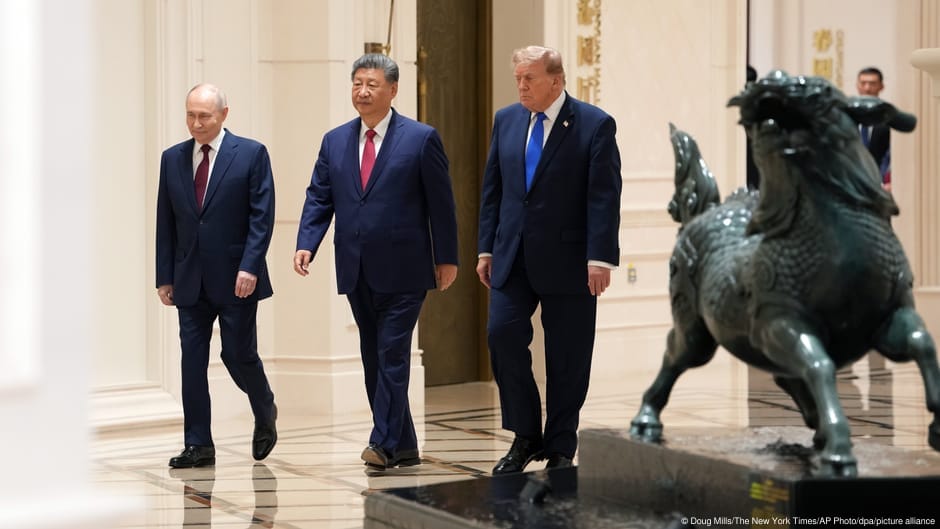
Behind the guarded lakeside gates of Kylin Villa, on the sidelines of the Asia-Pacific Economic Cooperation forum, the presidents of the United States, the People’s Republic of China and the Russian Federation sat together for approximately eighty minutes and emerged with a four-point document titled the China–Russia–US Heads of State Declaration toward Peace. Putin defended his country’s position on Ukraine during the summit, while Trump had arrived in Asia promising to press Beijing on Persian Gulf shipping lanes.
“We spy on China. They spy on us.” With eight words tossed casually into a television microphone on the eve of the first trilateral summit in modern history, Donald Trump accomplished what decades of diplomatic communiqués had laboured to obscure: he stripped twenty-first-century statecraft down to its bare wiring. Seven days earlier, Jensen Huang, the architect of Nvidia’s extraordinary rise over more than three decades, had resigned as chief executive amid a scandal involving reports of an affair with a Chinese businesswoman suspected by American authorities of having intelligence connections to Beijing.
Separately, allegations surrounding the diversion of Nvidia chips through Southeast Asia had intensified scrutiny of the company’s exposure to Chinese interests and the effectiveness of American export controls. Yet when asked whether he would confront Xi Jinping over espionage, the American president shrugged. Why moralise about shadows when both men own the lamps?
That unvarnished candour is the only honest lens through which to read what transpired on November 19, 2026, in Shenzhen. No setting could have been more deliberate. Four decades ago, Shenzhen was a cluster of fishing villages across the water from Hong Kong; today it is the gleaming nervous system of Chinese surveillance capitalism, artificial intelligence hardware and algorithmic control, a metropolis built to prove that autocracy and hypermodernity are not enemies.
Behind the guarded lakeside gates of Kylin Villa, on the sidelines of the Asia-Pacific Economic Cooperation forum, the presidents of the United States, the People’s Republic of China and the Russian Federation sat together for approximately eighty minutes and emerged with a four-point document titled the China–Russia–US Heads of State Declaration toward Peace.
Commentators immediately reached for the dusty vocabulary of the twentieth century, asking whether Shenzhen was a new Yalta, where great powers carved up a prostrate globe, or a new Reykjavik, where rivals gambled to abolish the nuclear abyss. It was neither. Yalta required victory, Reykjavik required imagination. Shenzhen was something far more contemporary and far more chilling.
A board meeting of three surveillance empires discovering that while they cannot trust one another with a single microchip or enriched uranium centrifuge, they share an urgent common interest in dismantling every referee left on the field. To understand the Shenzhen declaration, one must read it the way intelligence analysts read a redacted cable: by measuring the white space.
On the day the three men shook hands in Guangdong province, two major wars were actively distorting the global economy and bleeding thousands of lives. Russia’s full-scale invasion of Ukraine stood grinding through its fifth year. Meanwhile, the United States and Israel were locked in an escalating and costly war with Iran that had turned the Strait of Hormuz into a dangerous corridor for international shipping, sent missiles toward Gulf infrastructure in Bahrain and Kuwait, and pushed global energy markets toward a winter cliff.
Both conflicts were owned, financed or sustained by men sitting inside Kylin Villa. Putin defended his country’s position on Ukraine during the summit, while Trump had arrived in Asia promising to press Beijing on Persian Gulf shipping lanes. Yet when the White House, the Kremlin and Zhongnanhai published their joint declaration toward peace, neither the word Ukraine nor the word Iran appeared anywhere in the text.
That omission was not an oversight; it was the price of admission. Each man arrived at the table carrying a war he could not win outright and a domestic flank he could not afford to expose. Putin needed diplomatic rehabilitation and a return to the company of leaders from whom the international order had sought to isolate him, without surrendering a square kilometre of occupied Donbas.
Trump needed relief at the fuel pump before winter without admitting that his Middle Eastern campaign had metastasised. Xi, playing the serene host in China’s showcase city of glass and silicon, had little appetite for underwriting someone else’s ceasefire when prolonging Washington’s strategic distraction served Beijing’s timetable in the Taiwan Strait.
So they struck a pact of mutual silence: none of the three would embarrass the others in ink over the blood being spilled on their watch. Where the text suddenly found its voice, however, was in its coordinated assault on international institutions, paired with a calculated bait-and-switch for the rest of the world. In its opening clause, the declaration proclaimed that as permanent members of the United Nations Security Council, China, Russia and the United States were committed to “reform the U.N. so that the U.N. can respond more effectively to global challenges and conform to its fundamental mission of international peace and security”.
To capitals across Africa, Asia and Latin America, nations that hav
- shenzhen
- kylin
- villa
- trump
- putin
- donald
- jinping
- man