Why is Shabana Mahmood tackling ‘two-tier policing’ if she doesn’t believe it exists?
The year after that, officers at Charing Cross station were caught WhatsApping each other rape jokes and insults like “fuck you bender”, contributing to Louise Casey’s conclusion in a review not long afterwards that the force was both institutionally homophobic and misogynistic. Gaby Hinsliff is a Guardian columnist Continue reading...
Is it the home secretary’s job to act tough addressing a rightwing myth or to face it down? She seems to have chosen the path of least resistance
Ten years ago this month, Stephen Port was convicted of the murders of four young gay men lured to their deaths via the dating app Grindr.
But it took another five years for their families to learn through an inquest what some had long suspected: that the Metropolitan police’s failure to link the murders quickly enough may have contributed to the later deaths, raising difficult questions over whether that would have happened if the victims were straight. The year after that, officers at Charing Cross station were caught WhatsApping each other rape jokes and insults like “fuck you bender”, contributing to Louise Casey’s conclusion in a review not long afterwards that the force was both institutionally homophobic and misogynistic.
There have been extremely good reasons for the decision many forces across Britain made to let uniformed police officers march openly at Pride events in recent years, rather than simply stewarding. It seemed a quick, tangible way of signalling that times have changed, that hate crimes will be taken seriously and that gay officers are welcome to serve or join. But in a case brought against Northumbria police last year by a lesbian arguing that gender critical activists had been made to feel unwelcome at Pride, a judge ruled that Pride had become so politically contested that marching breached impartiality rules, warning other forces to take note. This week, the home secretary, Shabana Mahmood, made clear that she supported that ban. Some forces had drifted “out of the realm of policing and into the world of politics” in trying to engage the public, she told police commissioners, suggesting in future they stick to “tea and biscuits” with residents’ associations rather than hanging out with activists.
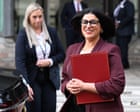
That sideswipe came as Mahmood made a speech announcing plans to tackle so-called two-tier policing – the false and inflammatory idea that the police routinely and deliberately go soft on ethnic minority offenders. These plans have been undeniably complicated by the fact that, as Mahmood herself acknowledged, there’s no evidence that the problem actually exists outside Nigel Farage’s imagination. Her solution was to scrap a police statement on anti-racism principles that Reform UK made hay with in the wake of the tragic murder of Henry Nowak, the teenager unforgivably handcuffed by police as he was dying of stab wounds because they mistook him for the assailant rather than the victim.
The statement argues that equality “does not mean treating everyone the same”, an established principle in anti-discrimination law (forcing a pregnant woman to lift the same heavy boxes as everyone else working in your warehouse is technically equal treatment, but that doesn’t make it fair). Though there’s no evidence that it directly affected the officers’ decisions the night of Nowak’s murder, and Mahmood acknowledged she could see what it was trying to achieve, she insisted that the public find it “patently absurd”, and she wasn’t about to argue with them. So there will be a new impartiality code, including rules on avoiding politicised symbols – another Reform gripe is LGBTQ+-friendly rainbow markings on police cars – and on engaging with the public, which is where Pride marches come in.
Police should, she argued, beware “misguided attempts at course corrections” made while scrabbling to keep up with culture wars. Though if the police seem confused, they’ve arguably only been reflecting successive governments, who have done their share of handbrake turns over LGBTQ+ rights.
What Mahmood was trying to do this week was one of the hardest tasks in politics, which is to side with the public on an issue where the public is hopelessly divided. Plenty of Britons now believe two-tier policing exists, according toYouGov research this summer; unfortunately, they disagree on who is in which tier. Over half think black people are singled out for differential treatment, but they’re more likely to say this treatment is extra strict than extra lenient. A third think the police come down harder on people with far-right views, but one in five think they’re harder on people with far-left views. And though 25% think white people get a uniquely raw deal, exactly the same number think they have it easier, with a marked tendency for people to think their own group is especially hard done by. (Though YouGov didn’t poll LGBTQ+ people specifically, Stonewall research suggests one in four of those who had experienced a hate crime and not reported it said it was because they didn’t trust the police.) It’s hard to draw any firm conclusions except that distrust of the police is remarkably widespread; but evidently that’s not the story either Reform or Labour wants to tell.
If Mahmood looks increasingly out of step with a cabinet that has shifted at least rhetorically to the left under Andy Burnham, that’s in part just the nature of being a Labour home secretary. Since Labour never gets the benefit of the doubt over law and order, its home secretaries end up forced into taking the hardest possible line on law and order so that nobody can say they’re soft on it. But there is another difference between Mahmood and her new boss emerging, and it’s about the willingness to make an argument.
If the public fervently believe something that you think is nonsense, is your job to agree with them or to bust the myth? On Brexit, Burnham chose the latter, pointing out politely but firmly that it hasn’t worked out. But Mahmood seems to be choosing the former, cracking down on a “perception” of injustice she freely admits is a chimera. The trouble with boxing shadows is that sooner or later, the wrong person risks getting punched in the face.
- shabana
- mahmood
- policing
- murder
- death
- tier
- home
- secretary