The best thing I ever ate? Lunch on the strait of Hormuz
The idea of any guest being hungry, or there not being enough food, is an unspeakable proposition for an Iranian host When most people think of the strait of Hormuz, the warm, tropical waterway connecting the Persian Gulf and the Gulf of Oman, incredible food isn’t usually the first thing that comes to mind. Over the course of several months, we cooked and ate in people’s home kitchens, meeting a cross-section of society, from farmers and pharmacists to yoga teachers and restaurant owners, who all shared their favourite foods with us in places as diverse as the snowy mountains outside Tabriz,…
The idea of any guest being hungry, or there not being enough food, is an unspeakable proposition for an Iranian host
When most people think of the strait of Hormuz, the warm, tropical waterway connecting the Persian Gulf and the Gulf of Oman, incredible food isn’t usually the first thing that comes to mind. But it should be, and I would know – it’s where I had one of my most memorable meals.
I was visiting Iran, traversing thousands of miles across the country with a local female photographer, mapping out regional specialities for my cookbook The Saffron Tales. Over the course of several months, we cooked and ate in people’s home kitchens, meeting a cross-section of society, from farmers and pharmacists to yoga teachers and restaurant owners, who all shared their favourite foods with us in places as diverse as the snowy mountains outside Tabriz, the rice paddies of the Caspian Sea, and the historic cities of Isfahan and Shiraz.
My mother is from Iran and it was here that I spent my formative early years, before my family settled in the north of England. I’ve travelled back and forth from the country all my life, mostly spending time in the Gilan province, in the rural north of the country. My grandparents were small-scale farmers, so I came to know the local produce intimately; from the abundance of fresh herbs and greens that are chopped, sliced and simmered into stews, to the fragrant long-grain rice that is so artfully adorned with butter and saffron, and rose and cardamom-infused desserts that are washed down with black tea drunk out of tulip-shaped glasses. When I cooked Iranian food at home in the UK, it always leant into this familiar flavour palette, which also involved a full embrace of the sour ingredients so beloved in Persian cuisine, such as pomegranate molasses, dried limes, verjuice and Seville oranges. Visiting the south of Iran changed all of that.
I arrived in Bandar Abbas, a small port city overlooking the strait of Hormuz, in February, when the weather was a cool and balmy (by their standards) 25C. Because of the different waves of migration to the region, brought about by its importance as a strategic port over hundreds of years, I knew the food was different from the rest of Iran: a thrilling blend of Persian, Arabic and Indian flavours, with seafood taking centre stage and fiery spices filling the air of the local markets. For centuries, Bandar (as it’s known to locals) was an important staging post on the maritime spice route from India to Europe. Traders, mercantile companies and empires sought to control the port and its lucrative trade in spices and, more recently, its oil reserves. Chillies, fresh coriander and tamarind form the holy trinity of Bandari cooking, used alongside ginger, cumin and curry powder to add heat and intensity to dishes. Tropical fruits, such as mangoes, pineapples and guavas, are picked green and used to make Indian-style pickles, and fresh fish from the warm waters of the Persian Gulf are poached in stews, grilled as kebabs, or fermented and dried before being ground into powders and pastes.
Wandering around its bustling streets, every corner of the city featured a new discovery. There was balaloot, a cardamom- and saffron-drenched buttery noodle dish, which I ate for breakfast, topped with a fried egg; sambusa, small triangles of deep-fried pastry stuffed with a spicy potato, green chilli and tamarind filling; wafer-thin crepes spread with suragh, a local condiment made with sardines that had been fermented with the local red soil, salt and Seville oranges under the hot sun.
But the best part of my trip was the visit to the home of Goli Heydari, a school teacher, and Ahmad Ravani, a musician, who hosted me for lunch, which in Iranian culture is the main meal of the day (followed, frequently, by a little siesta). As I entered Goli’s home, slipping my sandals off at the door, I was immediately struck by the earthy and pungent scent of fenugreek. Goli noticed me inhaling. “I’m making ghalieh mahi,” she told me, which is a local fish and herb stew. Did I want to come and see? She didn’t have to ask twice.
Goli pulled me into the kitchen to stir the stew simmering on the stove, twisting the lid off a jar of tamarind, which she generously spooned in. She handed me a spoon and, as I lifted the emerald green sauce to my mouth, it was hit by the fiery and bright taste of fresh coriander and green chilli. I watched her gently transfer fillets of firm white fish into the pot before turning her attention to the other dish she was making: fishcakes. I joined her, rolling flaked fish, mashed potato, coriander and yet more chillies into little patties with my hands.
While the fishcakes were frying, we made a salad: a classic Middle Eastern chopped combo of juicy tomatoes, crisp cucumber and sweet white onion, dressed simply with lemon, olive oil and salt. Once the food was ready, we gathered around the sofreh, an ornately patterned cotton tablecloth placed on the floor, around which Iranians traditionally eat. There were only four of us but, in typical Iranian fashion, Goli had cooked for eight. The idea of any guest being hungry, or there not being enough food, is one of the most unspeakable propositions for an Iranian host. As well as the stew, fishcakes and salad, there was steamed rice, toasted flatbread, a platter of herbs, creamy thick natural yoghurt, and small bowls of crunchy aubergine and chilli pickles. We passed bowls and spoons around as we filled our plates to the brim.
Over lunch I learned from Ahmad, a percussionist and rapper of African-Iranian descent, more about the region’s history. He told me that after the Portuguese relinquished control of Hormozgan in the 16th century, many of the slaves they had brought with them from East Africa stayed as free men in Iran, keeping their cultural customs alive. A key part of this was the drumming music at social gatherings, which is why this particular style of music has remained such an intrinsic part of Bandari life, unlike in many areas of Iran where, since the Islamic Revolution of 1979, the playing and performing of popular music in public has been restricted. Drumming was Ahmad’s passion and, after our plates were cleaned (and I had had at least three servings of everything), we leant back on the floor cushions and Ahmad taught me how to play a local percussion instrument, the jaleh (a clay water jug that you hit with your palms). As Ahmad rapped one of his songs – an ode to Bandar Abbas – Goli scuttled around us, pouring tea, serving fruit and singing harmonies. It was truly one of my most treasured life memories.
As we lounged in the afternoon, chatting, playing music, eating fruit and drinking lots of tea, the food became inseparable from everything that surrounded it – the warmth, the joy, the curiosity, the laughter. This is what I have always loved about eating in people’s homes. Restaurants can tell you a lot about a place, but home cooking gives you access to something far more magical: an intimate insight into people’s lives, their histories, their hopes, and their stories as friendships are forged around a table.
Over the course of that day, Goli and Ahmad shared so much with us. Ahmad worked nights as a security guard for an oil company, but music was his real passion, and the full drum kit squeezed into their living room left little doubt about that. He told me about the economic hardships of that area and the racism black Iranians like him continue to face. Goli was warm and constantly trying to feed us, pushing another fishcake in my direction whenever she thought I had gone too long without eating. Insisting I get married soon. When we talked of the future, she shared with us the pain of the many miscarriages she had experienced, and how much she still hoped to have a child one day. It was incredibly moving; the kind of conversation you only have when walls and boundaries are gently brought down, which so often is facilitated by a good meal. Years later, I would go on to have my own challenges with recurrent miscarriage and, while I was fortunate and did end up having a child, I often wonder how it all played out for Goli.
I’ve eaten in plenty of fancy restaurants over the years and worked my way through my fair share of tasting menus. It’s a privilege to say that, I know, but the meals that stay with me are not the most elaborate or expensive ones. Rather, they are the ones where there is some kind of shift. Where you learn something about another person, or another place, that you couldn’t have understood from a guidebook or a newspaper. Where you leave seeing a culture, person or a place slightly differently from how you did when you arrived.
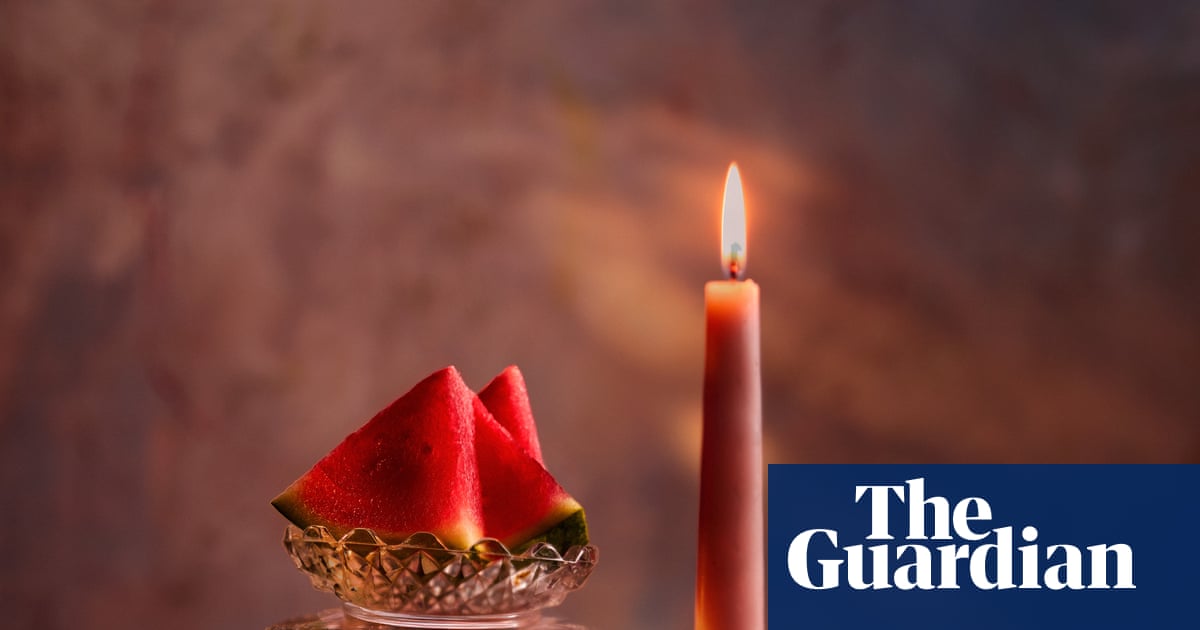
The food I ate that afternoon in Bandar Abbas was extraordinary: sour, hot, herbaceous, delicious and utterly unlike the Iranian food I had grown up eating. But when I think about that meal now, it’s not just the taste of the fragrant ghalieh mahi or the crunch of the sweet slices of watermelon that I remember. It is Ahmad telling stories, Goli’s jokes, and all of us laughing on the floor, groaning from far too much food.
This memory feels especially precious now as Bandar Abbas and the strait of Hormuz are plunged into war, and vital infrastructure in the region, such as water and electricity plants, has been destroyed. For me, when I hear the words strait of Hormuz, I don’t think of the bombs; I think of the people, like Goli and Ahmad, of a table shared with strangers who, by the time you leave, feel like friends. I wonder if they are OK, and hope, dearly, to be able to share a sofreh with them again.
The Saffron Tales: Recipes and Stories from the Persian Kitchen by Yasmin Khan, published by Bloomsbury at £26. To order a copy for £23.40, go to guardianbookshop.com
- thing
- strait
- hormuz
- food
- lunch
- people
- persian
- gulf