UK-EU food deal hailed by British firms: ‘We’re pretty aligned anyway’
Exporters welcome end in sight for Brexit checks – but are frustrated that implementation will take so long British producers have broadly welcomed the UK’s deal with the EU, designed to remove the vast majority of physical checks on food, plants and animal products. The sanitary and phytosanitary (SPS) deal is expected to benefit Britain’s food exporters and will enable UK delicatessens and other small retailers to import European cheese and wine again, something that became economically unviable because of costly Brexit checks.
Exporters welcome end in sight for Brexit checks – but are frustrated that implementation will take so long
British producers have broadly welcomed the UK’s deal with the EU, designed to remove the vast majority of physical checks on food, plants and animal products.
The sanitary and phytosanitary (SPS) deal is expected to benefit Britain’s food exporters and will enable UK delicatessens and other small retailers to import European cheese and wine again, something that became economically unviable because of costly Brexit checks.
The agreement is due to take effect on 1 March 2028 and is also intended to reopen the EU market for UK products including fresh sausages, burgers, seed potatoes and molluscs.
However, several years after the UK left the bloc, upending many decades-old trading arrangements, some food exporters said they would remain cautious until the deal came into force.
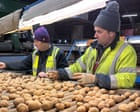
“Nobody’s going to believe this until it has actually physically happened,” said Iain Barbour, the operations director of the Scottish seed potato producer Jamieson Brothers.
Seed potatoes were not included in the post-Brexit trade deal after the two sides disagreed over certification, halting exports from the UK to the EU despite Scottish seed potatoes’ high health status classification.
The exclusion particularly hit the Scottish industry, whose farmers were among the biggest exporters for the production of chips and crisps in the world, as well as growers in northern England. Scottish seed potato farmers previously accounted for three-quarters of UK production and the sector was worth about £112m a year.
Ireland and the EU represented a fifth of Jamieson Brothers’ trade before Brexit. The company particularly suffered from the loss of the Irish business, given it grew many varieties that were popular on plates in the north and south of Ireland.
While the company adapted its business to start packing work that would have previously been carried out in the EU, Barbour estimates this change cost about £500,000.
“We evolved, we worked with more partners and that’s what kept the business going,” Barbour said.
Barbour is looking forward to supplying his Irish customers once againHowever, he said it would take at least three years until he could revive varieties that were no longer being grown and were instead stored in a seed bank.
“A lot of Scottish farmers stopped producing varieties that were popular in Ireland as they weren’t desired in England. Varieties that had been going about 100 years were killed off in a couple of years,” he said. “So we’ll have to look at bringing them back.”
The planned implementation of the food deal in March 2028 would also be “a couple of months late for the trade”, given most sales happen at the start of the year and the crops needs to be grown in advance.
Barbour anticipates most growers will be wary and will only fully resume trading in 2029. “People are obviously going to be a little bit hesitant to grow anything until it’s 100% official,” he said.
British exporters of live bivalve molluscs – the collective term for shellfish including mussels, oysters, clams, cockles and scallops – hope the deal will give the sector a shot in the arm.
The industry is small and specialised. It was valued at less than £12m a year before Brexit, but it is crucial for some coastal communities.
Offshore Shellfish, a family-run business produces rope-grown mussels in the waters of Lyme Bay, Devon, has managed to continue exporting to its European customers despite the administrative burden and occasional blocks by French customs.
The company exports the vast majority of the blue mussels it produces. It sends to the Netherlands for processing, before most end up in restaurants or on supermarket shelves in Belgium, where they are prized as a key ingredient in moules-frites, one of the country’s national dishes.
Sarah Holmyard, the commercial director of Offshore Shellfish, said the most important detail was an assurance that the deal would allow live bivalve molluscs to be exported even if they did not come from waters with the highest quality rating.
Offshore Shellfish’s farms are in waters which are considered “class A” for most of the year, but before the new SPS deal, any change in water quality to “class B” could have temporarily halted exports.
“That’s a huge win for us because we’ve been pushing and pushing and pushing for that,” Holmyard said.
However, the deal will come too late for those UK shellfish producers that have closed down since Brexit. Three out of four mussel fishing companies in the Menai strait, the channel that separates the north Wales mainland from the island of Anglesey, stopped trading after exports became too difficult.
The promised end of physical border checks on dairy, fish and meat products was welcomed by Rich Clothier, the managing director of Wyke Farms. The Somerset-based cheese and butter maker exports about a quarter of its cheddar to the EU, particularly France, Germany and Spain.
Dairy exports to the EU have been less contentious since Brexit than seed potatoes or mussels, but not without challenges. The removal of veterinary checks is viewed as a significant benefit by Clothier.
“It’s a very bureaucratic process to get everything signed off, in what is not a very modern sort of system,” he said. “The agreement will save a huge amount of cost and product waste as well, because these are perishable.
“Any reduction in friction saves cost, it makes business more efficient. But it is really frustrating that it’s going to take so long [to be implemented] because, to be honest, we’re all pretty aligned anyway.”
- food
- deal
- check
- exporter
- brexit
- firm
- end
- sight