Sorting through my mother-in-law’s belongings was heartbreaking. One generation’s treasure is the next’s trash
One generation’s treasure is the next’s trash. It went better than this threatened: after a whirlwind long weekend, we escaped with some crockery, a photograph of my husband as a cherubic spherical tot and “Queen Alexandra’s Christmas Gift Book 1908” (sepia snaps of scowling royals holding terriers).
Medals, ornaments, yellow-rimmed plates – so much life packed into binbags. What unwanted trinkets am I going to pass on?
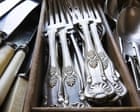
My mother-in-law recently moved from her apartment of several decades into sheltered housing and my husband and his brother were summoned to help. We arrived to find her arranging the last of 200-plus glasses on the table; the cupboards were still overflowing with oyster forks, tablecloths and, bafflingly, patchwork fabric artichokes.
It went better than this threatened: after a whirlwind long weekend, we escaped with some crockery, a photograph of my husband as a cherubic spherical tot and “Queen Alexandra’s Christmas Gift Book 1908” (sepia snaps of scowling royals holding terriers).
We might have travelled home light, but the experience was heavy: so much life shoved into binbags. Packing up the yellow-rimmed plates we’ve eaten so many meals from, to donate to charity, was a reminder that the family’s grande bouffe (they’re French) days are over: there’s no space in my mother-in-law’s new digs. My gentle, clever father-in-law has been entirely unravelled by Alzheimer’s and his tricolore mayor’s sash, carefully folded in tissue, undid us all; she dug in her heels about keeping 20 years of A3 plain cardboard calendars, the scribbles reminders of their busy, happy, sociable lives. We unearthed a long-forgotten trunk of heirlooms in the garage, inherited from her own parents, who possibly inherited it from theirs: a forgotten uncle’s medals, ornaments, broken pottery.
One generation’s treasure is the next’s trash. I’ve read two thoughtful, pained articles recently about trying to sort through a mother’s stuff – never just stuff, but affective landmines, freighted with meaning and memory. It’s a central preoccupation in Barbara Kingsolver’s new novel, Partita, too: the heroine is mired in the emotional swamp of clearing her hoarder mother’s house, expressing a fervent, relatable desire to set fire to it all.
That’s the reality of “the great junk transfer”: the inheritance we don’t really want, thanks. In a recent removal company survey, nearly half of 2,200 people across three countries said they would “rather inherit nothing” than deal with a relative’s belongings. One weary man on Instagram explained that he spent 80 days and filled three skips clearing his parents’ house. His message for boomers? “You’re going to die … Guess who’s going to have to deal with all your shit if you haven’t cleaned it up?” Millennial Inheritance on YouTube humorously catalogues the mindboggling crap adult kids are left contemplating – figurines, so many bloody figurines (no wonder my local auction house is full of them), 668 shot glasses, Christmas kitsch.
It was probably ever thus, but inheriting a bit of bedlinen and cutlery is a very different proposition from tackling the mountains of mass-produced knick-knacks and gadgets that filled homes following the postwar cheap consumer-goods boom. Plus generational junk transfer has become vastly more problematic in this broken housing economy: who has space for 12 boxes of VHS cassettes and three fondue sets? It’s depressing to see how things our parents loved, or at least wanted, become a burden.
We reached home determined to embrace austere minimalism, but a few hours later I bought a hedgehog-shaped incense holder. Over my shoulder as I type lurk skips’ worth of stuff: plasticine dinosaurs and pewter goats, creepy religious ephemera and Victorian mugs.
Because I really like stuff; humans do, generally. We always have and that’s going nowhere: Gen Z love their trinkets and I’ve just been reading about “shoptimism” – shopping carefully, for pleasure, from independents – as self-care.
But those Pokémon cards and noughties “graphic tees” will be someone else’s problem soon enough too. Is there anything to be done? Swedish death cleaning – disposing of your own shit – suggests a briskly unsentimental solution, but it’s one few of us feel emotionally up for (with honourable exceptions: my stepfather’s relentless geordie death clean will leave him standing naked in an entirely empty house soon). Maybe we should revive the ancient tradition of grave goods? Funeral directors could pack us up with all our worldly possessions, then burn the lot (“waste-to-energy recovery” in recycling centre parlance).
More realistically, we should probably accept that relieving our parents of the burden of decades of accumulated stuff is just one of those caring jobs everyone ends up taking on, eventually. One day all this (crocheted owl, capybara keyring, assortment of useless but attractive tins) will be yours, my sons. Sorry.
- mother
- law
- generation
- treasure
- trash
- husband
- belonging
- medal