Religious leaders push for transparent climate funding
The leaders, meeting in Nairobi for an interfaith dialogue organised by the Embassy of Israel in Kenya and the Konrad-Adenauer-Stiftung (KAS), said religious institutions must translate their influence into practical environmental action, including tree planting, water conservation, climate-smart farming and ecosystem restoration. Mathias Kamp, KAS Country Director in Kenya, said faith and indigenous communities were important partners in climate action because they possess local knowledge and are often at the forefront of supporting communities affected by environmental disasters.
NAIROBI, Kenya, Oct 26 — Faith and indigenous leaders have pledged to mobilize their communities to tackle climate change and hold authorities accountable for ensuring climate financing reaches vulnerable populations.
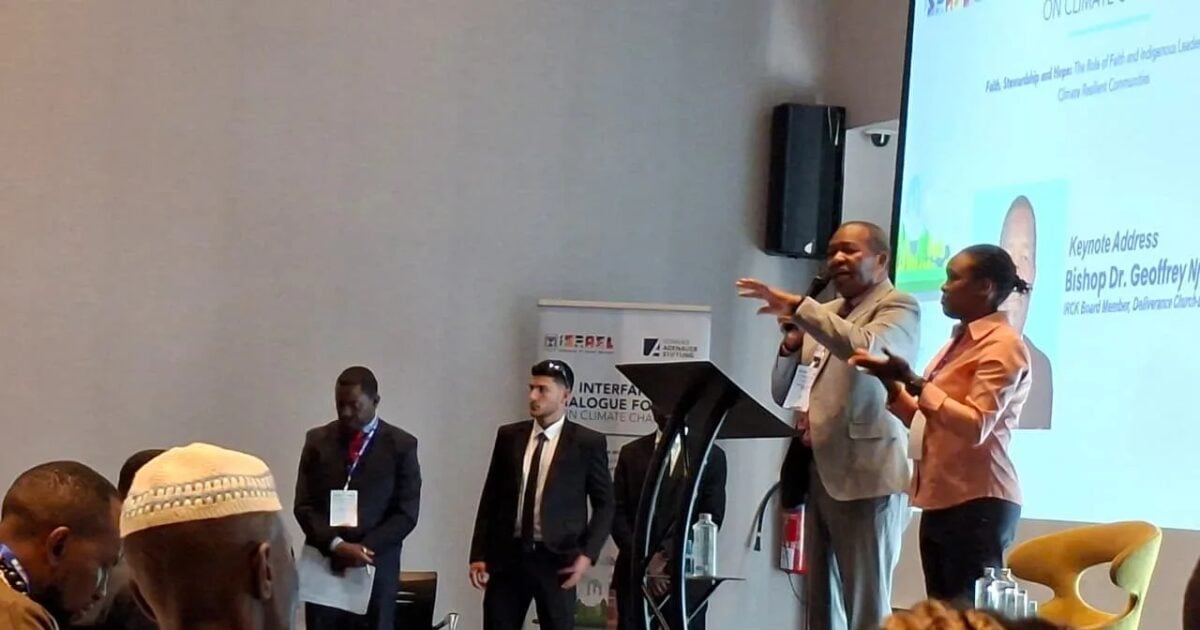
The leaders, meeting in Nairobi for an interfaith dialogue organised by the Embassy of Israel in Kenya and the Konrad-Adenauer-Stiftung (KAS), said religious institutions must translate their influence into practical environmental action, including tree planting, water conservation, climate-smart farming and ecosystem restoration.
Geoffrey Njuguna, a board member of the Inter-Religious Council of Kenya representing Deliverance Church-Lang’ata, said faith institutions would use their networks to promote environmental stewardship while demanding transparency in the allocation of climate funds.
“Faith leaders must hold every level of government and every partner to account so that climate finance reaches the communities who need it,” Njuguna said.
He outlined four commitments by the Indigenous Council of Kenya: integrating environmental stewardship into religious teachings, adopting sustainable practices within faith institutions, mobilising congregations to protect natural resources and speaking out on climate financing and government accountability.
Njuguna said religious institutions could use their land and facilities to plant indigenous trees, harvest rainwater, adopt green energy and manage waste responsibly.
He also pledged to take the forum’s outcomes through the council’s nine religious coordinating bodies and encourage member institutions to make practical commitments over the next 12 months.
Israeli Ambassador to Kenya Gideon Behar urged faith leaders to use their moral authority to drive environmental action, warning that the climate crisis could not be left to policymakers and scientists alone.
“We cannot leave the battle against climate change only in the hands of policymakers,” Behar said. “We need your voices.”
He challenged participants to identify partners from different religious communities and agree on immediate actions they could implement after the forum, including organising community clean-ups, planting trees and protecting local water resources.
Behar said the Israeli Embassy was ready to support initiatives by sharing expertise in water management, agriculture, science, technology, sustainability and renewable energy.
He expressed hope that the dialogue would become an annual gathering that produces measurable results rather than remaining a platform for discussion.
Mathias Kamp, KAS Country Director in Kenya, said faith and indigenous communities were important partners in climate action because they possess local knowledge and are often at the forefront of supporting communities affected by environmental disasters.
He said the forum sought to connect religious values and indigenous wisdom with modern climate solutions, strengthen cooperation among different faith traditions, and promote grassroots initiatives that protect land, water, and livelihoods.
“This is not a passive hope that waits for solutions to appear, but an active shared hope grounded in stewardship, justice, and a collective result,” Kamp said.
Thomas Lerenten Lelekoiten, Deputy Director of the Climate Change Directorate at the Ministry of Environment, Climate Change and Forestry, said the worsening impacts of global warming required urgent emissions reductions alongside stronger adaptation measures.
He warned that existing adaptation efforts were increasingly being tested by rising temperatures and the growing severity of climate impacts, making discussions around loss and damage more urgent.
Lelekoiten said Kenya had established a policy framework for climate action, including the Climate Change Act of 2016 and the National Climate Change Action Plan, but stressed that policies must translate into practical interventions.
“Policies by themselves cannot help,” he said, adding that partnerships among government, faith-based institutions, indigenous communities and civil society were essential because the government could not address the crisis alone.
He cited climate financing mechanisms through which Kenya, working with international partners, had mobilised more than $300 million, with two per cent of the resources going directly to communities under the model he described.
The funds support locally driven climate planning, including participatory assessments of climate risks and the development of county-level responses.
Lelekoiten also highlighted the government’s target of planting 15 billion trees to restore more than 10.6 million hectares of land.
However, he pointed to a significant global financing gap, citing the UN Adaptation Gap Report’s estimate that developing countries would require up to $365 billion annually by 2035 for climate adaptation, compared with about $26 billion currently available.
Catholic priest Rev. Fr Patrick Ndungu of the Archdiocese of Nairobi said environmental protection was a moral responsibility, urging religious institutions to make stewardship part of their teachings and everyday practices.
He called on congregations to conserve water, adopt sustainable transport, reduce waste and invest in activities that restore degraded environments.
Ndungu said faith institutions should incorporate environmental awareness into churches, families, schools and communities to build a lasting culture of conservation.
The dialogue comes amid growing concern over the effects of climate change on livelihoods, with droughts threatening pastoralist communities and floods destroying homes, schools and other infrastructure.
Bruhan Makong is a Senior News Reporter for Capital FM in Nairobi, covering diplomacy, foreign policy, national security, climate, and human rights across East Africa and the wider region.
- climate
- kenya
- faith
- community
- change
- action
- leader
- institution