The Guardian view on Serbia’s new political era: a generational opportunity must not be wasted
Brussels must find ways to show concrete support for a new government that will genuinely share the EU’s democratic values Following the extraordinary election that swept Aleksandar Vučić’s autocratic government from power, Serbia’s new political era has begun. Their defining challenge will be to restore trust and democratic legitimacy in a nation that, under Mr Vučić’s bullying rule, plunged towards the bottom of Europe’s corruption rankings.
Brussels must find ways to show concrete support for a new government that will genuinely share the EU’s democratic values
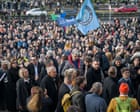
Following the extraordinary election that swept Aleksandar Vučić’s autocratic government from power, Serbia’s new political era has begun. Outside the National Assembly in Belgrade last week, large crowds celebrated as MPs from the victorious Student List movement were sworn in. Doctors, lawyers and academics put forward as candidates by the youthful protesters, who took on Mr Vučić, are now tasked with running an expectant country.
Their defining challenge will be to restore trust and democratic legitimacy in a nation that, under Mr Vučić’s bullying rule, plunged towards the bottom of Europe’s corruption rankings. Legal action has already begun against figures accused of illicitly profiting from the previous regime, while the new parliament’s elected speaker – a professor and organic farmer – called for the restoration of dignity and tolerance to its proceedings in his first address. Ensuring academic and media independence, and reforming the security services, which acted as the former president’s authoritarian enforcers on the streets, will be urgent priorities.
Beyond that, the unique nature of the moment suggests a journey without political maps. The new government will have a substantial majority. But it will be made up of novices, and the broad nature of the coalition assembled to defeat Mr Vučić comprises figures from the right as well as the liberal left. A governing programme published for the campaign tends to deal mainly in general principles, and although the students have said they intend to exercise a form of oversight over parliamentary decision-making, it remains unclear how that will play out in practice.
The direction of travel in relation to stalled European Union accession talks, which began in 2012, is more easily discernible. At an EU enlargement forum last week, the Student List MP Aleksandar Baucal received a standing ovation after pledging that rule-of-law reforms to which Mr Vučić paid only cynical lip-service would be fast-tracked. But for now there appears little prospect of the new government signing up to key EU foreign policy commitments, such as the recognition of Kosovo’s independence and support for sanctions on Russia.
Brussels should be patient on the geopolitics and generous in terms of investment and support, as Serbia’s new leaders focus their attention on domestic reform. A recent poll found that 42% of Student List supporters saw a closer relationship with the EU as the best way to protect Serbia’s interests, compared with 9% who opted for Russia and China. But after effectively tolerating Mr Vučić’s authoritarian excesses in a failed effort to woo him away from Vladimir Putin’s influence, European leaders must seize the opportunity to deepen links with a movement that genuinely shares its democratic values. The benefits of enhanced partnership with a country that sends two-thirds of its exports into the EU can become the gateway to alignment in other areas.
In 2000, a similar wave of student-led protests eventually led to the toppling of Slobodan Milošević and the election of a more orthodox coalition government committed to reform. A rising star under Milošević, Mr Vučić then spent the last 14 years reversing the progress made. His ousting and the tenacity and courage of the student movement have become symbols of gen Z ambitions across Europe for a new political settlement. The EU must do all it can to help ensure that, this time, Serbia’s democratic revolution is irreversible.
- serbia
- era
- vučić
- guardian
- view
- opportunity
- government
- brussels