TenTrade in Lagos: A conversation about education and the future of trading.
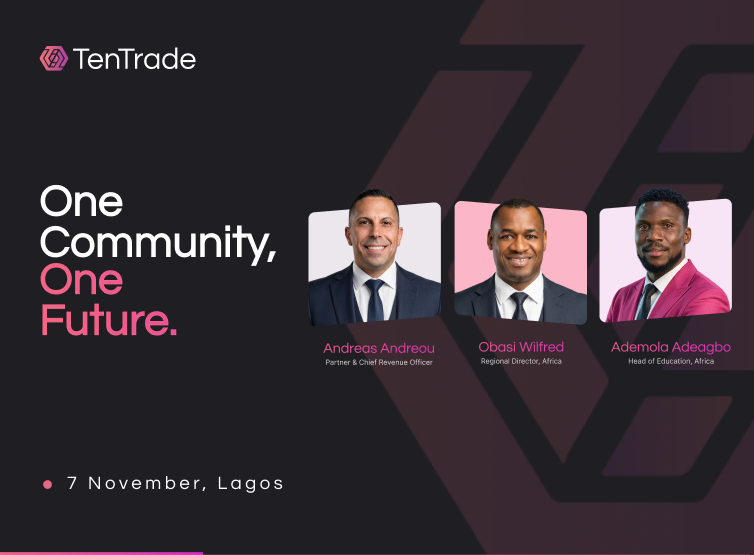
Ahead of TenTrade’s “One Community, One Future” seminar on November 7th, we spoke with Andreas Andreou, Partner & Chief Revenue Officer; Obasi Wilfred, Regional Director, Africa; and Ademola Adeagbo, Head of Education, Africa. Andreas Andreou: If we want a lasting presence in Africa, we need to invest time in meeting people and understanding their expectations.
Ahead of TenTrade’s “One Community, One Future” seminar on November 7th, we spoke with Andreas Andreou, Partner & Chief Revenue Officer; Obasi Wilfred, Regional Director, Africa; and Ademola Adeagbo, Head of Education, Africa. Together, they discuss what traders need to learn, how mentors can help and what building a trading community means in practice.
Q: What does “One Community, One Future” mean to you? Andreas Andreou: It expresses the kind of company we want TenTrade to become. A global business needs more than a presence in different markets, it needs meaningful relationships within them. For us, bringing educators, mentors and traders together is part of building those relationships. Obasi Wilfred: For me, the important word is “community.” Our work in Africa has to reflect the people here, their questions, circumstances and ambitions.
Community means having a two-way conversation and allowing what we hear locally to influence how we support traders. Ademola Adeagbo: I see it as creating an environment where learning is an ongoing conversation. You can attend a presentation and understand a concept, then struggle when you try to apply it. Having access to educators and mentors gives you somewhere to bring those questions.
That is the value I want people to see. Q: Why Lagos, and why now? Andreas Andreou: If we want a lasting presence in Africa, we need to invest time in meeting people and understanding their expectations. Lagos gives us an opportunity to do that in person. The decision to hold this event reflects the direction we want to take, which is building our presence through education and relationships.
Obasi Wilfred: Lagos is a starting point. Nigeria matters in our regional thinking in its own right, and we want to understand what traders here need rather than approach Africa as one single market. Meeting people allows us to hear the details behind a request for “more education”, which topics need explaining and what makes learning difficult. Ademola Adeagbo: From my side, the reason to bring people together is the quality of the learning we can do face to face.
A participant can ask a question and work through an example with an educator. We can move beyond defining risk management to discussing how someone would actually apply it. That is what makes an in-person seminar worth it. Q: How would you describe the Nigerian trader today, and what do they need most? Andreas Andreou: From a company perspective, I would be cautious about putting every Nigerian trader into one category.
We need to serve people at different stages of experience without assuming they all want the same thing. That requires clear information. Our global experience gives us a foundation, but our regional team helps us understand how to make that useful locally. Obasi Wilfred: I would describe a range of people rather than a single profile. Someone learning alongside a full-time job has different needs from an experienced trader refining a process.
In Nigeria, we need to understand the practical circumstances around those ambitions: the time someone can dedicate and the resources available to them. It also needs to be honest about the difference between wanting an additional income and being ready to take financial risk. Ademola Adeagbo: What a trader needs most depends on where the gaps are.
A beginner may know the language of trading without fully understanding leverage or position sizing. Someone with more experience may understand those concepts but struggle to apply them consistently. My priority is to help people identify what they actually need to learn next. Q: What do new traders most often get wrong, and how will the seminar address it?
Andreas Andreou: One misconception we want our education to address is that access to a trading platform is not enough. As a broker, we have a role in making learning part of the relationship from the beginning. The seminar reflects that approach by giving education and direct conversations with mentors a dedicated space. We want people to leave better equipped to assess decisions for themselves.
Obasi Wilfred: I would highlight the danger of allowing other people’s apparent success to set your expectations. If you are introduced to trading through a persuasive story or a result shared online, you may see very little of the risk behind it. For our audience in Nigeria, I want the event to make room for questions about those expectations. People should feel comfortable discussing uncertainty and losses as well as opportunities.
Ademola Adeagbo: A common mistake is leaving risk until later. Before entering, you need to consider how much you could lose and how the position size fits that limit. Our educational aim is to make that sequence practical through clear frameworks and discussion. No seminar can remove uncertainty, but it can help someone approach a trade with a more structured decision process.
Q: How can this become a lasting community rather than a one-day event? Andreas A
- education
- trader
- lagos
- trading
- people
- tentrade
- conversation
- future