Cop31 left Chris Bowen stuck between petrostates and climate reality. But the f-word failure is not his alone
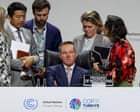
Cop31 left Chris Bowen stuck between petrostates and climate reality. Australia’s climate change minister will face a torrent of criticism over his role, but disagreement over fossil fuels proved an unbridgeable sticking point After delivering a major speech to the UN climate talks in Turkey last week, the Australian prime minister, Anthony Albanese, dismissed criticisms that he hadn’t managed to name the problem that is overwhelmingly driving catastrophic global heating – burning fossil fuels.
Australia’s climate change minister will face a torrent of criticism over his role, but disagreement over fossil fuels proved an unbridgeable sticking point
After delivering a major speech to the UN climate talks in Turkey last week, the Australian prime minister, Anthony Albanese, dismissed criticisms that he hadn’t managed to name the problem that is overwhelmingly driving catastrophic global heating – burning fossil fuels.
“You could pick out any number of things that were not in what was a short speech,” he later said.
If Albanese really thought the head of a leading coal and gas exporter failing to address the issue head-on was inconsequential or trivial, then his climate change minister, Chris Bowen, will have a story for him after the finals days of the fractious talks that became the longest UN climate summit ever.
Those talks failed spectacularly to nail its prime ambition – an “Antalya pact” that was meant to drive investment in renewable energy and electrification, boost finance to help developing countries facing worsening climate damage, and acknowledge the world is bursting through a goal of limiting the increase in global temperatures to 1.5C, with alarming consequences across the planet.
As president of negotiations, Bowen barely slept for three days, and on the final night caught only a few moments of shut-eye on a couch in the office where a parade of negotiators had been coming to sit and talk to him.
Many of them raised a “red line” they said was non-negotiable – that any agreement from the summit must refer to the need for the world to “transition away from fossil fuels” that had previously been agreed at talks in Dubai three years ago. Others, including Saudi Arabia, didn’t want the words “fossil fuels” mentioned at all.
A compromise was proposed in the two final drafts of what was meant to be a “cover decision” – an overarching agreement that all countries would back. Drawn up by Bowen and his verbose Turkish counterpart, Cop31 president Murat Kurum, it suggested countries would “recall” the decision in Dubai “in its entirety” – effectively acknowledge its existence – but not say fossil fuels directly.
The European Union, Panama, the Marshall Islands, Vanuatu, Norway and Belize were among the countries that said no. Ireland’s climate minister, Darragh O’Brien, said the omission was “unconscionable” and the EU could not support it. Climate campaigners agreed.
With the scheduled Friday finish of the summit a distant memory, Bowen left the stage of the plenary hall late on Sunday afternoon when it was clear too many countries could not accept the text that he had helped put on the table.
Speaking to journalists, Bowen said “Australia left nothing on the field” but the red lines he and his staff tried to negotiate were “unbridgeable”. In particular, the way a transition away from fossil fuels was mentioned.
Some countries said they couldn’t support a pact that didn’t mention it, and others “insisted if it was mentioned, they would veto”. “I would have been happy with transition away from fossil fuels being in the text, but that was not going to get support,” Bowen said.
Bowen said despite the breakdown, “in the real world” the transition away from fossil fuels was inevitable and irreversible – and happening at speed. A promised electrification target – that 35% of final energy will come from electricity by 2035, a step that analysis has found could significantly cut fossil fuel use – had the backing of more than 90 countries and was not a deal-breaker.
The climate minister will be presented with a torrent of criticism that the talks failed and he failed. Much domestic news coverage has focused on the cost of Cop31 to Australian taxpayers, rather than the substantive issues being dealt with.
In Antalya, the narrative out of the talks was quite different. Some said the rejection of the pact was a line in the sand that showed the world was no longer willing to accept lukewarm responses on the climate crisis that bent to the whims of fossil fuel interests and petrostates. Some nations are setting up voluntary pacts outside the UN negotiations to try to get the results they need.
Despite some claims in the dramatic final hours, the talks did not actually collapse. Many less controversial elements of the convention’s myriad processes were passed.
But the talks did fail to agree to the Antalya pact that Bowen and Kurum had spent so much political capital on. Some of this failure may be down to the Cop process itself – its reliance on consensus to pass agreements creates plenty of opportunities for countries to block and delay.
Luke Menzel, the chief executive of the Energy Efficiency Council, a membership group focused on electrification in Australia, was at the talks for the full two weeks. He says the reality is “this process has been fracturing for a long time” and had become much tougher after years of wars, rising geopolitical tension and a fuel price crisis caused by conflict in Iran.
“It turns out Antalya is where the conference finally fractured. In many ways it is remarkable we have had as many Cops as we have had in a row that have achieved a consensus,” he says.
Many climate experts and high-profile figures were left questioning whether the Cop process needs major revision. The former US vice-president and long-time climate campaigner Al Gore was among them, arguing it was “an outrage” that “a handful of petrostates have veto power over any mention of fossil fuels” and concluding “it has been clear for years that the Cop process is in need of significant reform”.
Some campaigners sharply criticised Australia’s role. Denise Cauchi, the chief executive of Climate Action Network Australia, said it had “failed to broker an agreement” and “caved” to the hundreds of lobbyists that were pushing for controversial carbon capture and storage technology to be promoted in the pact. Its attempted inclusion was seen as a sop to fossil fuel interests.
But some from Pacific nations, who see the breach of the 1.5C temperature goal as existential and whose interests Bowen had promised to champion, said the failure in Antalya is shared more widely.
In the chaotic final plenary session, the Fijian climate change minister, Lynda Tabuya, addressed Bowen directly as the rest of the world listened.
“You have tried your utmost best, and we have seen it. Your door has always been open,” she said. “This work is hard – sleepless nights, and over hours and days of constant negotiations. This is not easy but we do it and we do it for our people.
“The failure here is not yours to carry. It is the responsibility of all parties.”
- climate
- chris
- bowen
- reality
- failure
- minister
- criticism
- fossil