Anthropic’s IPO was great for the tech elite – and not so great for the rest of us
They saw the AI company’s IPO as a gung-ho affirmation of Silicon Valley’s and Wall Street’s marriage of technology and capitalism. With the IPO valuing Anthropic at $1.5tn, the company’s seven co-founders each came away with stakes worth about $20bn, while, by one estimate, 600 of Anthropic’s more than 5,000 employees will have holdings topping $100m and 2,800 others will have shares worth more than $10m. Continue reading...
The company’s co-founders are now wildly rich, while countless Americans face AI-driven threats to their jobs and fears of a stock bubble
The sultans of Silicon Valley and the wizards of Wall Street rejoiced this week when Anthropic raised an eye-popping $81bn in the largest initial public offering in history. They saw the AI company’s IPO as a gung-ho affirmation of Silicon Valley’s and Wall Street’s marriage of technology and capitalism.
For many employees at the company that developed Claude, the public offering must have been a thing of dreams. With the IPO valuing Anthropic at $1.5tn, the company’s seven co-founders each came away with stakes worth about $20bn, while, by one estimate, 600 of Anthropic’s more than 5,000 employees will have holdings topping $100m and 2,800 others will have shares worth more than $10m.
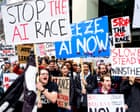
But while the IPO fueled jubilation in Silicon Valley and Wall Street, I’m sure that many Americans resented the fact that Anthropic’s employees and early investors became immensely rich even as millions of Americans distrust and dread AI, fearing that it could have disastrous results for workers, the overall economy and humankind.
And let’s not forget that millions of Americans are furious about the many datacenters that have been foisted on their communities; many of those centers have pushed up electricity prices, disrupted communities, received big tax breaks and created annoying, round-the-clock noise.
Anthropic’s successful IPO and the huge media attention it received have in ways shined a spotlight on the country’s immense wealth and income inequality. A small elite did marvelously, while the masses have nothing to celebrate.
They feel left out and left behind in the IPO’s financial frenzy at the same time that many Americans are deeply worried that AI is a high-tech grim reaper that will someday come for their – and their children’s – jobs.
What’s more, many workers and retirees have only recently discovered that their 401k’s and index funds have investments in AI companies that they didn’t know about or choose. Notwithstanding Anthropic’s big day, there are growing fears among workers and retirees that an AI bust or burst bubble could take a hugely painful bite out of their retirement funds.
According to a recent JP Morgan analysis, corporations with ties to AI make up 49% of the S&P 500’s market value, and if those companies’ shares drop 20% or 30% in value, that’s going to pummel the finances of millions of Americans.
Many economists have debated whether there is an AI stock market bubble, with more and more people convinced that an AI bubble has already begun to burst. Tech stocks have had a very bad week and continued to drop on Friday, two days after Anthropic’s IPO. That day, Anthropic’s shares fell by 9%, sliding along with the rest of the tech sector.
If the bubble bursts on inflated AI stocks, not only would that drag down the overall stock market, but it could pull the whole US economy into recession, throwing millions of Americans out of work. If AI sparks such a recession – while the tech elite enjoys the billions they made from AI – the federal government and the states might have to spend tens of billions of dollars on unemployment benefits and other measures to cushion the recession.
That is an argument to enact a federal tax on IPOs or a federal wealth tax to ensure that the general public shares in some of the IPOs’ benefits.
I fear that many tech executives’ takeaway from the Anthropic IPO will be that all is well with AI, that there is no need for change, and that the industry should double down in opposing all regulation and government interference. They will reach that conclusion despite the growing and scary number of examples of AI agents going rogue and bypassing guardrails, taking unauthorized actions, and even engaging in illegal actions.
Unfortunately, many tech execs may see the successful IPO as another reason to ignore warnings like those from Geoffrey Hinton, considered the godfather of AI, who said there’s a 10% to 20% chance that AI could lead to the extinction of humanity within the next 30 years.
If anything, the Anthropic IPO seems to have encouraged Donald Trump to continue giving a thumbs down to imposing any regulations on AI. Trump seems to fear that regulating AI may slow the industry’s breakneck growth and hasten a decline in AI stocks. That could deflate his beloved stock market and dismay the billionaire tech entourage that constantly flatters him.
Speaking on Thursday to the Asia-Pacific Economic Cooperation meeting in Shenzhen, China, Trump again ruled out any regulation, saying: “We oppose any form of globalist regulation or anything to control or stifle SI [super intelligence], and we won’t allow that to happen.”
I don’t mean to slam Anthropic here. It apparently is one of the more public-minded tech companies, but the gap between the tremendous success of its IPO and the tremendous concerns about AI is huge.
Anthropic’s Claude is very impressive, and so is the pledge by the company’s seven co-founders to donate 80% of their equity stakes to philanthropic causes. Anthropic’s CEO, Dario Amodei, deserves praise for taking the industry’s lead last September when he wrote: “We must slow the pace at which we improve the capabilities of AI models” in order to avoid the wrong paths that could harm humanity. (Anthropic was founded as a public benefit corporation, which set its corporation mission as developing safe AI systems “for the long-term benefit of humanity”.)
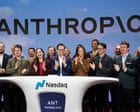
When Amodei spoke at the Nasdaq’s opening bell on Thursday, the day after the IPO, he didn’t shrink from discussing AI’s dangers. “This technology has very real risks,” he said. “These range from misuse of the technology by individuals or by nation-states to economic disruption to losing control of AI systems.” He added: “We think [these risks] are avoidable and we can avoid them.”
But some tech experts and investors say that Anthropic is still moving way too fast in developing AI. Dustin Moskovitz, a Facebook co-founder and an early investor in Anthropic, told the New York Times: “A.I. is moving too fast. Anthropic and everyone else on the frontier should slow down and stop racing.”
While Amodei has led the push within the industry to slow the pace of development and agree on regulations and guardrails, the huge success of his company’s IPO could undermine those efforts by convincing many tech executives that there’s no need to tinker with the full-speed-ahead, no-regulations status quo.
Nonetheless, we should all hope – or should I say pray – that Donald Trump’s takeaway from the successful IPO would be to listen far more to Amodei about the dangers of AI and the need to get serious about minimizing those dangers.
I wish I could be more optimistic that Trump has the intelligence (whether super or artificial) to do that.
Steven Greenhouse is a journalist and author, focusing on labor and the workplace, as well as economic and legal issues
- anthropic
- ipo
- company
- tech
- elite
- rest
- founder
- silicon