world

Arctic air brings colder temperatures to Europe this week
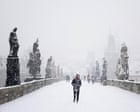
Arctic air brings colder temperatures to Europe this week

After a warmer-than-average November so far globally, a cold snap is on the horizon in parts of Europe While average global temperatures continue to set records through one of the strongest El Niños on record, temperatures across a large swathe of Europe could plunge this week, as Arctic air sweeps in. On Friday, the global average temperature was 2.12C higher than the preindustrial average, the biggest ever anomaly and equivalent to 1.22C above the 1991-2020 climate average.

After a warmer-than-average November so far globally, a cold snap is on the horizon in parts of Europe

While average global temperatures continue to set records through one of the strongest El Niños on record, temperatures across a large swathe of Europe could plunge this week, as Arctic air sweeps in.

On Friday, the global average temperature was 2.12C higher than the preindustrial average, the biggest ever anomaly and equivalent to 1.22C above the 1991-2020 climate average.

But in parts of Europe, high pressure building over Scandinavia and low pressure shifting south-east into western Russia will open a corridor of cold air from the north. Temperatures in the Baltics and in countries such as Germany, Poland and Ukraine are likely to fall widely below zero from Monday, with ice days – in which temperatures stay below 0C all day – expected from midweek. By the weekend, temperatures could be 5-15C below average, reaching double-digit negatives on higher ground.

The low pressure over eastern Europe and western Russia will bring extensive snowfall. Southern Poland, Belarus, eastern Ukraine and south-eastern parts of the Baltics will be the first to see widespread snow, which could reach up to 10cm in southern Poland.

Later in the week, as a smaller area of low pressure pushes into western and central Europe, significant snow is expected to spread across southern Germany, Austria and Czechia, where depths of 10-20cm could build. The Alps could get a significant dumping of snow, a welcome boost for the region’s ski resorts which will open in the coming weeks.

Into the weekend and the start of December, high pressure is set to remain dominant across northern Europe, maintaining below-average temperatures in central and eastern Europe and possibly extending into the Balkans. There are also hints that the sudden stratospheric warming earlier this month could finally begin influencing the lower atmosphere, with high pressure extending farther west and perhaps bringing cold easterly winds into western Europe and the UK, although confidence on this is low.

The cold in Europe is in stark contrast to the global picture. This October was the warmest on record, with an average global temperature of 15.35C, 0.9C above the 1991-2020 average and 1.75C above the estimated preindustrial level. It was the third month in a row above 1.5C, following August and September, and while parts of Europe, including the UK, have seen below-average temperatures so far this November, global temperatures this month have continued to run above average.

  • europe
  • air
  • temperature
  • record
  • arctic
  • average
  • warmer
  • november

Summaries and tags are generated automatically. Stay informed with VidiaNews.

Related news

Zelenskyy says Ukraine responsible for sinking Russian warship in Libya – Europe live
world

Zelenskyy says Ukraine responsible for sinking Russian warship in Libya – Europe live

President says Kyiv responsible for sinking Merkury warship in Benghazi on Sunday and also drone attack on cargo vessel MV Angara Russian warship sinks in Benghazi after suspected Ukrainian drone attack And here’s Zelenskyy’s video from the attack: Ukraine’s president Volodymyr Zelenskyy has claimed responsibility for sinking a Russian warship at a Libyan naval base on Sunday, saying it was part of Kyiv’s response to Russia’s continuing aggression.

Read →
Israel’s destruction of Gaza has created a ‘toxic wasteland’, experts find
world

Israel’s destruction of Gaza has created a ‘toxic wasteland’, experts find

Scientific and satellite findings warn of widespread contamination in Gaza, posing grave threats to public health ‘for generations to come’ Israel’s destruction of Gaza has left a devastating environmental legacy with poisoned water, contaminated soil and toxic air threatening the life-support systems that the population depends on for survival, according to a report. Israel’s military assault has created widespread contamination across the entire strip, the report by Oxfam and the Conflict and Environment Observatory (Ceobs) finds, with heavy metals, explosive residues, asbestos from destroye

Read →
Gas prices in Europe surge as forecast cold snap feeds supply shortage fears
business

Gas prices in Europe surge as forecast cold snap feeds supply shortage fears

Jump in price follows slowdown in Qatar supplies and depleted summer stocks due to heatwaves Business live – latest updates European gas prices surged on Monday as a forecast cold snap in the coming weeks fed fears across the continent’s over depleted supply this winter and costly household bills. The Dutch month-ahead contract – the European benchmark for gas prices over the next four weeks– rose by as much as 8.6% to €96.08, before settling up 4% at €92.50.

Read →
Europe is entering a ‘supercycle’ of national elections. Their outcomes could shake the EU’s foundations
politics

Europe is entering a ‘supercycle’ of national elections. Their outcomes could shake the EU’s foundations

Europe is entering a ‘supercycle’ of national elections. The effects of the continent’s coming polls will be felt far and wide – and could well turn into ‘key tests’ of the bloc’s resilience In late 1998, Tony Blair was prime minister of Britain, Lionel Jospin was prime minister of France, and Gerhard Schröder had just been elected chancellor of Germany.

Read →
Why I love Berlin in winter: ‘Christmas markets arrive in a blaze of twinkling lights’
business

Why I love Berlin in winter: ‘Christmas markets arrive in a blaze of twinkling lights’

The cold is legendary, but there’s hot chocolate and Glühwein to warm you up, plus crowd-free museums and galleries and cosy candlelit pubs One of the first things Berliners warned me about when I moved here in 2008 was the winters. No sooner has the temperature dropped, and the last yellow leaves see-sawed from the trees at the end of November, than the city’s Christmas markets assert themselves in a blaze of twinkling lights, aromatic grill smoke, candied nuts and warming cups of Glühwein.

Read →