After Japan's APEC snub, what's ahead for China ties?
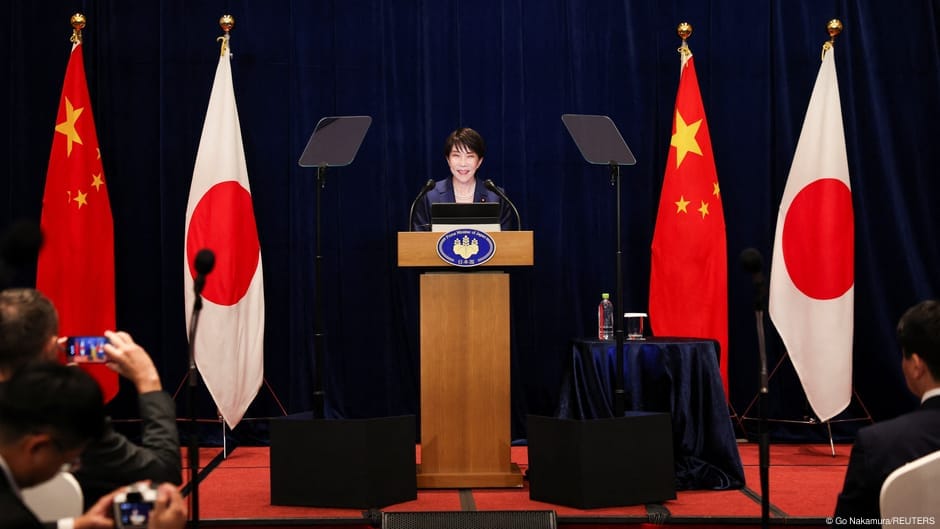
Japan has long-running concerns over Chinese military expansionism, and Beijing has bristled over Sanae Takaichi's comments on Taiwan. The frosty ties were on full display at last week's APEC summit.
Japanese Prime Minister Sanae Takaichi received a cold shoulder from China during the recent Asia-Pacific Economic Cooperation (APEC) summit in the tech hub of Shenzhen.
After Takaichi arrived in Shenzhen on November 18 for the two-day summit, there was an immediate issue when the mobile stairs to the door of her aircraft were some way short of the threshold, requiring her to hold on to the door frame to step down around 40 centimeters (about 15 inches) to the top step.
It may have been completely inadvertent, but upon safely reaching the airport tarmac, her official welcome was decidedly low-key. There were no musical performances, no cheering crowds or traditional dances, which were laid on for many other APEC leaders as they arrived.
Japan's Yomiuri newspaper reported on November 20 that when Takaichi met Chinese leader Xi Jinping at the dinner reception, "his reaction was cold." And while many other regional leaders managed at least a brief one-on-one with Xi on the sidelines of the main event, the Japanese delegation was not granted such access.
"The level of frostiness from the Chinese side was on full display from the moment Takaichi's plane landed," said William Yang, a Taiwan-based analyst for the International Crisis Group.
"I cannot think that the issue with the plane steps was anything other than deliberate and there was a huge contrast between the welcome she received and virtually everyone else," he told DW.
Yang added the ice didn't break when Takaichi tried to speak to Xi at the dinner reception and the entire occasion "just reflects the state of bilateral relations."
China and Japan share a troubled history, marked by the Japanese invasion of China in the 1930s and the often brutal occupation of cities that were captured and subjugated.
Chinese schoolchildren learn about the horrors of the Nanjing Massacre and the use of chemical and biological weapons by Japanese forces.
Japan maintains that its repeated post-war apologies and massive economic aid that helped China to become the economic powerhouse it is today are overlooked amid the criticism.
Diplomatic relations were normalized in 1972 and Tokyo pursued a policy of engagement over the following decades, although that came to a halt in the mid-2000s, points out David Adebahr, a professor of international relations and Asia-Pacific security policy at Kobe University.
"China's rising military spending, the breakdown of talks over the East China Sea in 2006, and a resurgence of nationalism raised concerns even among Japan's more China-friendly diplomats, while defence analysts noted an increase in Chinese submarine activity near Japanese waters," he told DW.
The nationalism on display during the 2008 Beijing Olympics, coupled with China's more assertive stance over the Senkaku Islands, which Japan has sovereignty over but which Beijing claims, accelerated this shift.
Ties took a sudden nosedive in November 2025 when Takaichi responded to a question in Japan's parliament, the Diet, by saying that any "contingency” involving Taiwan would also inevitably threaten the national security of Japan.
According to Adebahr, the Japanese leader was merely saying out loud what "had long been the internal logic of Japanese security planning." Nevertheless, Beijing has reacted with fury.
China has demanded that Takaichi retract the statement and raised pressure on Japan by restricting exports of rare earth minerals critical to Japanese industry, banning imports of Japanese seafood and telling tourists to take Japan off their destination list.
And while ruffled national feelings have been smoothed in the past with shows of reciprocal goodwill, China is standing firm on its demands this time.
"From Tokyo's perspective, it is clear that Beijing believes it holds more cards than in the past," said Adebahr.
"Today, Beijing has considerable leverage: Japan's dependence on Chinese rare earths; an increasingly visible military presence around Japan, sometimes in conjunction with Russia; and a US administration that has urged Tokyo to de-escalate rather than firmly backing it."
"This gives China little incentive to offer Takaichi a face-saving compromise," he said. "However, this approach comes at a cost to Beijing too: the more it relies on coercion, the more it pushes Japan towards increased defence spending and closer ties with other partners."
Still, the Japanese leader finds herself in a difficult position, said analyst Yang.
As a committed conservative who has talked tough on Beijing's rapid military buildup, its seizure of islands and atolls in the South China Sea and the inexorable pressure on Taiwan to capitulate and become one with mainland China, Takaichi cannot give in to Xi's demands for fear of losing face with her hardline base.
"This is a major test of her abilities and wisdom as the nation's leader," Yang said. "She is walking a political tightrope between reducing tensions with China but, at the same time, preparing the nation and its allies for a potential contingency over Taiwan."
"I foresee China maintaining its current approach, continuing to step up the pressure by limiting targeted exports and amplifying the assertion with Russia and North Korea that Japan is embracing remilitarization," he said.
"I expect Japan to try to find areas where it can signal goodwill and seek to improve relations in return for small-scale compromises, but a reset in the dynamics will be determined by how the Trump administration shapes its foreign policy for the remaining years of his term," Yang added.
Analyst Adebahr said that while he expects diplomatic relations to remain frosty, there are too many interdependencies for a full decoupling between China and Japan.
"I would not be too pessimistic about the relationship, because in the medium term, trade, technology and critical minerals are now seen as security issues," he added. "Therefore, complex interdependence will prevent a return to the old pattern of keeping politics and economics separate."
"While economic interdependence alone will not be enough to stabilize the relationship, full decoupling is highly unlikely, as transaction costs would be far too high for both sides."
- apec
- japan
- snub
- china
- tie
- concern
- expansionism
- beijing