Saariaho’s Adriana Mater transcends horror for hope. Female composers are rejecting opera’s legacy of violence
Saariaho’s Adriana Mater transcends horror for hope. Kaija Saariaho and today’s female composers are challenging this narrative, and thereby connecting with today’s world In 1992, the Finnish composer Kaija Saariaho saw a Salzburg festival production of Messiaen’s Saint François d’Assise.
The death and pain of female characters has always been a bedrock of opera. Kaija Saariaho and today’s female composers are challenging this narrative, and thereby connecting with today’s world
In 1992, the Finnish composer Kaija Saariaho saw a Salzburg festival production of Messiaen’s Saint François d’Assise. A series of meditative theological tableaux in which naturalism and plot is secondary to the revelation of deeper spiritual truths, it is now hailed as a masterpiece although it divided critics on its Paris premiere in 1983.
Saariaho, one of the painfully few female composers in opera’s 400-year history, recalled thinking: “If that is an opera, then I can write one”. And she did, to notable international acclaim. Her first opera L’Amour de loin (Love from Afar), a tale of medieval courtly love with a libretto by war correspondent and writer Amin Maalouf was premiered, appropriately, at 2000’s Salzburg festival and came to the UK when English National Opera staged it in 2009.
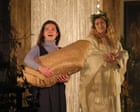
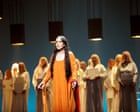
Her second opera with Maalouf was Adriana Mater. The work charts a clear path towards hope and reconciliation. Amid the backdrop of a civil war, Adriana is raped and becomes pregnant by Tsargo, a man from her own community. She chooses to give birth to the son she conceives, raising him with hope for the future, while shielding him from the truth about his father. Many years later her son discovers the truth of his origin and becomes consumed by the desire to kill Tsargo. But faced with the reality of his now old and blind father, Yonas cannot bring himself to avenge Adriana and returns to his mother feeling a failure as a man and a son. This is her moment of triumph – “This man deserved to die, my son, but you did not deserve to kill … We are not avenged, Yonas, but we are saved.” Saariaho’s opera illuminates the decades long, often unrewarded work of peace-making after civil conflict that many women across the world quietly commit to – my native Northern Ireland included.
As Peter Sellars, the director of the 2006 world premiere, said of the piece, “In the 21st century we have a responsibility to do more than sit around and tell sad stories. Here we see there will be a future. And that future has been guaranteed all over the world by women, women who, in impossible situations, nourish and cultivate human dignity.”
The uncompromising themes and sound world of this second opera so contrasted with the mystical romanticism of her first that Saariaho disconcerted many. “After L’Amour de loin, I felt the need to write an opera reflecting the world around me. My relationship to music as an intimate and protected universe had broken down after the events of 11 September 2001,” she said. Her creative courage cost her critical appreciation at the time – a price that perhaps a male composer would not have paid. It is only now after the immediate acclaim that met her final opera Innocence about a school shooting (seen at the RBO in 2023, shortly before she died aged only 70) that Adriana Mater is being reassessed – the recent Esa-Pekka Salonen recording won both the Gramophone and Grammy opera recording of the year.
For centuries, men have been using the death and pain of female characters as a bedrock of the art form. It is notable that Saariaho and the female composers of today are not reacting to this legacy by rejecting the subject of violence in their own work – just the opposite. They are championing the relevance and impact of opera by using it to confront modern life’s most difficult issues and, as Cesar Cruz’s aphorism declares – proving that art should “comfort the disturbed and disturb the comfortable”.
Du Yun’s Angel’s Bone, which opened ENO’s London season after an immersive run in Aviva Studios in Manchester, is a harrowing parable about the human trafficking that underpins the dark reality of modern capitalist societies. Our upcoming production of Breaking the Waves by Missy Mazzoli is an adaptation of the devastating film by Lars von Trier about love, faith and marital martyrdom. And for one night only we have a guest performance of To Die For – a darkly comedic exploration of the search to find meaning in a meaningless world by the Russian-born British composer Elena Langer.
These productions join those of Thea Musgrave’s Mary, Queen of Scots and Janine Tesori’s Blue in recent seasons. Moving towards a canon that reflects the talents of as many female composers as male will be a long process – but in our more equitable modern world how can opera as an art form seek to connect with its future audience if it doesn’t?
Recent research from the Laidlaw Trust, which champions the need for new, relevant opera, has found that although nearly 60% of the public want to go to opera, far fewer are now regular attenders. The company that became English National Opera was created in 1931 by the legendary Lilian Baylis who gave us our rallying cry – that opera should be for everyone. For ENO, the presentation of female-created work is key to making sure the future of opera is thrilling for current and future audiences. As Arts Council England has noted, of the 6,500 opera performances across England between 2017 and 2023, the 25 most frequently performed titles are more than 100 years old – and not one of them was composed by a woman.
Of those top 25, Puccini’s operas are of course among the best loved and most performed – ENO’s current season also includes a reimagined Tosca. Puccini adapted his opera from the controversial hit stage play of the same name by Victorien Sardou that had caused political and moral consternation when premiered in Paris in 1887. Puccini knew well the power of this collision of art and politics. He chose to premiere his operatic version in a 1900’s Rome that was experiencing riots, chaos and conflict leading to ruthless authoritarian clampdown on the population. The political atmosphere in the run-up to Tosca’s opening was so heightened that death threats were delivered to the stage door for the performers and the first night had to be postponed due to threats of an anarchist bombing.
Famously, the initial critical response to the premiere of what musicologist Joseph Kerman later called Puccini’s “shabby little shocker” was damning. The impact of the opera’s sexual content, torture and violence-driven melodrama thrilled its audiences. And it still is doing so today in the London Coliseum, relevant as much in 2026 as it was in 1900 as attacks on artists and art play out in our international news today.
In this season this conversation between the old and new canon is made tangible: Puccini ’s Tosca is in artistic dialogue with Saariaho’s Adriana Mater. Tosca is a woman attacked by a violent military man and, in fighting back, pays a terrible price as conflict continues; Adriana suffers a similar attack, becomes pregnant and fights back in a different way by bringing up a son who rejects violence. This journey from Tosca’s war to Adriana’s peace places both stories in the same world as prequel and sequel.
But above all, Adriana Mater is about a mother’s legacy. As such, it is especially meaningful for ENO to be collaborating with Saariaho’s own children – author of the English translation Aleksi Barrière and Aliisa Neige Barrière, who will conduct two of the performances.
There are many of us who love opera. Creative teams, conductors, composers, commentators, the singers who sing it, musicians who play it, audience members of both long and recent standing – all know that it is bigger than any one opinion or perspective. As the story of Saariaho’s transcendent heroine Adriana shows, opera’s synthesis of emotion and intellect captures the impossibly complex beauty and pain of being human. Opera is like life – impossible to pin down, and all the better for it.
- opera
- saariaho
- composer
- adriana
- mater
- horror
- hope
- legacy