Lucy Worsley’s Keys to the Castle review – heavenly TV that instantly brightens up your day
To have it be also about one of your favourite subjects is another, and so Lucy Worsley’s Keys to the Castle has me practically insensible with delight before we so much as shift the first tumblers on the lock to the Doge’s Palace in Venice, where the four-part series begins. It then moves on to Versailles and Blenheim before finishing up with – joy of deepest joys, though not perhaps for its poor, lonely conceiver and inhabitant Ludwig II – Neuschwanstein Castle in Bavaria.
The brilliant historian has a gift for cheering everybody up. In this series, she discovers the delights of European castles – and makes you want to spontaneously book a holiday
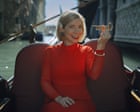
When I think of Lucy Worsley, I am immediately cheered up. Partly it’s the coats. (So neat! So bright! So wonder where she gets them and if I could carry one off!) Partly it’s the hairclips. (How big has she gone this time? Is it going to stay in?) But mostly it is her; her energy, her indefatigability, her determination to impart what she knows in the most accessible way and, above all, her abundant confidence without ego. It’s the latter that allows for that rare thing – other historians to be interviewed and share their knowledge with the lay person at home without the presenter champing at the bit to show that he or she knows this already and that they are just letting them simplify things for the good of the show. This is my personal bugbear, so thank you for letting me exorcise it here, and thank you to Worsley for not adding to my burdens.
To feel cheerful as you approach a history lesson is a great boon. To have it be also about one of your favourite subjects is another, and so Lucy Worsley’s Keys to the Castle has me practically insensible with delight before we so much as shift the first tumblers on the lock to the Doge’s Palace in Venice, where the four-part series begins. It then moves on to Versailles and Blenheim before finishing up with – joy of deepest joys, though not perhaps for its poor, lonely conceiver and inhabitant Ludwig II – Neuschwanstein Castle in Bavaria.
The Doge’s Palace is really, Worsley notes, a government building. More untraditionally palatial than that, even, it was the nerve centre of an imperial spy network back in the days when Venice was a rich and ruthless beneficiary of its geographic position on the Adriatic as the gateway to maritime trade between east and west, rather than a honeymoon hotspot.
Floorplans and cutaways (oh, I am in heaven) show us where in this enormous gothic fortress, disguised as a home for a figurehead, disguised as a ruler (the doge was an elected noble but fell in line with whatever his Council of Ten dictated) we are. We move up golden staircases, fly drones around the ceiling friezes of the great hall, then descend into the depths of the piombi prison to see cells beneath the water level (quite as unpleasant as that suggests, even before we see the explicit graffiti left behind by prisoners – “Disappointing,” says Worsley). Next, we follow the route of the bold escape taken by its most famous detainee, Casanova, before looking inside the special post boxes set up by the increasingly totalitarian government for citizens to tip their denunciations of others into, and at a possibly ill-advised demonstration of the council’s preferred method of torture.
By the end of the set pieces, interspersed with chats with other historians and experts, you find – as always with Worsley – that you have absorbed an awful lot with remarkable ease. We have moved through the history of the castle, of Venice, its politics and economy, its influential adoption of quarantine (hence the word’s derivation from the Italian for 40 days) to deal with the plague that landed on its 15th-century shores and its eventual decline in powers (thanks to the emergence of competing trade routes and the fact that all days in the sun come to an end), Napoleonic takeover and its evolution into tourist destination and Cornetto-shifter. But now we can all go and see beyond the beauty to the darkness below. Happy honeymooning, y’all!
The same trick is effected at Blenheim (early adopter of the corridor, dontcha know!, as well as the childhood home of Winston Churchill who largely grew up there with his grandparents while Randolph and Jenny, his parents, found more fun things to do elsewhere), and then at Versailles, with an emphasis on Marie-Antoinette’s misery there.
From the libertine Sun King’s glittering abode we move to the lonely, nocturnal Ludwig II of Bavaria’s alpine retreat from the world. Created out of an obsession with Wagner, a passion for Romanticism and a denial of the love that dared not speak its name in 19th-century Germany, it is lined with scenes from his favourite operas, depictions of knights, damsels and dramatic rescues, but none of it was enough to save him from an early death, by drowning in a nearby lake – whether by suicide or murder is still not clear – though his fantastical creation lives on as the quintessence of all our castellated dreams.
I long to visit. As soon as I find my passport, a suitable hairclip and a tomato-red coat, I’m off.
- worsley
- castle
- lucy
- keys
- review
- historian
- series
- delight