Natural beauty made this New Zealand tourist village. Now it threatens its existence
Natural beauty made this New Zealand tourist village. Famed for its nearby glacier, Franz Josef village faces ‘catastrophic’ flooding and deaths if action not taken to manage the Waiho River The small village of Franz Josef sits on the rugged west coast of New Zealand’s South Island, its natural beauty providing the drawcard for a million tourists to pack its hotels, spas and restaurants every year.
Famed for its nearby glacier, Franz Josef village faces ‘catastrophic’ flooding and deaths if action not taken to manage the Waiho River
The small village of Franz Josef sits on the rugged west coast of New Zealand’s South Island, its natural beauty providing the drawcard for a million tourists to pack its hotels, spas and restaurants every year.
But that drawcard – which has turned it into a hotspot for everything from hiking to kayaking and made it one of the country’s most popular destinations – may change the course of the village’s fate once again.
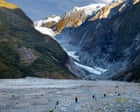
Its collection of buildings lies in the shadow of the famed Franz Josef glacier, on an alpine fault and beside the Waiho River, a globally rare braided river. And the river is rising.
The latest technical report, released in September, shows the Waiho is rapidly rising and changing course – several years earlier than previously predicted – and scientists warn that Franz Josef is at risk of “catastrophic” flooding and deaths if action is not taken to release its waters. The report shows the original 10-year plan to release water from the river needs to be brought forward.
“If the full force of the Waiho goes through the township, then the structures, buildings – whatever is in its way – will be significantly damaged, if not destroyed,” says Prof Ian Fuller, a fluvial geomorphologist and spokesperson for the independent Waiho technical advisory group, set up to advise the West Coast regional council.
“We’ve now got seven years ... essentially we need to be doing 10 years work in seven,” Fuller said.
Since the report’s release, scientists have been calling for urgent intervention to prevent a disaster, which has prompted local authorities to accelerate their river management plans.
While links to climate change affecting the river are tenuous at this stage, global warming and El Niño will bring more rainfall and the potential of floods, Fuller says.
Adding to the risk, there is a 75% probability of a magnitude eight earthquake within the next 50 years, according to Earth Sciences NZ. A rupture could trigger flooding, landslides and cause “wholesale destruction of the town,” Fuller says, describing the damage as “potentially catastrophic”.
But he was quick to reassure residents they could “sleep safely in their beds” because the river and rainfall are closely monitored, while urging better evacuation plans and information signs for tourists. The community is not living with fear, says Janelle Shaw, a Franz Josef resident and chair of the Glacier Country Tourism Group. But it is becoming increasingly frustrated at the lack of action. “We’re three years on from when a similar report was released, and we have made no further progress.”
For years, Shaw, alongside the residents and community association, has lobbied authorities to include the community in its planning.
“It has to be something that’s happening with the community rather than something that’s happening to the community,” she said, adding the Westland District Council’s new working group, which is supposed to include residents, is a good first step.
Braided rivers move large amounts of gravel and sediment downstream, but in narrowed rivers, the gravel builds upwards, instead of spreading out. The Waiho riverbed is rising about 20 centimetres a year. A large amount of sediment accumulating near the glacier could accelerate the problem if a storm pushes it downstream.
Since the 1980s, stopbanks – a long mound of gravel and soil that limits water spreading on to land – have been erected to contain the river, to make way for land-use such as building, farming and infrastructure. The rising riverbed makes stopbanks more vulnerable to flooding.
“Now the bed of the river is perched two metres above the land adjacent to the river, in the vicinity of the township,” Fuller says.
In 2023, the advisory group found the river was carving out a new channel, north of Franz Josef village. It recommended a 10-year plan to give the river room to move and lessen flood risk. But in September, the group found the river is changing much faster than initially predicted, despite a period of relatively quiet weather.
Franz Josef has long discussed the possibility of relocating the village, but the advisory group recommends first releasing the river’s southern stopbanks to allow the water to fan out and slow the rate of riverbed rise.
It would buy the village time, but requires relocating the highway, wastewater infrastructure and landfills, and submerging swathes of private farmland at a cost of more than $200m (£83m).
Westland District’s mayor, Helen Lash, says the prospect of releasing the river is “very raw” for the community.
“These homes and farms are where they live, what they have invested in and brought their families up in,” Lash says. “It’s a damn hard conversation to have with anyone but it is something we have to look at … if we are to protect the northern side of the town.”
Lash has formed a working group in response to the report, with relevant agencies, local authorities and the community aiming to present a plan to the government in early 2027.
A future government – which will be confirmed when the country’s election results are finalised on 27 November – will decide how to manage the situation. Simon Watts, the minister for local government and climate change, has said authorities are working on legislation to ensure councils are creating adaptation plans for areas exposed to natural hazards.
But Fuller is concerned the government is not acting with enough urgency and pointed to January’s deadly landslide in Tauranga – a known hazard before disaster struck – as a warning.
“We cannot allow that to happen at Franz Josef,” he says. “We know about the risk. We’ve got a solution. It requires investment. There’s no need for anyone to lose life here.”
- village
- beauty
- zealand
- tourist
- existence
- franz
- josef
- drawcard