entertainment

RPO/Hisaishi review – Studio Ghibli’s genius brings his concerto to a rapt London
RPO/Hisaishi review – Studio Ghibli’s genius brings his concerto to a rapt London

Royal Albert Hall, London The Royal Philharmonic rode the bucking rhythms of the star composer’s intricate score, the highlight of an evening that also included works by Steve Reich and David Lang If anyone tells you that classical music is dead you need just two words to refute them: Joe Hisaishi. You can debate style and genre, but there’s no arguing with the impact of a man who can sell out the Royal Albert Hall on a Monday night in November with an evening of music by Steve Reich, David Lang and Hisaishi himself – and not a film score in sight.

Royal Albert Hall, London The Royal Philharmonic rode the bucking rhythms of the star composer’s intricate score, the highlight of an evening that also included works by Steve Reich and David Lang

If anyone tells you that classical music is dead you need just two words to refute them: Joe Hisaishi. The 75-year-old Japanese conductor, composer and pianist may be best known for his soundtracks, particularly his long association with Hayao Miyazaki’s Studio Ghibli films, but has parlayed his popular success into serious concert-hall credentials.

You can debate style and genre, but there’s no arguing with the impact of a man who can sell out the Royal Albert Hall on a Monday night in November with an evening of music by Steve Reich, David Lang and Hisaishi himself – and not a film score in sight.

The centrepiece of his latest collaboration with London’s Royal Philharmonic Orchestra was the UK premiere of Hisaishi’s Concerto for Orchestra. Co-commissioned by an astonishing 11 ensembles spread across six different countries, its musical DNA is no less international. Hisaishi’s programming emphasised its lineage in American minimalism, but there’s Vivaldi in there, a nod to Stravinsky’s Shrovetide Fair, to Bernard Herrmann and even Caribbean colours in the kaleidoscopic mix.

Five movements are identified only by number – no performance direction or speed marking to frame our expectations. We start where Reich and Lang left off, in fiercely patterned, meticulously layered processes. As the beat is divided smaller and smaller the surface starts to gleam with sequinned texture: a mathematical exercise dressed up in black-tie. It’s off to carnival in the genial second movement, which together with the queasy cross-rhythms of the central panel features a series of jazz-style breaks for sections or solo instruments (a trio of bassoons supply gusty comedy, and there are some arresting histrionics from double basses). A Ravellian pastoral leads into a meaty, contrapuntal finale.

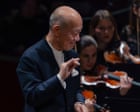
This is a well-established partnership, and the RPO were glued to Hisaishi’s precise beat: riding the bucking rhythms of this intricate score, moving seamlessly between solo and ensemble spirit. This shapeshifting was also uppermost in Steve Reich’s 2018 Music for Ensemble and Orchestra: at once monumental and playful in the RPO’s polished account. But Lang’s Mountain (2014) swapped musical metamorphosis for a monolith. A single idea – a big thump for brass and timps that ricochets through the strings, followed by silence – isn’t enough to sustain its span. A note by the composer himself describes the holiday view that inspired it. “Unchanging” may be a virtue when it comes to a mountain; it’s not for music.

  • hisaishi
  • studio
  • ghibli
  • london
  • royal
  • hall
  • rpo
  • review

Summaries and tags are generated automatically. Stay informed with VidiaNews.

Related news

To Hold a Mountain review – a spectacular setting for tough savvy woman’s fight against the government
entertainment

To Hold a Mountain review – a spectacular setting for tough savvy woman’s fight against the government

A livestock farmer with a sad secret in her past rallies to keep military training out of her breathtaking mountain home in Montenegro An award-winner in Sundance, where it premiered earlier this year, this slow-burn documentary follows a middle-aged Montenegrin livestock farmer called Gara and her 13-year-old daughter Nada. Although Gara calls Nada her daughter, the young girl is actually her niece; Gara adopted her after her sister, Nada’s mum, was killed by a violent husband.

Read →
Everything Else Is Noise review – a musician attempts to raise her art above the cacophony of city noise
entertainment

Everything Else Is Noise review – a musician attempts to raise her art above the cacophony of city noise

A TV shoot is beset with barking dogs, power cuts and personal animosities in Nicolás Pereda’s docufiction exploring the fight for artistic space in a world of distractions This latest docufiction from Mexican-Canadian film-maker Nicolás Pereda finds rhythm amid chaos. On this particular day, Teresa has opened her home to fellow musician Rosa (Rosa Estela Juárez Vargas), who wants to use the space for her interview with a two-man television crew.

Read →
The Boy and the Suit of Lights review – a sensitive portrait of an aspiring toreador in a changing Spain
entertainment

The Boy and the Suit of Lights review – a sensitive portrait of an aspiring toreador in a changing Spain

Encouraged by his grandfather and single mother, the teen Borja dreams of a career that will end his family’s poverty, but the protesters are gathering strength Where last year’s bullfighting documentary Afternoons of Solitude by Albert Serra was a tightly trussed formalistic affair concerned by the question of style in the arena and in art, this Scottish-produced film is a looser, more social-realist approach to la corrida. Supported by his harried, cigarillo-smoking single mother, Raquel, Borja hopes that wearing the sequined “suit of lights” will help lift his family out of poverty.

Read →
Focker In-Law review – triangle of sadness as Ariana Grande joins Stiller and De Niro in the circle of trust
entertainment

Focker In-Law review – triangle of sadness as Ariana Grande joins Stiller and De Niro in the circle of trust

Even Grande’s talent can’t save the fourth outing of this 90s-style grossout cringe comedy from a depressing sense of overfamiliarity So to the fourth film in the most consistently moderate but undeniably lucrative comedy franchise in modern Hollywood history, often featuring heavyweight actors (Dustin Hoffman, Barbra Streisand, Harvey Keitel) who don’t appear to be completely sure about what they’re supposed to be doing. Even now, even after all this time, I’m still not convinced that the great Robert De Niro is 100% on top of it.

Read →
Bill Wyman’s Rock & Roll Lists review – greatest hits and biggest misses
entertainment

Bill Wyman’s Rock & Roll Lists review – greatest hits and biggest misses

The rock critic’s obsessive yet incisive sorting of musical genius is a contrarian delight As veteran US music journalist Bill Wyman (no relation to the Stones bassist) would be the first to point out, the listicle is not a revered form of internet journalism. Suddenly the music press was awash with retrospective charts, evidence that an increasingly rosy view of rock history was abroad: the 90s also saw the rise of the heritage rock magazine, the expensively packaged retrospective box set and, indeed, of Britpop, an entire genre more or less predicated on evoking vague memories of the past,…

Read →
Interpol and Bloc Party review – two of 00s indie’s most revered acts go toe-to-toe
entertainment

Interpol and Bloc Party review – two of 00s indie’s most revered acts go toe-to-toe

Utilita Arena Cardiff Kele Okereke has a tough challenge selling Bloc Party’s trite latest album – a far cry from Interpol’s ‘masterpiece’ eighth record, performed here to darkly hypnotic effect Try as one might to resist comparison, the balance of this particular yin and yang has been shifting for some time. Twelve months ago, when Interpol and Bloc Party announced a UK and European co-headline tour, the pairing looked like an even contest: two of 00s indie’s most revered acts, whose landmark debuts remain touchstones of the era.

Read →