Tinubu reduces Nigeria’s 2026 budget by N3.2 trn, retains N29.2 trn borrowing plan

The total expenditure was reduced from N68.3 trillion, as earlier approved, to N65.1 trillion. Government revenue, including receipts from government-owned enterprises, is projected at N33.7 trillion, while aggregate capital expenditure stands at N26.2 trillion.
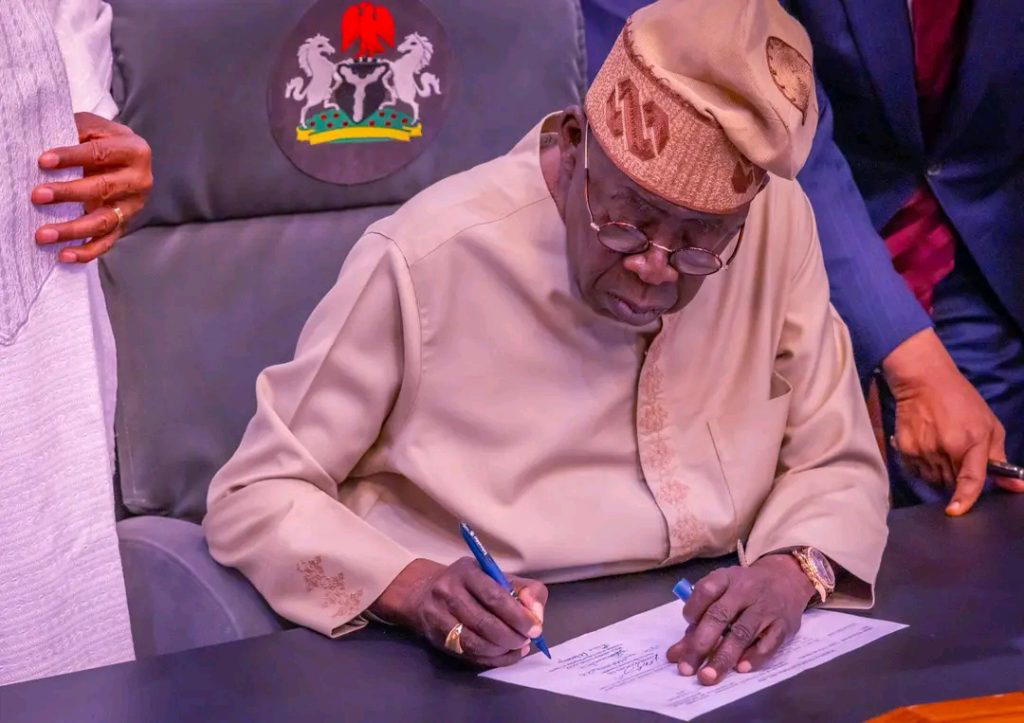
President Bola Tinubu has revised Nigeria’s 2026 budget, reducing the total expenditure by N3.2 trillion while retaining the borrowing plan contained in the earlier approved version.
Mr Tinubu therefore asked the Senate to consider the revised budget, which its implementation is expected to expire by the end of next month.
Under the revised proposal, total expenditure was reduced from N68.3 trillion, as earlier approved, to N65.1 trillion. Government revenue, including receipts from government-owned enterprises, is projected at N33.7 trillion, while aggregate capital expenditure stands at N26.2 trillion.
However, the fiscal deficit, including project-tied loans, remains unchanged at N31.4 trillion, equivalent to 5.6 per cent of Nigeria’s Gross Domestic Product (GDP).
The revision is intended to regularise some expenditures incurred by the Nigerian National Petroleum Company Limited (NNPCL) on behalf of the federal government, address under-provided debt service obligations, recognise issued capital warrants and supplementary commitments, and provide for reforms involving ministries, departments and agencies (MDAs) and social accounts.
The details of the revised budget were contained in an executive communication read by the Senate President, Godswill Akpabio, during plenary on Tuesday.
“Under the revised framework, aggregate expenditure is slated at N65.1 trillion compared with N68.3 trillion in the approved budget. While projected federal government of Nigeria revenue, including government-owned enterprises, is N33.7 trillion, aggregate capital expenditure is N26.2 trillion. The fiscal deficit, including project-tied loans, remains unchanged at N31.4 trillion, equivalent to 5.6 per cent of our GDP,” Mr Tinubu said.
The revised budget also retains the government’s borrowing plan at N29.2 trillion, comprising N18.4 trillion in domestic borrowing and about N10.8 trillion in foreign borrowing.
Similarly, the president said the proposed $7.7 billion external borrowing under the 2026–2027 Supplementary External Borrowing Plan, intended to partly finance the 2026 budget deficit, would remain unchanged.
“Planned new borrowing also remains at N29.2 trillion, comprising N18.4 trillion in domestic borrowing and N10.7 trillion in foreign borrowing.
“The proposed $7.7 billion external borrowing is equivalent to approximately N10.3 trillion at $1 to N1,346.5. This is intended to finance the existing foreign borrowing provisions and does not increase the borrowing envelope,” he said.
Mr Tinubu said the revision also provided for additional capital and overhead allocations to some MDAs as priority national interventions.
He said the provisions were intended to facilitate the completion of critical projects, protect agricultural production, reduce production costs, improve farm use and enhance market access, while addressing water vulnerability.
“The MDA capital provision consists mainly of amounts already warranted. A few new MDA capital and overhead provisions were included as priority national interventions, particularly to complete critical projects, protect agricultural production, reduce production costs, improve farm use, and enhance market access while addressing water vulnerability,” the president said.
After reading the communication, Mr Akpabio referred the revised budget proposal to the Senate Committee on Rules and Business for further legislative action.
The Senate is expected to deliberate on the president’s request in the coming days before deciding whether to approve the revised budget.
The 2026 budget, initially signed into law at N68.32 trillion in April, allocated N32.29 trillion to capital expenditure, N15.81 trillion to debt servicing, N15.43 trillion to recurrent (non-debt) expenditure and N4.80 trillion to statutory transfers.
The budget was based on projected government revenue of N36.87 trillion, leaving a fiscal deficit of N31.46 trillion, which the government planned to finance largely through borrowing, alongside asset sales and multilateral and bilateral project-tied loans.
The decision to retain the borrowing plan and fiscal deficit despite the reduction in total expenditure raises questions about the government’s fiscal priorities and its ability to manage the country’s growing debt obligations.
Although the revised budget provides for additional interventions in agriculture and the completion of critical projects, the reduction in capital expenditure could affect funding for infrastructure and other development projects if the government does not adequately protect existing commitments.
The retention of the borrowing plan also means the government will continue to rely heavily on loans to finance its expenditure, potentially adding to future debt repayment obligations. This comes against the backdrop of the substantial amount already earmarked for debt servicing in the 2026 budget.
The revised budget will therefore require closer legislative scrutiny, particularly regarding the projects affected by the reduction in capital allocations, the utilisation of borrowed funds and the government’s capacity to generate sufficient revenue to meet its obligations.
- tinubu
- nigeria
- budget
- trn
- borrowing
- plan
- expenditure
- government