‘This gadget could genuinely replace your tumble dryer’: the best heated airers – tested
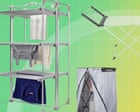
Heated airers claim to dry your clothes without costing the earth in energy. Can a hot clothes horse really change your life, let alone dry your soggy washing as fast as a tumble dryer for a fraction of the cost and, in most cases, with none of the noise?
Heated airers claim to dry your clothes without costing the earth in energy. We put 19 to the test over two years, from covered options to winged racks
Rising energy bills and perma-drizzle are conspiring to keep the nation’s laundry damp, not least by making it such a turn-off to turn on the heating. No wonder heated clothes airers are having a moment. These modish appliances sell out within hours of reaching shops and inspire evangelistic fervour among owners, who call them “life-savers” and “gamechangers”.
Can a hot clothes horse really change your life, let alone dry your soggy washing as fast as a tumble dryer for a fraction of the cost and, in most cases, with none of the noise? After testing 19 bestsellers over the past two years – during which time I took my tumble dryer to the dump and slashed my dependency on radiators – I can confidently say yes.
Not every airer I tested made the final cut. A few, though, impressed me so much I’m now fully converted to the belief that the heated clothes airer is the best thing in laundry since the clothes peg.
I’ve spent three decades testing products from Sky boxes to mattress toppers, and it’s made me professionally sceptical of manufacturers’ claims to magically solve domestic problems. I also have a solid background in procrastinating by doing laundry, hanging laundry and folding laundry, so I couldn’t resist the Filter’s offer to pay me to watch clothes dry.
Heated airers all do much the same thing in much the same way. There are small differences in design – some have triangle frames, some are winged and some have covers – but they’re basically all clothes horses that you plug in. I had to find clear distinctions between them, and this chiefly meant devising fair, quantifiable tests to measure how quickly, evenly and cheaply each airer dried clothes.
The key test was a half-hourly laundry weigh-in to measure how quickly each airer dried an identical load. Actually, two identical loads – one small (4kg) and one big (8kg) – 19 times, once for every airer. I removed and weighed the clothes every 30 minutes to see how much moisture had evaporated until the fabric was dry, and this gave me an overall drying time. Room temperature remained at a steady 19-20C throughout. For more behind-the-scenes insights into weighing knickers, check out the Filter’s newsletter.
I took other measurements too, not least to give me something (anything) to do while the laundry dried, such as the dimensions of each airer and the length of its heated bars. I used an infrared thermometer to take the bars’ temperature every 30 seconds to compare heat-up times, and a wattage meter to check power usage. I then used the October 2026 electricity price cap (26.32p a kWh) to work out running costs an hour.
After testing, I donated the airers to two organisations that do important work in and around Southampton. The first is Scratch, which provides services and furniture for families and individuals experiencing poverty, and the other is Yellow Door, a charity offering support for people affected by domestic abuse.
Here’s my guide to the 10 best heated clothes airers based on my tests.
Heated clothes airers are such a simple and smart idea that it’s weird they haven’t been around longer. They’re wildly popular, too: Aldi’s winged heated airer sold out within days of going on sale in 2025, and I’m feverishly awaiting news of this year’s model. But do they deserve the hype – and how can you get the best out of yours?
Minimal running cost is the biggest selling point of heated airers. Their packaging bears promises that they’ll dry your clothes for as little as 6p an hour, dramatically undercutting all rival methods other than blazing sunshine. With electricity prices marginally lower than a year ago, while gas prices have risen, heated airers are certainly a more cost-efficient way of drying clothes than using your radiators.
Six pence an hour was a little optimistic, though. I found that standard barred airers, running at about 320W, worked out at 7p an hour in September 2024 and 8p an hour now. It’s cheaper than putting on the central heating, but it does add up, because most heated airers take a whole afternoon or more to dry a full load of washing, and those 8p hours will add up. Airers that dry clothes faster, such as the fan-heater-based Minky SureDri Heat Pod Pro, cost more to run. At 1kW, the SureDri costs about 26p an hour, adding up to 78p for three hours of drying.
That’s still significantly cheaper than running a tumble dryer or, indeed, a washing machine. Under October 2026 energy prices, a tumble dryer running at 3kW costs 79p an hour to run, and it can cost even more to switch on the central heating.
A standard T-shirt, laid flat and unfolded across several bars of a 300-320W barred heated airer, should dry in about two hours. If you’re drying a whole load of clothes, though, it’ll take a whole afternoon – or about eight hours if the air feels cold or humid. You will need to flip and rearrange items during this time to give the fabric equal access to the bars.
Airers that contain a fan heater dry clothes more quickly. The fastest-drying airer in my test, the Minky SureDri, blew out enough hot air to dry my small load of washing in less than two hours. With a large load, I found it easier to halve it and dry it in batches.
There are ways you can speed up the drying process. My best tip is to ignore the marketing photos that show airers draped like Christmas trees, with clothes hung from every bar. As I discovered while running this test, your clothes simply won’t dry that way unless it’s a warm day, which rather defeats the point. Instead, lay individual items across the bars.
Covered airers cut drying times by almost half, but I’d recommend removing it as soon as your clothes are dry. Covers are vented to avoid condensation, but I found that some moisture crept back in if I left my clothes inside.
However powerful your airer, always spin your clothes to remove as much water as possible before laying them on it. Wet clothes won’t dry, and water and electricity are not a happy combination.
On that note, don’t use a heated airer in the bathroom. Electric peril aside, bathroom air is notoriously damp. I had the best results when using my test airers in the bedroom with the window ajar – and the faint fabric softener scent was a sweet bedtime bonus.
When you dry clothes on any warm surface, whether it’s a heated airer or a radiator, the moisture rises from the clothes – to where? I asked a range of experts about this, and they broadly agreed that the key is to let the moist air escape from your home.
“It’s not the drying method alone but the combination of moisture and lack of ventilation that leads to damp problems,” says Dr Anastasia Mylona, technical director at the Chartered Institution of Building Services Engineers. “You can manage this by ensuring good ventilation when drying clothes indoors; for example, by opening windows or using extractor fans.”
A dehumidifier can help avoid damp, as well as speed up the drying process, says cleaning expert Nancy Emery of bathroom retailer Drench. “If you’re investing in a heated airer, my advice is to invest in a dehumidifier as well, and always run them together.”
I’ve found heated airers much less likely than radiators to cause damp walls, and property expert Phil Spencer explains why. “Airflow is key, so if you want to use a heated airer, put it in the middle of the room rather than next to the wall,” says Spencer, who, among other things, founded the property advice website Move iQ. “This is why heated airers are preferable to wall-mounted radiators.”
However, radiators can heat up the room, and heated airers can’t, at least not significantly. That’s an important factor in the battle against damp, says Emery. “Maintaining your home’s temperature above 18C helps because condensation can’t settle on warmer surfaces.”
I put these tips to the test using an affordable humidity meter. I measured the moisture in my spare room’s air before doing any laundry, and then again at various stages of drying a medium load on a large heated airer – with and without opening the windows and using a dehumidifier.
It had rained all week, so perhaps it’s no surprise that my house boasted a base humidity level of 70%, 10 percentage points higher than the recommended UK maximum. I was surprised, though, when this only rose to 72% once I’d loaded the airer with damp clothes. Running my dehumidifier brought the room’s humidity down to 70%. When I opened the windows, it dropped to 65% – even before the load was completely dry. I’ve now defaulted to leaving the windows open whenever possible, whether or not I’m drying clothes.
“Opening windows regularly is the best way to allow humid air to escape, though it may seem counterintuitive in colder weather,” says Nicholas Donnithorne, UK technical services manager at Rentokil Property Care. “Leave quarterlights ajar or trickle vents open. Dehumidifiers can help, but they require regular emptying and aren’t a substitute for proper ventilation.”
For more autumn and winter home essentials, read the Filter’s guides to: The best electric blankets and heated throws The best electric heaters, tested
Jane Hoskyn is a features journalist and WFH pioneer with three decades of experience in rearranging bookshelves and “testing” coffee machines while deadlines loom. Her work has made her a low-key expert in all manner of consumables, from sports watches to solar panels. She would always rather be in the woods
This article was originally published on 18 October 2024. Reviews published in the Filter may be periodically updated to reflect new products and at the editor’s discretion. The date of an article’s most recent update can be found in the timestamp at the top of the page. This article was updated on 26 October 2026; two new airers were added after testing, three models were removed, and prices were updated throughout.
- dryer
- tumble
- airer
- clothe
- gadget
- energy
- life
- earth