Reeling in the years: how Hollywood fell for its own vanishing glories
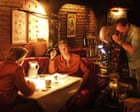
The Further Mis-Adventures of Cliff Booth is the latest in a growing wave of movies steeped in nostalgia for a heyday in stark contrast to its current ruination If Los Angeles was a person, it might just be a laid-back fiftysomething trouper with cool sunglasses and an even better haircut. In other words, Los Angeles personified is Cliff Booth – the over-the-hill stuntman played by Brad Pitt in Once Upon a Time … in Hollywood, now turned studio fixer in the sequel, The Further Mis-Adventures of Cliff Booth.
The Further Mis-Adventures of Cliff Booth is the latest in a growing wave of movies steeped in nostalgia for a heyday in stark contrast to its current ruination
If Los Angeles was a person, it might just be a laid-back fiftysomething trouper with cool sunglasses and an even better haircut. Some dodgy episodes in his past, but still handles himself with style. In other words, Los Angeles personified is Cliff Booth – the over-the-hill stuntman played by Brad Pitt in Once Upon a Time … in Hollywood, now turned studio fixer in the sequel, The Further Mis-Adventures of Cliff Booth.
Set eight years later in 1977, Further Mis-Adventures is more plot-driven, more Elmore Leonard-esque than the pure expansive “memory piece” of Once Upon a Time. But both films are steeped in the ambience and lore of old LA, drawn in part from Quentin Tarantino’s memories of cruising around the streets aged six in his stepdad’s Karmann Ghia (the car Booth also drives). They’re part of the recent intensely nostalgic LA revivalist mini-boom of work that also includes Paul Thomas Anderson’s Licorice Pizza (2021), Damien Chazelle’s Babylon (2022) and Ti West’s MaXXXine (2024).
It’s no accident that this retrospective crew is in high gear just as Los Angeles, and Hollywood, hit the skids in real life. Runaway production to other states and overseas has been sapping the heartland of the California film industry for decades: from its peak in 1996, feature film activity in the city had dropped by 50% by 2013 – and has further declined since. The cardiac arrest suffered by theatrical box office during Covid and the post-2022 streaming slowdown pushed it deeper into the red zone: 42,000 jobs have been lost over the last two years. With half-empty studio lots, landmark talking shops like Patrick’s Roadhouse dying out and swathes of iconic neighbourhoods ravaged by wildfires, the current fear is that job-stealing AI will further hollow out the city, inducing an irreversible state of digital dereliction.
No wonder returning to the 60s and 70s to soak up the agent chat at the bar at Musso & Frank, or bask in Sharon Tate basking in her own image at the Bruin theater, is comforting. The late middle-aged LA revivalists like Tarantino, David Fincher (who’s taken over directing from Tarantino on Further Mis-Adventures) and Anderson (who also made the similarly LA-besotted Inherent Vice in 2014) were too young to have experienced that era directly. But hitting working age in the 1990s, the final generation to experience Hollywood’s pre-digital imperial phase, they are the ones now memorialising its heyday as a creative powerhouse.
Like today’s AI inflection point, many of the LA revivalist films deal with a moment of transition. Once Upon a Time is caught between the tail end of the stodgy studio system represented by Leonardo DiCaprio’s floundering star Rick Dalton and the New Hollywood noisy neighbours of Roman Polanski and his ilk. And like today’s furore over AI slop supplanting human-led film-making, a strain of panic runs through the new films about the survival of true cinema. “You know what we gotta do? We gotta redefine the form,” says Pitt, playing a silent-film veteran staring down the barrel of the talkies in Babylon. “The man who puts gasoline in your tank goes to the movies – why? Because he feels less alone there. Don’t we owe him more than the same old shit?” Mia Goth’s porn star Maxine Minx, hoping to cross over to “real” movies in 1985 LA, is on the receiving end of a similar pep talk from her director in MaXXXine.
So staring into the abyss of the San Andreas fault and fearing for its soul is nothing new for Hollywood. Often for the current revivalist crew, it’s an elusive woman who crystallises this search for a halcyon authenticity: “This is the girl”, as David Lynch intuited a long time back in Mulholland Drive. In Once Upon a Time … in Hollywood, Sharon Tate is the golden-tressed spirit of aspiring LA – and actor Margot Robbie repeated a similar job with her wild-child ingenue in Babylon (with a near-identical scene of watching herself in the cinema). Inherent Vice isn’t specifically about the film industry, but the disappeared Shasta Fay Hepworth leaves behind an incense whiff of the lost idealism of hippy California. Seemingly hunted by serial killer the Night Stalker, Maxine Minx looks destined to become another LA sacrificial woman – until she bucks the trend and saves herself.
But finding “the girl” – or in other words sifting the real from the fake – is no cinch in Los Angeles, the town that made its name intertwining the two. Trudging in the footsteps of Philip Marlowe, Inherent Vice and David Robert Mitchell’s Under the Silver Lake (2018) both feature pseudo-detectives trying to decode this city of signifiers. Also hanging on a missing girl, the latter film stages its own inquest on Angeleno artistic integrity: its arch-conspiracy leads to a mysterious songwriter who devastates Andrew Garfield’s slacker by telling him he manufactured all his favourite rebel alt.culture.
It’s Tarantino, though, who supplies the subtlest take on the twin spooling of representation and reality in Los Angeles. Already Pulp Fiction – the movie he has deemed closest in spirit to Once Upon a Time … in Hollywood – took place at a retro-tinted remove from the actual city. But his 2019 masterpiece lingered in backlots and dressing rooms, making full use of its backstage pass to tease out the interplay of artifice and life in a series of paradoxes. It’s Cliff Booth, the behind-the-scenes stalwart, who supplies the film’s movie-star moment when he walks tall into the Manson family’s Spahn Ranch. Meanwhile, screen star Rick Dalton gets a lower-key, realistic triumph: besting his insecurities and alcoholism to finally deliver “the best acting I’ve ever seen in my whole life”. And in rescuing Sharon Tate from her grisly real-life fate, Tarantino delivers the ultimate movie resurrection.
But perhaps, pained by an industry on the brink, the new pack of sentimentalist LA redeemers wilfully misremember their history. Perhaps the reality is there was no Hollywood golden age, no well of authenticity. Fabrication and artifice are the city’s true trades. Tarantino also knows this, as the irony about movie-star facades – Bruce Lee included – in Once Upon a Time lets on. Paul Thomas Anderson is even clearer about this tawdry fabulation factory in Licorice Pizza, with its San Fernando valley milieu of cocky teen actors, Sean Penn’s leathery star vaingloriously recreating a stunt outside the Tail O’ the Cock restaurant on Ventura Boulevard, and an explosive cameo for legendary hairdresser turned cokehead producer Jon Peters. The most truthful scene in the otherwise coarse and forced Babylon is the one-shot through the multitude of entertainments shooting out on the desert lot: the radical, illusionistic inauthenticity of Hollywood production in full flow. As Cliff Booth has it in Mis-Adventures: “I know better than to get in the way of a good story.”
The least bewitched film about the city is Thom Andersen’s 2003 cine-essay Los Angeles Plays Itself, which is clear-eyed about its penchant for constant self-erasure and reinvention. In this sprawling “any city”, there is no there there – least of all in Hollywood. This floating constellation of studios and production companies is a fungible entity. He points out that Culver City in 1937 almost renamed itself Hollywood, trying to grab some of the glory. Even the sign itself – which, unlike film-industry self-obsession, Andersen tolerates – is testimony to this incorrigible restlessness: “Maybe I find it poignant that a decayed advertisement for a real-estate development could become a civic landmark.”
With AI knocking, Los Angeles and Hollywood are about to head somewhere else. Likely the industry will absorb and integrate the technology, and emerge leaner and meaner, a little more cynical, a little less interesting. Some people will have to find new lines of work. Like Cliff Booth, you could do worse than becoming a fixer. There’s never a shortage of work, because Hollywood, and Los Angeles, can’t be fixed.
- hollywood
- booth
- mis
- adventures
- cliff
- los
- angeles
- time