Ebola Fight Runs Up Against Customs, Rites In Remote DR Congo

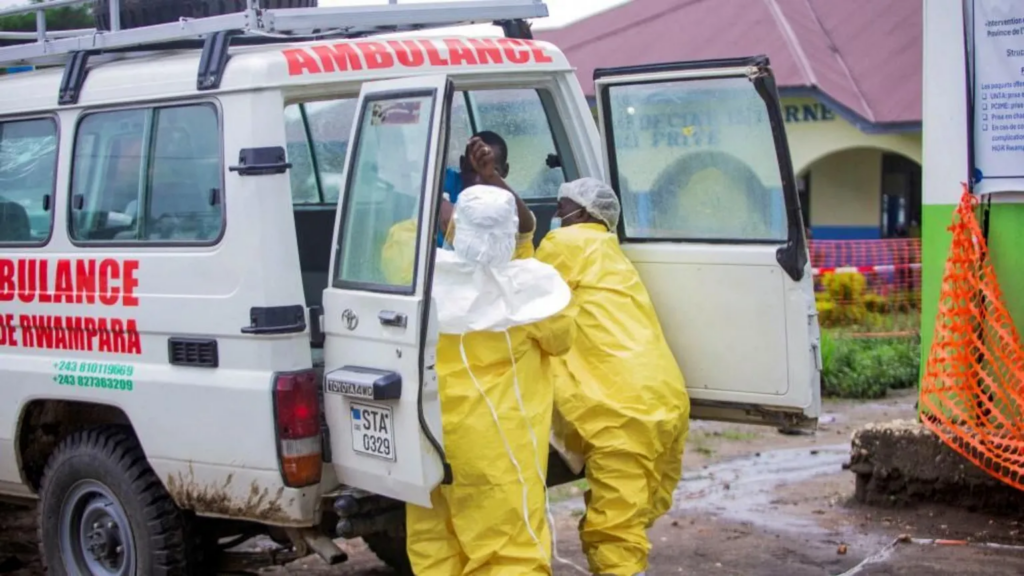
Wilson Kasyani, chief doctor for the Vuhovi health district that includes Bulambo-Isale, a rural settlement in North Kivu province, was worried for the ambulance and its occupants. Photo by LUIS TATO / AFP Roland Vivaya, head of the local youth council, said “most people” in Bulambo-Isale “don’t believe Ebola exists”.
For health workers in the volatile eastern Democratic Republic of Congo (DRC), tackling local suspicions is as big a problem as combating the Ebola virus that has plagued it for six months.
In the rural community of Bulambo-Isale, AFP saw a small crowd gather this week along a dirt track, determined to prevent an ambulance bringing the body of a local Ebola victim for burial.
Victims of the highly contagious haemorrhagic fever, which spreads through direct contact with bodily fluids, must be interred in sealed body bags to prevent infection spreading from the corpse.
Burial ceremonies are conducted by specially trained health workers, anonymous in protective hazmat suits, some of whom locals allege are brought in from outside the community and do not speak the local languages.
But custom dictates that the deceased be buried by their own family and their body be allowed to fuse with the earth of their ancestors.
“The authorities have imposed the Ebola response on locals without first making sure how they interpret it,” grumbled Patricien Kambale, who became a livestock farmer after university.
“The sick victim gets carted away in a vehicle and locals don’t know where they’re being taken. Then we learn later that the person has died so locals think the doctors are using poisoned medicine to kill people,” he said.
Locals say they are distrustful of Congolese authorities, who have a reputation for corruption and nepotism.
Left to cope with the miseries inflicted by myriad armed groups that have stalked their mineral-rich region for more than three decades, they fear their customs and lives matter little to the powers that be.
Wilson Kasyani, chief doctor for the Vuhovi health district that includes Bulambo-Isale, a rural settlement in North Kivu province, was worried for the ambulance and its occupants.
“Weapons are everywhere” in the mountainous region, he said.
Medical workers face almost daily attacks due to locals’ hostility to efforts to respond to the Ebola outbreak, which has killed more than 5,000 people out of more than 11,000 cases since May.
“Today, people entered a nurse’s home and wounded her son,” Kasyani said wearily.
“And yesterday we had to stop someone who wanted to attack investigators with a machete.”
Roland Vivaya, head of the local youth council, said “most people” in Bulambo-Isale “don’t believe Ebola exists”.
He admitted he hadn’t “really” believed himself until he almost died of the virus.
Vivaya said the difficulty was not so much defiance but locals not understanding — despite memories of the last Ebola outbreak between 2018 and 2000.
The image at the time of “doctors protected by the military, scared the community”, Kambale said.
No vaccine or specific treatment currently exists for the Bundibugyo strain of Ebola, responsible for the current outbreak.
“How can you explain to locals — many of whom have never been to school — why there’s this sudden focus on this disease, when we’ve been dying for decades from the conflicts here,” Vivaya said.
“Personally, I only understood the virus when I had to go to the treatment centre, because they put on information sessions. But these meetings don’t get the message across to everyone,” he added ruefully.
Suspicions stem, in part, from health workers having not been trained in local customs or languages, leading to “resistance” among locals, he said.
“They think it might be some kind of profiteering,” Vivaya added.
Bulambo-Isale is the cultural and religious heart of the Nande people, one of the eastern DRC’s largest ethnic groups.
From his palm-frond hut, blackened by wood smoke, traditional chief Pimbo Kakule watches, pipe clenched between his teeth, over one of Bulambo-Isale’s 12 sacred hills.
As in many rural communities affected by Ebola, the fight to staunch its spread runs up against ancient traditions.
“Our people believe there is life after death and our customs must be respected when a person is buried. Otherwise we think they’ve been sacrificed,” he said.
Nande custom dictates that a person should be buried by their family and their corpse enter the soil of their ancestors so the living can speak to them in the afterlife.
“A person who isn’t able to communicate with their dead can’t get into heaven,” Kakule said.
He said there were better ways to manage the issue than the current top-down approach.
“If we were to say: ‘Your brother’s died. We’re going to teach you how to bury him,’ we might reach an agreement and there wouldn’t be all this tension,” he said.
“We are fighting the disease, not the response teams.”
The salaries that some locally recruited people are offered for joining the Ebola fight is also a source of mistrust.
Their wages, higher than the local average, feed jealousy and conspiracy theories.
When Kambale was vaccinated in 2020 against the Zaire strain of Ebola, responsible for the epidemic of the time, his neighbours accused him of taking a bribe in order to spread the virus and threatened to torch his house.
“Even protecting yourself has become a problem,” he said.
“Pressure groups” made up of members of youth organisations linked to local politicians, weaponise the tensions and sometimes prevent health workers reaching sick people.
In Vuhovi, such incidents are often the work of troublemakers who feel marginalised, said Salama Mwengesyali, who coordinates public Ebola information sessions.
“If we could bring all these individuals in, train them and get them involved in tackling Ebola, we could overcome this resistance,” the soft-spoken woman said.
“What we lack are the means to do that.”
Mwengesyali said her team lacked money to “motivate” locals in rural farming communities to attend lengthy Ebola information sessions, or pay health workers to ring them or travel to where they live.
“It’s come down to us having to go door to door to plead for body bags,” concurred Kasyani, the doctor.
Their Ebola treatment centre is cobbled together from planks of wood where patients “put up with intolerable conditions”, he said.
Two patients have run away in recent days.
“People tell themselves that if they go there, they’re going to die.”
- ebola
- congo
- local
- worker
- health
- people
- outbreak
- democratic