Spain has been hit hard by the climate crisis. Why are politicians saying so little about it before the election?
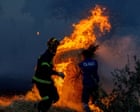
Spain has been hit hard by the climate crisis. Four months after one of the summer’s many wildfires threatened to devour the hamlet of El Morro, an hour west of Madrid, local people are still counting the cost and awaiting compensation.
Wildfires and floods can do little to move climate change up voters’ list of priorities, experts say
Beneath the blackened branches of a pine tree that rises high above a landscape of scorched hillsides and the odd charred and ruined house, two older men address the obvious. Four months after one of the summer’s many wildfires threatened to devour the hamlet of El Morro, an hour west of Madrid, local people are still counting the cost and awaiting compensation.
“Look at that house,” said Esteban Pérez, pointing to one of the properties that did not make it through July’s flames. “Everything inside is scorched, completely destroyed. You can still see the windows, but they’re gutted. The entire structure of the house next to mine had to be torn down, too. And they’ve given the owner nothing so far.”
His friend nods and offers a more laconic observation: “We’re still screwed here.”
And yet, for all the abundant recent evidence of the effects of the climate crisis around Spain’s capital and in the eastern region of Valencia, which is still recovering from the deadly floods that killed more than 230 people two years ago, there has been little mention of the issue as the country prepares for this week’s snap general election.
Pérez is not surprised that the politicians are keener to focus on housing and immigration than on Spain’s immense vulnerability to climatic disasters and the attendant costs.
“The thing is, they only talk about whatever interests them during the campaign,” he said. “If something doesn’t interest them, they don’t talk about it.”
Four hundred kilometres to the east in the Valencian municipality of Benetússer, Rut Moyano, a member of the local emergency and reconstruction committee, has been stunned by the lack of focus on the climate crisis.
“It’s not just the floods we have experienced, there are also the forest fires; the temperatures the Mediterranean is reaching; the fact that we spend our summers in a state of permanent heatwave, and the droughts,” she said.
“Everything is changing because of these factors, but it’s as if there’s an attempt – I don’t know if it’s an intentional silencing – but certainly a failure to give the issue the importance it truly deserves.”
Despite the lack of stump speeches and calls to action, climate policies do feature in this year’s manifestos.
The ruling socialist party – which describes the climate emergency as “one of the greatest challenges of our time” – has promised to “speed up a just ecological transition, boost renewable energy, move towards greater energy autonomy, and turn sustainability into a source of employment, innovation and prosperity”.
The conservative People’s party (PP) has vowed to “act from science and without dogmatism” when it comes to fighting climate change and pursuing decarbonisation.
Meanwhile the far-right Vox party, which could well form a coalition with the PP, has pledged to tackle “climate fanaticism” and to put an end to international agreements that “hinder our productive development and the prosperity of Spanish workers, families, businesses and industries”.
Even though Spain’s three biggest parties enthusiastically defend their very different climate policies on paper, some observers are unsurprised at their reluctance to place them centre-stage at rallies and in interviews.
Jordi Muñoz, an associate professor of political science at the University of Barcelona, is part of a team that has researched the effect that natural disasters, such as the Valencia floods, have on voter behaviour.
“Our research reveals that the 2024 floods significantly increased the perception among Valencians that their region is particularly affected by climate change,” he said. “However … this did not translate into greater concern about climate change relative to other issues, nor did it increase the likelihood of people identifying climate change as one of the country’s top three problems.
“Furthermore, we observed no increase in support for climate policies, nor any rise in individual actions taken to mitigate climate change.”
Given the lack of votes to be had on the issue, Muñoz added, it’s hardly unexpected that parties opt to “pay it no attention during the campaign”.
Nuria Blázquez, a spokesperson for Ecologists in Action, acknowledges that the sheer scale and effects of the climate crisis are a tough sell. Even after the fires, floods, heatwaves and droughts of recent years, both politicians and voters tend to focus on specific failings in disaster response rather than the over-arching cause.
“In the case of the Valencia floods, the discussion was centred on whether the proper alerts were sent,” she said. “With the wildfires, the focus shifts to a lack of vegetation clearing or similar factors – problems that are somewhat easier to address.
“Climate change feels a bit more abstract; it’s clearly a problem, but it’s so difficult to tackle that the general public finds it much easier to look for a culprit in simpler, more tangible things.”
But Blázquez also warned that a huge amount is at stake as Spain prepares to vote – and that the results of the election will be felt well beyond the country’s borders. Under the leadership of the prime minister Pedro Sánchez – and his former environment minister Teresa Ribera, who now serves as the EU’s green transition chief – Spain has become what she terms the bloc’s “leader in environmental and climate policy”.
But Sunday’s election could change all that.
“Neither the PP – and especially not Vox – seem to acknowledge the reality of the situation. In fact, Vox’s narrative suggests that climate change basically doesn’t exist,” added Blázquez. “So we have no reason to be hopeful about a potential PP-Vox government … Without a doubt, that’s where the biggest loss would be: the total disappearance of any hope for leadership on environmental and climate issues within the EU.”
- climate
- house
- spain
- crisis
- election
- politician
- wildfires
- flood