Nasa knocked an asteroid off course. New closeup photos may shed light on aftermath
Nasa knocked an asteroid off course. Images of Dimorphos four years on from crash should give clues for design of potential planetary defence system Humanity may not yet have a means of fending off a Vogon constructor fleet – the destroyers of Earth in The Hitchhikers Guide to the Galaxy – but its prospects of surviving an encounter with a rogue asteroid are looking considerably brighter.
Images of Dimorphos four years on from crash should give clues for design of potential planetary defence system
Humanity may not yet have a means of fending off a Vogon constructor fleet – the destroyers of Earth in The Hitchhikers Guide to the Galaxy – but its prospects of surviving an encounter with a rogue asteroid are looking considerably brighter.
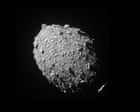
Four years after Nasa deliberately slammed a spacecraft into a roughly 160-metre-wide asteroid called Dimorphos to knock it off course, scientists are poised to release the first closeup images of the aftermath.
The images, captured by the European Space Agency’s (ESA) Hera spacecraft, should shed further light on exactly what happened to the asteroid and help scientists design more effective missions to deflect potentially hazardous space rocks in the future.
Dr Ian Whittaker, a senior lecturer in physics at Nottingham Trent University, said: “We know that there was a change in orbital speed of the asteroid, and that debris came away from the impact, but it is difficult to know what was spacecraft and what was asteroid. These images will allow us to see if anything of the Dart mission is still on the surface or if it was mostly debris that came off.”
Nasa’s Double Asteroid Redirection Test (Dart) mission aimed to test-drive a planetary defence system that could prevent humanity from going the same way as the dinosaurs, should an asteroid or comet threaten Earth.
Neither Dimorphos nor its larger companion asteroid, Didymos, posed such a threat, but their movements provided scientists with a convenient means of assessing whether the strategy of trying to knock an asteroid off course might work.
On 26 September 2022, the roughly half-tonne Dart spacecraft ploughed into Dimorphos at more than 13,000mph, blasting a vast cloud of rocky debris into space.
Observations by telescopes on Earth revealed that the mission had succeeded in shortening the time it took Dimorphos to orbit Didymos by about 33 minutes. Before the collision, Nasa officials had said a change of 73 seconds or more would be considered a success.
But how much of the asteroid was displaced and precisely how it responded to the collision have remained open questions.
To investigate, ESA launched its Hera mission on 7 October 2024. After a two-year journey, the car-sized spacecraft reached the asteroid pair this month and has been surveying them from a distance of 15-18 miles (25-30km).
Computer simulations published in 2024 suggested that rather than excavating a large crater, Dart may have reshaped the entire asteroid.
Whittaker said scientists would closely examine the images for evidence of such changes, while instruments onboard Hera would enable them to look at the height of surface features.
“The original Dimorphos had a mixture of smooth areas, equatorial ridge and boulder-like shapes. An analysis of [whether] this is still the case will be useful in knowing what happened,” he said.
Over the coming months, Hera will venture progressively closer to the asteroids and deploy two shoebox-sized satellites, one of which will use radar to peer inside Dimorphos.
The ultimate aim of these investigations is to transform asteroid deflection from a successful one-off experiment into a reliable means of planetary defence.
“The initial idea of deflecting an asteroid is not as straightforward as it sounds,” Whittaker said. Although the momentum transferred by a spacecraft colliding with an asteroid should alter its motion, much also depends on how the asteroid responds to the impact, including how much material is blasted into space.
“These images will help with understanding what is present after the impact and make for more accurate calculations in the future,” Whittaker said.
- asteroid
- nasa
- course
- aftermath
- light
- image
- dimorphos
- photo