LS Lowry review – matchstick men, or the broken denizens of a smog-filled hellscape?
MK Gallery, Milton Keynes With his heaps of mud, decaying sheds and chimney-filled skies, Lowry depicts northern England as a spirit-crushing dystopia While people queue at the British Museum to see the Battle of Hastings, this excellent survey of LS Lowry at the MK Gallery in Milton Keynes takes you back to another, maybe more decisive part of our past – the age when Britain was the most industrialised society on Earth. Laurence Lowry was born in 1887 and worked for 41 years as a rent collector, a job that took him all over his native Greater Manchester observing its people and places.
MK Gallery, Milton KeynesWith his heaps of mud, decaying sheds and chimney-filled skies, Lowry depicts northern England as a spirit-crushing dystopia
While people queue at the British Museum to see the Battle of Hastings, this excellent survey of LS Lowry at the MK Gallery in Milton Keynes takes you back to another, maybe more decisive part of our past – the age when Britain was the most industrialised society on Earth. Laurence Lowry was born in 1887 and worked for 41 years as a rent collector, a job that took him all over his native Greater Manchester observing its people and places. He had the city’s grime and grind in his soul. The MK wants to show him as a fully rounded artist, to uncover the Lowry with a song in his heart, but it’s the misery of his urban hell that holds and harrows you.
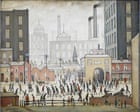
In his 1930 painting Coming from the Mill it’s the end of the shift and scores of people emerge from a factory’s bleak yellow gatehouse as if leaving prison. Their daily captivity has left them broken and exhausted and the little abstracted figures hunch forwards as they walk without pausing to laugh or chat, going to their separate homes, each one withdrawn, wretched. They are not the painting’s protagonists – they are passive victims. The architecture of industry dominates the picture as it rules their lives. How can any of these little people, dwarfed by the mill that eats their time and energy, attain individuality? No wonder they all look the same except for minor variations in their drab clothes. They’ve been reduced by the Industrial Revolution to matchstick people.
Lowry is the Franz Kafka of industrial Britain. He is not a naive artist who painted crudely because that’s the best he could do. Nor is he a patient social realist laying bare the injustices of capitalism – although Friedrich Engels would surely have recognised his Manchester. He is a modern expressionist who finds his inner melancholy reflected in the industrial sublime. He drinks in its despair, feasts on its poetry of alienation. As you journey through Lowry’s North, you sink ever further into his personal slough of despond.
Slough of Despond would make a good alternative title for his 1924 drawing The River Irwell at the Adelphi. Heaps of mud and ash choke the slow-moving river that runs through Salford, its shores lined with decaying sheds and slums against a smoggy, chimney-lined sky. It’s Lowry at his purest as he depicts the stunning, crushing presence of the city itself. He draws and paints the black, gnarled spires of urban churches with as much relish as those monstrous mills. In the second world war he was a fire-watcher with a privileged view of the blitz: a drawing of freshly bombed buildings in Piccadilly, Manchester shows husks of charred brick still wreathed in smoke.
This show digs out other, less well known dimensions to his talent. But his paintings of the Lake District are even more chilling than his cities. Lake Landscape, painted in 1950, is a vista of low curving hills divided by silvery still water, receding in abstract, musical pulses of sadness. No people or animals inhabit this eerie world. When he paints people close up it’s even more disturbing: a young man with staring eyes, a father and sons who all seem equally desperate. He lightens up to paint his ideal woman with a simplified doll-like face apparently intended as his tribute to Pre-Raphaelite red-lipped beauties but the result is weirdly robotic. Her face is on the exhibition merchandise, perhaps because Halloween is coming.
The most bizarre painting, however, is his 1963 work In a Park. At first glance it’s another city crowd scene until you realise everyone in this fenced enclosure has something different about them. A one-eyed face screams while people walk around the white-earthed, empty space with spinal deformities, facial palsies, amputated limbs. The catalogue gets itself in knots – is Lowry mocking the disabled or questioning how we define disability?
But this painting is not about disability in a political sense at all. It uses it as an image of humanity in general: all people are broken and alone, misshapen in Lowry’s hopeless universe.
Lowry is a tricky customer. If it is pure snobbery to look down on him for being popular it is also patronising to see this troubled artist as a warmly sentimental nostalgist of the north. He is a painter of modern life in the age when that meant huge crowds staggering home in the shadow of smoking chimneys in cities blackened by carbon. At his best, Lowry is a great modern artist. His 1919 painting Pit Tragedy shows working-class people waiting for the worst news. They are statuesque, tragically posed in the grey dusty light. A woman turns towards us, her head veiled. Her pain is lost in the past but lives on here, observed and recorded by Lowry, visionary of the industrial age.
LS Lowry: The Theatre of Life is at MK Gallery, Milton Keynes until 28 February
- lowry
- people
- review
- hellscape
- gallery
- milton
- keynes
- painting