Bring me the scrotum stapler! Is this the world’s most extreme performance artist?
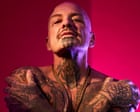
As Ron Athey hits the UK, he talks about his upbringing in ‘a cult’ – and why being naked just isn’t enough ‘The nicest way to say what I do is that I want to create a miracle,” says Ron Athey. The softly spoken performance art legend has come to the Guardian’s offices in a flat cap and navy blue Fred Perry hoodie.
He’s been pierced, chained, inflated, stretched, suctioned and denounced in the Senate. As Ron Athey hits the UK, he talks about his upbringing in ‘a cult’ – and why being naked just isn’t enough
‘The nicest way to say what I do is that I want to create a miracle,” says Ron Athey. “The gnarly way is that I know what the edges are when it comes to the mortification of the flesh.” The softly spoken performance art legend has come to the Guardian’s offices in a flat cap and navy blue Fred Perry hoodie. Only his facial tattoos and platform boots hint at the fact that he has been responsible for some of the most extreme works of live art of all time.
Take Self-Obliteration, which begins with a naked Athey violently brushing a long blond wig pinned to his head with blunt needles, before tearing it off, upon which blood pours down his face and on to his body. (Blunt needles, you see, make bigger holes.) Or Solar Anus, in which he puts hooks in his face that stretch the skin of his cheeks and eyes, turning his face into a kind of ancient Egyptian death mask. In St Sebastian, Athey is suspended by chains while assistants pierce his flesh with arrows and needles.
Not that you’d know he’s taken all this punishment – his face seems surprisingly scar-free. “I just have liquid skin,” says Athey, who is 65 next month. “Not to brag!”
While unsuspecting audience members may flee or faint, there is beauty and high drama in Athey’s work along with the gruesomeness and gore. This weekend in London, he will stage a new work, Asclepeion, which draws on his painstaking research into Greek myths such as “the wounded healer, Asclepius”. Athey explains that the show also alludes to Acéphale, the secret society formed in the 1930s by French writer Georges Bataille, whose emblem was a headless man: “In a juicy way, you could say they were doing chaos magick against fascism.” Another inspiration was the Eleusinian projector, an ancient camera obscura-style trick through which the ancient Greeks created the illusion of a goddess appearing to worshippers who were, Athey says, “coming up on a primitive psychedelic wheat drink”.
Like the Greeks, Athey loves to create illusions with smoke and mirrors. But as in almost all his work, there will be punishing physical transformation, too. In Deliverance, first staged in 1995, Athey appeared to be castrated, an illusion created by wrapping his scrotum around his penis and holding it in place with surgical staples. In another performance, he injected his scrotum with two litres of saline solution, expanding it to an enormous size. “I just like grotesque genitals,” Athey says. “I’m like, OK, you’re naked, but what else? I do a little bit of that with suction in this piece. I think I’m a shapeshifter.”
For all his deep dives into esoteric religions and rituals, the biggest influence in Athey’s art is undoubtedly his impoverished, abusive and loveless upbringing by relatives in the grip of religious mania in Pomona, California. “My mother was severely schizophrenic and epileptic. So she was always institutionalised,” Athey says. “My father was in the navy, so he was always somewhere far-flung on a submarine. I met him in my later 20s. My grandmother and aunt who raised me were Pentecostal and spiritualist. There were crystal balls, dream interpretation, automatic writing, faith healing and demon possession.”
At seven, Athey spontaneously started crying in church, which the congregation interpreted as a sign that he was an “ecstatic child” who had been visited by the Holy Spirit. “The minister carried me up and took his white shirt off and tore it into squares. He put a tear on each square and passed them out with a safety pin, to pin inside people’s clothes.” The infant Athey became the focus of the church’s services: two years later, “oil was rubbed all over me in church and I started speaking in tongues. So I had that vibration in me, the same vibration that I’m always courting in performance.”
At nine, Athey was given a four-times-a-day Valium prescription to treat the severe shakes he was experiencing, which led to a full-blown drug addiction. “I mean, the 70s were bonkers,” Athey says. The doctor was subsequently arrested. The artist sums up his childhood thus: “I always felt like I was doing time. Just watching the clock, like, ‘How the fuck do I get out of this situation?’”
He managed it aged 16: Athey, who excelled at school, spent a summer working at the Salk Institute in San Diego as part of a plan to become a biochemist, thwarting his family’s hopes that he would become a minister. His teenage rebellion manifested itself in other ways, too. The first man he dated was a Mexican gang member called Rudi who had just finished serving a nine-year jail sentence. Rudi had a tear tattooed on his face in prison, so Athey decided to get one too, along with a black widow spider on his forehead. “I wanted to be marked so that I had to be in my lane,” Athey says – by which he means completely outside the strictures of conventional society. Athey saw himself as a rebel outcast of the kind celebrated by writers such as Jean Genet. “So was that really well thought out?” he asks rhetorically. “I don’t know. But did I deal with it fine? Yes. I never wanted to be anything conservative.”
At 18, Athey met and started going out with Rozz Williams, the 16-year-old singer in a group called Christian Death, often cited as the first US goth band, whose self-declared remit was to defy religion and conventional morality. The pair moved to Los Angeles and started exploring the nascent punk and industrial music scenes, along with as much alternative culture as they could get their hands on. “We lived in the record store,” Athey says.
They would listen to Crass and Throbbing Gristle, often while taking LSD – “Heathen Earth over and over on five hits of acid” – and, in the newly launched LA art magazine High Performance, read about the Viennese Actionists, the extreme performance artists whose actions (including public masturbation, faeces-smearing and blood-letting) often got them arrested. They also went to shows by the local artist Johanna Went, who fused punk and performance art with lashings of fake blood.
Inspired by all this, in 1981 Athey and Williams formed a performance art troupe of their own called Premature Ejaculation, appearing in nightclubs – always a central part of Athey’s practice – and cinemas. They horrified their audiences – an early show featured Athey eating a dead cat, roadkill he’d found on the highway. PE swiftly fell apart as Athey’s drug addiction worsened. In 1986, he managed to kick substances that by then included heroin. “Because I have an institutionalised mother, I never wanted to go into a treatment centre,” he says. “So I did the 12-step thing. I went to a friend’s ranch in Nevada and stayed there and somehow managed [to get clean] with different support groups.”
There was another turning point: Athey was diagnosed HIV positive, at a time when it almost certainly meant premature death. In the absence of medical treatment or government support, Athey threw himself into alternative therapies such as reiki, attended the Wednesday night gatherings led by self-help guru Louise Hay and studied the Hindu philosophy vedanta, taking what he needed from each: “Being raised in a cult, I never wanted to join anything and I never did,” he says. He found kinship in the “modern primitives” movement, practitioners of then-niche activities including body piercing and extreme tattooing – some of whom believed it led them to higher states of consciousness, and others who came to it via BDSM. Athey started making performance art again, urged to do so by his friend, the punk singer Lydia Lunch. Aids, Athey has said, lit a fire under him: he wanted to make his mark in the time he had left.
His subsequent performances would use his bleeding body to express his anger and defiance about being a person living with Aids: “I’m not this frightening, dying thing – or I am, but I’m still alive and expressing myself,” he says. He saw parallels with Catholic iconography in the suffering of the time. “When everyone started dying and I would see someone holding someone that looked like a skeleton, I’d see the Pietà, [or] Saint Irene tending Saint Sebastian. Those were my 90s influences and a way of coping with that much morbidity.”
In 1994, Athey staged a work called Four Scenes in a Harsh Life at Patrick’s Cabaret in Minneapolis. Part of it saw Athey make cuts in the skin of co-performer Divinity Fudge, blot them with pieces of tissue paper, then hoist the bloodied tissues on a pulley. A local paper wrote that there were complaints about the performance, and the story was picked up nationwide. Before long, Athey was being denounced on the floor of the Senate by the Republican Jesse Helms, and erroneously accused of putting his audience at risk of contracting HIV from the dripping blood – though Divinity Fudge was HIV negative.
Athey found himself caught in a culture war. Rightwingers had already attempted to suppress work by gay artists including Robert Mapplethorpe and David Wojnarowicz by withdrawing funding from the National Endowment for the Arts, and Athey became their next target, even though the show was only indirectly NEA-funded and had taken just $150 of public money. “Suddenly I was in 200 newspapers,” Athey remembers. After he went on Mo Gaffney’s daytime chatshow, “I remember going to the supermarket and the cashier was like, ‘Oh my God, I saw you on TV.’ I was a celebrity.”
Athey thinks he did a good job of explaining extreme live art to the US mainstream. “I worked for LA Weekly for 19 years,” he points out. “I was the editor-in-chief’s assistant. I’d bring the mayor in to be interviewed. And then I had a certain amount of freelance writing I did per month. So I know how journalism works. Almost all interviews said, ‘He may look like a freak, but he’s a really sweet guy.’ So I got savvy, and that stopped me being over-emotional about it.” While he found himself blacklisted from most US arts venues, he discovered an eager audience in Europe, in avant garde venues such as London’s ICA and fetish clubs like Torture Garden, where he would perform late at night.
In the UK, 1990 saw the Spanner trial, in which 16 gay men were criminally convicted for engaging in consensual BDSM. In this climate, Athey’s work struck a chord, as it has always affirmed the idea that your body is yours to do what you like with. “There’s a weird judgment people have on other people’s bodies,” Athey says. “If someone becomes trans and then goes back, who cares? What if someone’s an M to F, or F to M, and then they start dressing as a drag queen, which is like a whirligig of genderfuck? It’s still your vessel, no matter how much history you put in it, how much scar tissue you put in it, how much adornment.” Boxers are allowed to beat each other up to the point of brain damage, he says, so why shouldn’t he be allowed to play with the idea of gaining pleasure or enlightenment through pain?
Though Athey’s work is unlikely ever to be mainstream, it is hugely respected within the live art community, and these days he even gets grants, most recently $40,000 from the Trellis Art Fund. He can’t see himself ever retiring. “My spirit is in performance,” says the man who never expected to make it to 30. “The pathos of older performers, it kind of thrills me. I love oldies. No one’s crazier than a crazy old person.”
- performance
- athey
- needle
- face
- scrotum
- stapler
- world
- artist