Mourinho’s plan comes together as Real Madrid relaunch with clásico statement
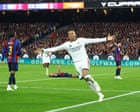
It was just like old times as José Mourinho ended a night at the Camp Nou with a knee slide and three points José Mourinho had already done the por qué?, the printout and the press conference no-show in under 100 days. When Kylian Mbappé scored the first in the clásico on Sunday night, Real Madrid’s manager hardly moved, sitting in the shadow of the bench, but when the striker got the second to win it with time running out, that was different.
It was just like old times as José Mourinho ended a night at the Camp Nou with a knee slide and three points
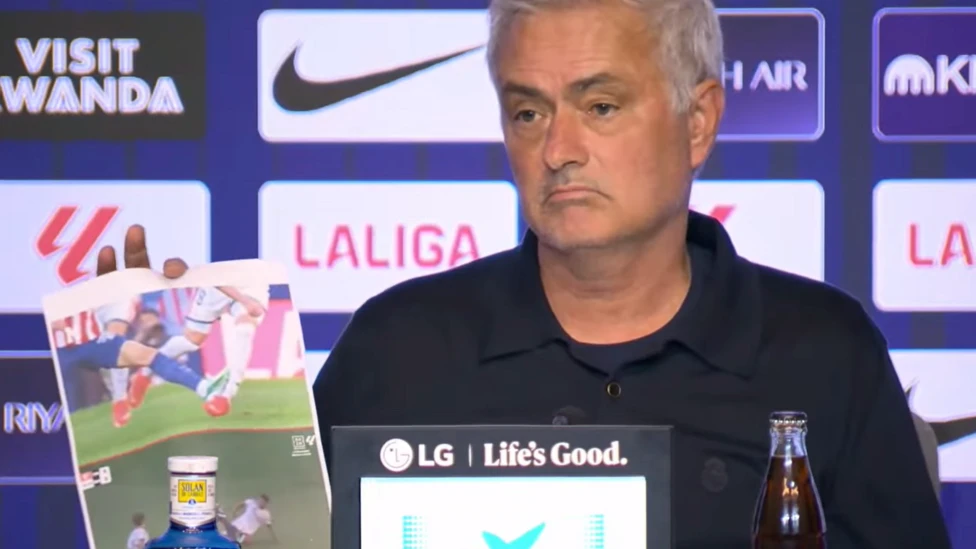
José Mourinho had already done the por qué?, the printout and the press conference no-show in under 100 days. Now he’s done a knee slide too, and in the perfect place: back where it all began and where it can all begin again. When Kylian Mbappé scored the first in the clásico on Sunday night, Real Madrid’s manager hardly moved, sitting in the shadow of the bench, but when the striker got the second to win it with time running out, that was different. Mourinho leapt into the light, throwing himself to the grass, the knees of a 63-year-old’s trousers muddy as a schoolboy’s, stuck his tongue out and pumped his fists.
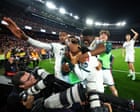
He does so love it when a plan comes together. To the right of him, the bench was emptying, subs joining the players in sprinting towards the south-west corner. As they leapt about, dodging the bottles thrown towards them from the end, way, way up in the furthest corner and stuck inside a glass box like a bunch of David Blaines, the small group of Madrid fans who had come were going mad. In the main stand, a thousand phones were raised. And 600km west, back in Boadilla, Thibaut Courtois was watching his teammates from the sofa at home, presumably wrapped in a blanket and cradling a cup of Lemsip. On the morning of the biggest game there is, he awoke with flu, forced to miss out.
“We have the best goalkeeper in the world, but none of us cried because Thibaut couldn’t play,” Mourinho said. Plenty might have felt like it, more reason to be fearful. But the coach called Andriy Lunin, the sub goalkeeper so serious he bought a roll of astroturf and spent the pandemic diving round the living room of his flat, and told him this was his moment: “You train to play, not to sit on the bench, so go on.” As for the rest of them, the manager told them nothing changes: the plan remains in place. By the time they headed back to the dressing room, “Fucking get in!” echoing along the Camp Nou corridor, so it had proved.
Thirteen years later, Mourinho was back in Barcelona for a clásico and he had guided Madrid to a 2-1 win. It wasn’t supposed to be like this, or maybe it was. Barcelona, the team who had won nine in a row, banging in 4.3 goals per game, had been beaten by Madrid, the team who had lost twice already and, truth be told, were mostly just not very good. The night it could have been all over, the title race done when it’s not even in November, was instead the night it finally started. “If you leave here nine points behind, it’s very heavy psychologically; if it’s six, it’s more balanced; if it’s three, that’s different,” Mourinho said.
This was different, and so is the season now. Counting the clásicos all those years ago, Mourinho racked up his sixth consecutive meeting with Barcelona without defeat, and there had been no parked bus, nor many lumps kicked. They didn’t just desperately hang on, although there was a moment when Dean Huijsen saved a shot with his face. Nor had they just waited for a moment, resisting and then robbing it, even if João Cancelo did insist: “That’s Madrid; they don’t have many chances but they score them.” The final shot count said 18-10 to Barcelona, and possession was 62% Barcelona’s.
“The way we won is important: you can win luckily or by defending a lot. But we won with calmness and totally deservedly. We did it by being organised, concentrated and having the courage to come out from the back,” Mourinho said. And if that might have been pushing it a little – and, let’s face it, the analyses might be different had Lunin not made an astonishing save from Gerard Martín or Lamine Yamal’s second-half shot not faded just past the post – he had a point.
Barcelona were not at their best. They had been hurried and imprecise, Rodri telling his teammates to lower their “pulse rate” as they came out for the second half. Lamine Yamal somehow missed an extraordinary chance just before the break. And when they did tighten the screw in the second half, they couldn’t break the wall. Xavi Espart was forced off, yet another injury at the back, the failure to sign a centre-back in the spotlight again. Yet this was still a faster, more aggressive, tighter Madrid than anyone expected. Asked to define it, Lunin went for “discipline and attitude”. And if that is partly about occasion, the least you can ask for, it’s more than you sometimes get.
Besides, it was also more than that. More than Marc Cucurella getting under Lamine Yamal’s skin, although he certainly succeeded. They went for the space beyond Barcelona’s full-backs: superb in his first clásico, aged 19, Yan Diomandé – the left winger – got more touches than any Madrid player, and protected his full-back as well. But it was more than that, too. More than the wonderful winning goal, a flash of inspiration with Jude Bellingham going all Nureyev, the ball flitting between his feet and Gabriel Jesus’s legs, pirouetting to release Eduardo Camavinga. This was a team with an idea and a victory that vindicated their manager, some kind of resurrection.
Before the game, Rodri said that one of Madrid’s tricks is to convince you that they’re not that good, but insisted he wouldn’t fall into that trap. Still he felt that plan particularly. Pedri did too. Bellingham dealt with Rodri, Bernardo Silva with Pedri. Pressed and tired too, according to Hansi Flick, neither truly took control. The inclusion of Arda Guler and Silva – the surprise in the middle, starting his first league game in six weeks – underlined an intention for Madrid to keep the ball when the could. They actually had a midfield, which was new. From the back they tried to build, draw Barcelona in. And if a time came when they had to wait, to put bodies in before the ball, well, they would do that too. Six times Barcelona shots were blocked. At least twice more, shots were taken from their toes. At the other end, meanwhile, Madrid attacked with an intent and an incision that probably drew the clearer chances: the xG showed 1.19 v 1.94.
Victory puts Madrid three points behind Barcelona and, Federico Valverde claimed, “will give us a kickstart”. It has taken 10 weeks but it’s game on. Hay liga, as they like to say. There is league. There is Madrid too. Something has shifted, starting in Rome, where 70 dreadful minutes gave way to 20 pretty good ones, another inexplicable comeback actually having something of an explanation too. The changes were impossible to ignore. Valverde and Aurélien Tchouaméni no longer the partnership in the middle, Valverde going to right-back instead. Guler playing. Diomandé playing. And, yes, Vinícius Júnior not playing. “I’m not stubborn; I can change,” Mourinho said. Madrid have won five in a row now; something was seen that night, a way ahead. They’ve won every game since Vinícius was suspended, facile and perhaps even cruel though that may be to say. And since Mourinho grew a beard, if you believe in that kind of thing.
Before the clásico, Mourinho had said it wasn’t fair to compare his team, a side in construction and a long way from the finished product, to Barcelona. He insisted that he was still getting to know his players; he hadn’t been there long, after all. After the clásico, he admitted: “We have improved, we can’t hide that.” The idea has shifted, almost like it was an epiphany: “I’ve learned something about the middle of the pitch; I have learned that a mixture is better, that it is better to have a combination of qualities than two players of similar characteristics.” In short, Tchouaméni and Valverde doesn’t work. There needs to be some football in there somewhere, and so a shift started. Sunday came as a kind of confirmation, a hope, an identity emerging.
“The best Madrid is born at the Camp Nou,” ran the headline in El País. “Madrid are here now,” AS’s cover said. “I won’t let them have their heads on the moon; if we win this and then don’t win at the Sardinero, it won’t mean much,” Mourinho said, but this was a start, not just an end in itself. At full-time, Mourinho headed on to the pitch and shook Lunin’s hand as all around players embraced. High in the north-east corner, Madrid’s fans stayed and sang. Back home, Courtois was watching. He had “a horrible night” on Saturday, they said, but now he was feeling a little better. They all were.
- mourinho
- madrid
- plan
- real
- knee
- relaunch
- clásico
- statement